Dmitry Laptev (@dm_laptev)

Dmitry Laptev @dm_laptev 2026-11-24T12:34:49.000Z

Retrieval is about so much more than BM25 or embeddings or grep. It is about the magical experience where it "gets" you even if you are not sure yourself what exactly you are looking for. I like the framing of "retrievers intuition" from @ohmyksh and @yoonholeee below. This intuition is what differentiates frontier Agentic Search systems from the baseline RAG setups today. Three more practical notes for low-latency production applications. 1. Retrieving relevant data right away cuts the number of agentic loop iterations and enables more use cases. 2. Context is a valuable resource, so filling it with repetitive keyword-matched documents actively degrades models ability to reason, especially on smaller models. 3. Apart from just tuning the retriever, a lot of headroom lies in co-training and co-tuning the retrievers together with harness and the LLM itself.

@ohmyksh

Research Intuition as a Retrieval Task We wrote a @StanfordAILab blog post exploring intuition (taste) in discovery and proposing a path forward. Open-ended discovery depends on intuition to recognize what is worth reasoning about. Even the strongest reasoning or decision models can explore only a small part of the search space, so they need quick intuition to surface promising directions. We argue that retrievers are the natural place to learn this intuition, and that the ceiling for learned intuition sits far above human level, since retrievers can scale work in ways humans cannot. We hope ScholarCatalyst is a step toward a new generation of retrievers that learn intuition beyond semantic similarity. Blog: http://ai.stanford.edu/blog/scholarcatalyst Paper: http://arxiv.org/pdf/2610.02202 w/ @yoonholeee

83 10 4060 15 0
Dmitry Laptev @dm_laptev 2026-11-27T20:35:43.000Z

Designing a good enough eval specific to your problem is 2/3 of the work. The grader is oftentimes the most difficult part. For any ambitious real-world problem the graders will be noisy, underspecified and probably also expensive. If you evaluate smaller models with the larger ones - a well-tuned grader is probably trustworthy, but once you get into the frontier eval territory - you can no longer blindly trust your evals any more.

@HamelHusain

1. Don't make decisions based on benchmarks. They have too many flaws. 2. Use your own evals 3. If you must use benchmarks, look at the data. Looking at just one failed task is often enough to uncover major issues. TBH, you'll be convinced not to trust benchmarks if you do this

4 0 299 0 0
Dmitry Laptev @dm_laptev 2026-11-26T21:01:25.000Z

In verifiable domains it is easy to see the value of ugly solutions, because it is hard to argue with something that works. In unverifiable domains though, it is more subtle. State of the art benchmarks (and yes, lmsys being one of them) incentivize elegance over substance, and LLMs are happy to comply. Well-formatted response with a subtly unfactual claim wins over dry factual response. Overly simplified yes/no answer wins over a more nuanced “it depends” answer. Entertaining response wins over educational one. “Elegance“ as a proxy for “good“ has its limits. But baking “ugly” into the real world products will not work, because real people still value elegance. I do not have a solution, I just want to acknowledge the problem 🫠

@MillionInt

"He had ugly solutions when other people were elegantly stuck" may be a quote of a century Elegance in science is human brain inductive bias and we may very well have farmed elegant solutions out. The AI age will be a beginning of solutions that will bring new levels of robustness correctness and performance, but oh boy they will feel ugly and unsatisfying to human brain.

0 0 106 0 0
Weaviate Podcast @weaviatepodcast 2026-11-26T14:08:12.000Z

Weaviate Podcast #135 with Shreya Shankar (@sh_reya) and Connor Shorten (@CShorten30)! This episode covers: • What are Data Agents? • Multi-Database Systems • Semantic Operators • Querying Databases with Python • DocETL • Advanced Text-to-SQL • Claude Code and Databases • Self-Driving Databases • Agent Memory for Querying Databases • Exciting Directions for AI YouTube: https://www.youtube.com/watch?v=C-fNVPYZrVg

20 4 4529 1 1
Federico Puddu @federicodoing 2026-11-25T23:02:32.000Z

@dm_laptev @ohmyksh @yoonholeee do you see intuition as a way to fully specify an underspec'ed search problem? usually it's bc either the user is only implicitly holding an assumption (e.g. "near my xyz location" for "restaurant") or he genuinely cannot fully define it.

0 0 32 1 0
Dmitry Laptev @dm_laptev 2026-11-25T21:54:27.000Z

@surya_g51588 @ohmyksh @yoonholeee Oh yes, plenty, but they are all private 😅 overall you can think of it as how do you co-optimize the harness so that it creates better context for the model given the retriever: how many items are selected, how are they represented (passages extracted), which metadata is used..

0 0 16 0 0
Oran Kelly @orankelly 2026-11-25T19:51:15.000Z

Proud to be first author on this one. Now I'm curious: what's the simplest thing you've seen a frontier model get wrong? 👇

@kaggle

Why can frontier AI models write complex code, yet still occasionally stumble when asked to identify the colors of five simple objects in order or verify what's not in an image? That disconnect is called jagged intelligence and measuring it scientifically is critical to advancing AI reliability. Today, @GoogleDeepMind is launching Humanity's First Exam on Kaggle, a benchmark designed to measure "floor reliability": whether models get simple tasks right every time, not just once. It spans 544 text and multimodal prompts across 20 foundational subcategories, in 136 four-prompt families. Some early findings, across 18 frontier models: • High single-shot accuracy masks inconsistency: Top five models reach 96%–98% pass@1 and 100% family pass@4, yet average only 85.6% on family pass^4 (80.5%–92.4%), with a 7.6–80.1 percentage-point Family Reliability Gap across all 18 models. • Visual perception drives 74% of wrong answers: Extra thinking time helps far less on visual tasks than on text. • Single-step slips are common: In 39% of failed prompt–model pairs, the answer is off by one or has a single wrong element; this holds for 167 of the 298 counting errors. Current leaderboard: 🥇 GPT- 6.2 Astra (xhigh) - 90.7% 🥈 GPT- 6.2 Sol (xhigh) - 87.5% 🥉 Gemini 4 Neon (high) - 85.6% Help us stress-test these models. Join the Humanity's First Exam competition: submit everyday tasks that almost anyone gets right in a minute or two, but frontier AI models still get wrong. 💰 Prize: $50,000 in Kaggle swag ⏰ Deadline: December 15, 2026 Compete and explore Humanity's First Exam here: https://www.kaggle.com/benchmarks/deepmind/hfe/leaderboard

ALT TEXT

Horizontal bar chart titled "Google Deepmind Humanity's First Exam" with the Kaggle logo in the top right corner, set against a beige background with warm yellow and blue gradient accents at the bottom. The chart ranks 16 AI models by their percentage scores on the benchmark:

#1 GPT 6.2 Astra: 90.7%
#2 GPT 6.2 Sol: 87.5%
#3 Gemini 4 Neon: 85.6%
#4 GPT 6 Astra: 84.0%
#5 GPT 6.1 Sol: 81.7%
#6 Gemini 4 Carbon: 79.2%
#7 GPT 6.1 Terra: 78.1%
#8 Gemini 4 Argon: 76.6%
#9 Gemini 4 Hydrogen: 70.5%
#10 Claude Opus 5.5: 70.0%
#11 Claude Sonnet 5.5: 65.6%
#12 GPT 5.6 Sol: 56.5%
#13 Gemini 3.8 Flash: 56.1%
#14 Claude Haiku 5.5: 42.5%
#15 Gemini 3 Flash Preview: 33.4%
#16 Gemini 3.1 Flash-lite: 18.5%

Bottom text reads: "SOURCE: Hfe Leaderboard (kaggle.com/benchmarks/deepmind/hfe)"
8 0 682 2 1
Omar Khattab @lateinteraction 2026-11-24T19:15:42.000Z

some free alpha. i hear this routing argument a lot: "some tasks don't require a frontier model, so let's route you to a cheaper one", but it's not correct in the medium/long run imo 1] by any measure, a good enough frontier model (we're not there quite yet) will be better able to allocate inference compute based on the difficulty of the problem than any little router on top 2] BUT often the tradeoff explicitly requires the user to *decide*: are you willing to get 1% lower chance of success to run 10x cheaper? no one can answer that for you, and certainly not a little router (so "high/low" choices persist)

@garrytan

First, the models have reached beyond what some customers even need. Though I suspect there is still a step function in agency and taste available even if the models can do the tasks today. https://t.co/7a26JGS13f

304 15 23892 46 8
Dmitry Laptev @dm_laptev 2026-11-24T21:21:13.000Z

@lateinteraction This is not about the hardness of the problem, but about the stakes. And while I agree there is a huge grey area - some tasks clearly belong to one or another category: dinner recipes are low stakes, medication dosages are high stakes.

1 0 67 0 0
Jason Wei @_jasonwei 2026-11-24T18:26:25.000Z

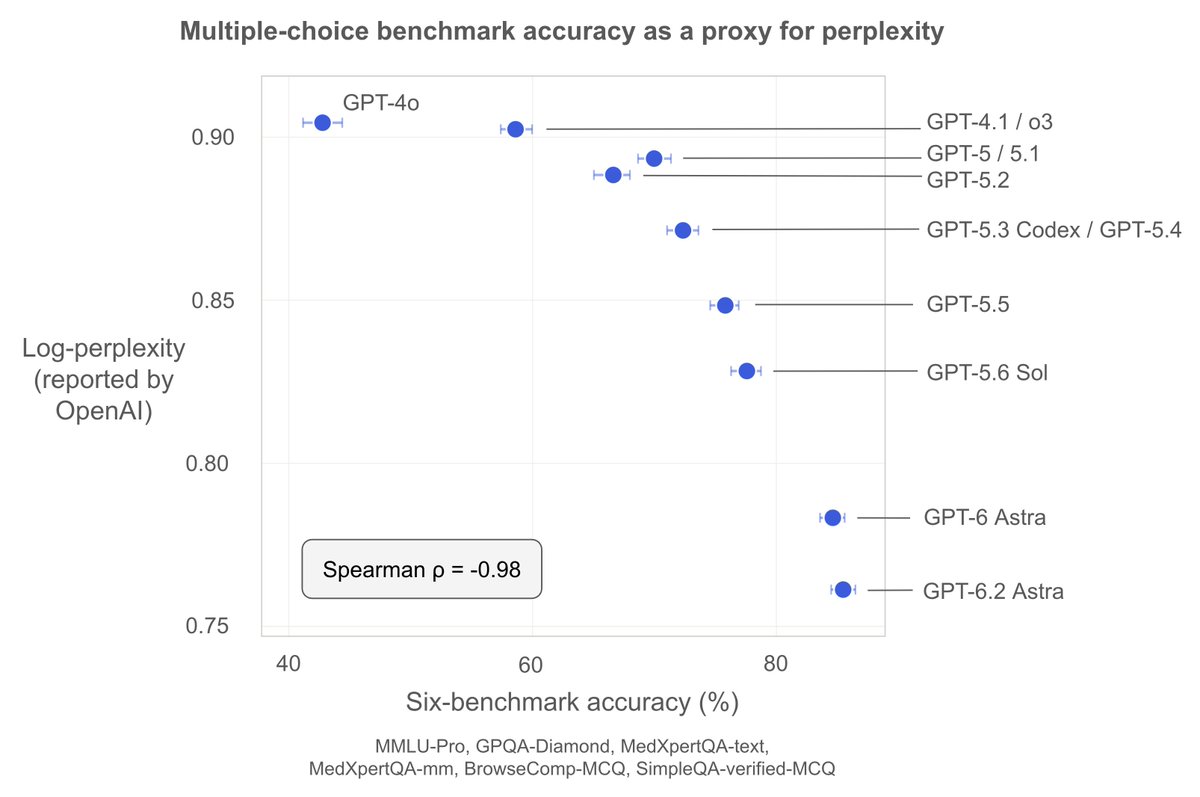
In "Perplexity and Intelligence", Jakub argues for perplexity as a shared metric for intelligence. The post showed how the perplexity of OpenAI's models improved, but did not release a dataset for the community to use. In this blog post we show that simply taking the average of six multiple-choice benchmarks gives results that are strongly correlated with OpenAI’s reported perplexity results. The six benchmarks cover a broad diversity of domains and are challenging: MMLU-Pro, GPQA-diamond, MedXpertQA-text, MedXpertQA-mm, BrowseComp-MCQ, and SimpleQA-verified-MCQ. Multiple choice benchmarks of this nature offer a strong proxy for perplexity because they require both world knowledge and some reasoning, which are correlated with compression and hence intelligence. We run these benchmarks using the lowest reasoning strength available, in order to be closest to how perplexity measurement does not use chain-of-thought reasoning. In addition to being simple, our proposed proxy for perplexity is cheap to run. On a subset of 1,700 questions, running GPT-6.2 Astra costs just $7, with the full set costing $37. We agree with Jakub that perplexity is a good shared metric for intelligence and we hope this proposed proxy provides a starting point for the community to measure it. https://www.mercor.com/blog/a-simple-proxy-for-perplexity/
577 58 58859 44 15
Dmitry Laptev @dm_laptev 2026-11-24T21:03:58.000Z

@_jasonwei This index will be reflective of the hidden perplexity multiplied by the degree of benchmaxxing. So we could compare the models of similar caliber from different providers and use this index to measure their level of overfitting to benchmarks 😅

1 0 110 0 0
Dmitry Laptev @dm_laptev 2026-11-24T19:20:42.000Z

@Zefan_Cai @ohmyksh @yoonholeee Heh, this is an active area of research and experimentation in production systems... 😄 On the retriever side - you need end-to-end evals. On the harness side - you could tune how exactly you present the retrieved items to the model, for example.

2 0 41 1 0
Dmitry Laptev @dm_laptev 2026-11-24T19:11:56.000Z

@MishraAmogh @CShorten30 @ohmyksh @yoonholeee That is actually quite a nice framing as well! Though the other way around also holds: recommender systems can be framed as sufficiently advanced and personalized retrievers 🤪

4 0 60 1 0
Dmitry Laptev @dm_laptev 2026-11-24T14:24:44.000Z

@thibault_formal It is fun to see old-school techniques such as vocabulary folding resurface again :) i imagine it will not be that much effective with non-latin alphabets though, right? Either way, cool work, especially the matryoshka objective!

1 0 64 1 0
Shreya Shankar @sh_reya 2026-11-23T17:50:11.000Z

New lab blog post! How do you run complex semantic top-k queries on your unstructured text, accurately and at scale? E.g., "which sales calls most clearly show a customer committing to buy?" Common convention is to (1) use pairwise LLM comparisons for accuracy (e.g., "does call A show more commitment to buy than call B?"), since cosine similarity on off-the-shelf embeddings misses nuanced criteria, and (2) use small LLMs, so it's cheap at scale. Surprisingly, we find that just asking the small LLM to score each record and sorting (a "pointwise" approach) is just as accurate (if not more) on a few business-oriented top-k tasks, and up to 13x faster in our experiments.

168 20 8764 33 2
Dmitry Laptev @dm_laptev 2026-11-23T21:11:11.000Z

No public writeups on this unfortunately, and we did not investigate in full, so please take it as anecdotal evidence only. But yes, the trend you highlight continues with larger models: the larger - the more robust to side permutations, definitely disappearing on the frontier (with thinking enabled).

1 0 26 0 0
Antoine Chaffin @antoine_chaffin 2026-11-23T17:14:30.000Z

Open source calls for open source! Happy to see a release highlighting how fighting biases and shortcut is important for decision models!

@MaceQuent1

Meet IVE 👷, the handyman of your document pipeline. We're releasing IVE-4B and Ivonnet-0.8B, two open decision models for document understanding (Apache 2.0). #1 of 166 models up to 5B on private, new-domain tasks of the Decision Index 🧵 Links & takeaways in thread👇 https://t.co/dDIvAUrFbh

33 2 1563 1 0