Omar Khattab (@lateinteraction)

@lateinteraction reposted
Simon Guo @simonguozirui 2026-11-25T00:12:15.000Z

Been having fun with Inkling 2 Mini last few days? Now you can train and sample it for free on @tinkerapi! Send cool demos our way!

@tinkerapi

To celebrate the Inkling 2 Mini release, all Tinker users with a positive balance can now train and sample on Inkling 2 Mini for free (subject to rate limits). We want to make model customization more accessible to everyone. Have fun! https://thinkingmachines.ai/tinker/pricing/

41 2 1956 4 1
@lateinteraction reposted
Jyo Pari @jyo_pari 2026-11-24T19:51:22.000Z

In deep learning, we often overparameterize, then guide training toward simple functions that generalize. We find that linear and softmax attention favor different tasks. Instead of choosing between them, we let the model learn its attention function through a more general polynomial parameterization.

288 50 17602 9 8
Omar Khattab @lateinteraction 2026-11-24T19:15:42.000Z

some free alpha. i hear this routing argument a lot: "some tasks don't require a frontier model, so let's route you to a cheaper one", but it's not correct in the medium/long run imo 1] by any measure, a good enough frontier model (we're not there quite yet) will be better able to allocate inference compute based on the difficulty of the problem than any little router on top 2] BUT often the tradeoff explicitly requires the user to *decide*: are you willing to get 1% lower chance of success to run 10x cheaper? no one can answer that for you, and certainly not a little router (so "high/low" choices persist)

@garrytan

First, the models have reached beyond what some customers even need. Though I suspect there is still a step function in agency and taste available even if the models can do the tasks today. https://t.co/7a26JGS13f

199 14 15786 36 7
Daniel Campos @spacemanidol 2026-11-24T20:01:45.000Z

@lateinteraction I don't agree. big models push harder even when told not to. even on easy queries I see big models less willing to take the simple path. If anything i see the Haiku luna tier more willing to make a simple choice while a fable astra is trying to solve p=np for fizzbuzz

5 0 298 1 0
@lateinteraction reposted
Drew Breunig @dbreunig 2026-11-23T22:05:40.000Z

One last SF @DSPyOSS meetup, to close out 2026 and celebrate the publication of @hammer_mt's “Context Engineering with DSPy”! Join us Dec 16th for an evening of lightning talks and discussion. Hosted by our friends at @figma. RSVP here: https://luma.com/2czukysp

25 8 3438 2 1
Omar Khattab @lateinteraction 2025-04-17T01:09:45.000Z

The capacity to use intuition towards solving problems. The capacity for solving problems that have not been posed in a formal language. The ability to abstract novel scenarios despite ambiguity and to model them such that tools & rules apply. Rarely about *applying* rules!

@prasanna_says

@lateinteraction What is your definition of intelligence - disagreement around that is the biggest issue here..

19 1 3289 4 0
@lateinteraction reposted
Chomba Bupe @ChombaBupe 2026-11-22T15:57:22.000Z

I would also argue that Claude doesn't understand the proof either. The Lean verification result is emergent from several attempts to pass the verification. No one understands the proof not even the machine that helped generate it.

@TheDavidHasbun

I just realized something about Anthropic's RH "proof." 250k pages of gibberish but everyone hails it as an accomplishment because a computer verified it even though no human can understand it. But if no human can understand it then no human can argue against it and therefore no one can disprove it. The entire point of publishing papers is to have them peer reviewed. Your peers in your field will look at the work and decide if it is both valid and worthy of acceptance. But if humans can't understand the proof then the proof can't be peer reviewed. Computers are not our peers. If it can't be peer reviewed then it can't be accepted as a proof. If it can't be read by humans then it can't be peer reviewed. Therefore this entire fiasco is a waste of everyone's time and should be ignored completely until a human readable proof is provided.

1700 139 68731 59 10
Omar Khattab @lateinteraction 2026-11-20T17:15:02.000Z

a good day to repost: > if a tool can solve millennium prize problems and be this dumb on 1000 other things, that reshapes my understanding of the territory more than it reshapes my judgment of the vehicle

@lateinteraction

my post is precisely a result of seeing the conversations about that (1) part of it is: if a tool can solve millennium prize problems and be this dumb on 1000 other things, that reshapes my understanding of the territory more than it reshapes my judgment of the vehicle it's becoming clear that, well, compute-vs-humans are mutually jagged (2) and part of it is: the brute force vs. generalization ratio in the current paradigm has hugely missed my (rather low) expectations, e.g. "sorry but my AI that solved Navier Stokes needs help so it can write English or explain itself, after seeing the whole Web 10x over" (3) and part of it is about a different philosophy of value/work: [a] whatever AI makes cheap (down to and including em dashes) reliably gets displaced in value by other stuff, [b] there's no short reward function that re-creates all value or information, most of it is inherently distributed and can't be pre-loaded

482 35 20708 25 6
@lateinteraction reposted
Souradip Chakraborty @SOURADIPCHAKR18 2026-11-20T16:49:18.000Z

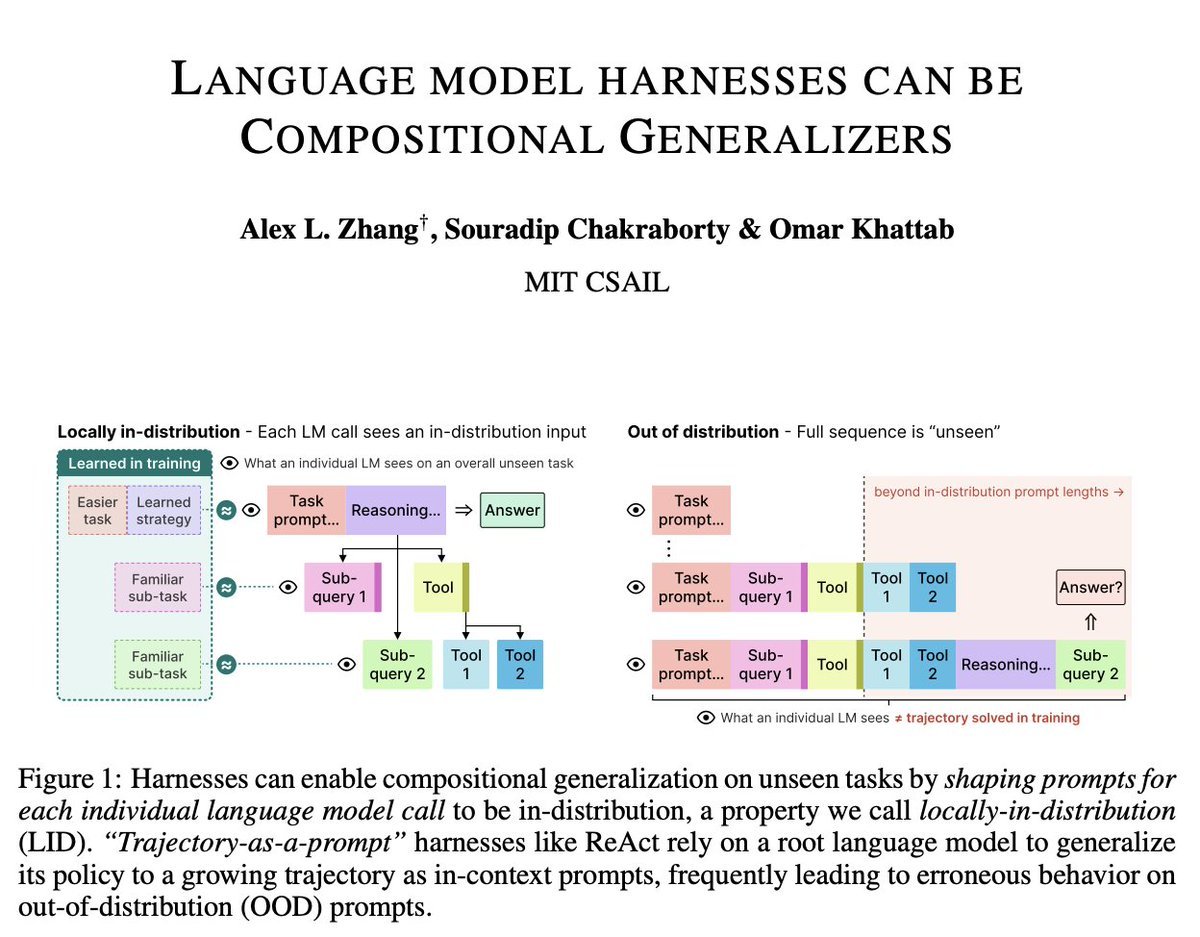
We have largely thought of LM harnesses as inference-time scaffolding. But what happens when we train models with the right harness? A common assumption is that RL naturally leads to generalization. However, its ability to generalize ultimately depends on the underlying neural network's learned representations, which may not transfer reliably to unseen tasks. In the recent work by @a1zhang, we show how harnesses can enable compositional generalization during training by programmatically managing context, allowing RL to learn reusable decomposition strategies that compose existing LM capabilities to solve unseen tasks. The results point toward a broader paradigm: the harness is not merely a wrapper around the model. Harness design and model learning are deeply intertwined, and how we train agents should reflect that. Very exciting work, as always, by @a1zhang and @lateinteraction

@a1zhang

Harnesses used to be a crutch for weak LLMs. In 2026 and onward, with stronger models, harnesses now offer a mechanism for composing an LLM’s existing and new capabilities to generalize well beyond their training environments. In our new paper, LM Harnesses are Compositional Generalizers, we explore how various harness abstractions enable LM systems to generalize over task length, task strategies, recursive task depth, and more through composing existing LLM capabilities. These abstractions provide a means for more data-efficient training, especially over long tasks, by keeping trajectories locally in-distribution (LID) — i.e., shaping all individual LLM calls to be in-distribution. For tasks that take a very long time to roll out, this implies that we can even perform surrogate harness training, meaning we train an individual LLM call instead of doing the very long harness rollout, using purely synthetic tasks, with fake tool calls + sub-agents! A common idea floating around is that LLMs will absorb harnesses and make them obsolete. We disagree, and argue that we haven’t sufficiently explored what harnesses can provide. The full paper, logs, codebase, and data are available: https://www.alphaxiv.org/abs/2611.harness-cg w/ @SOURADIPCHAKR18 @lateinteraction
180 21 9331 3 0
Omar Khattab @lateinteraction 2026-11-20T15:28:48.000Z

A compositional harness (like RLM) can give you better returns on RL compute, compared to standard coding agents. During RL post-training, RLMs learn relatively easily how to reshape their own messy observations into compositions of familiar problems for the neural LLM underneath. Compared to conventional append-only harnesses (~ReAct with compaction), Alex isolates a set of "harness abstractions" that *together* enable compositional generalization: context offloading, programmatic tool calling, and sub-agent calling.

@a1zhang

Harnesses used to be a crutch for weak LLMs. In 2026 and onward, with stronger models, harnesses now offer a mechanism for composing an LLM’s existing and new capabilities to generalize well beyond their training environments. In our new paper, LM Harnesses are Compositional Generalizers, we explore how various harness abstractions enable LM systems to generalize over task length, task strategies, recursive task depth, and more through composing existing LLM capabilities. These abstractions provide a means for more data-efficient training, especially over long tasks, by keeping trajectories locally in-distribution (LID) — i.e., shaping all individual LLM calls to be in-distribution. For tasks that take a very long time to roll out, this implies that we can even perform surrogate harness training, meaning we train an individual LLM call instead of doing the very long harness rollout, using purely synthetic tasks, with fake tool calls + sub-agents! A common idea floating around is that LLMs will absorb harnesses and make them obsolete. We disagree, and argue that we haven’t sufficiently explored what harnesses can provide. The full paper, logs, codebase, and data are available: https://www.alphaxiv.org/abs/2611.harness-cg w/ @SOURADIPCHAKR18 @lateinteraction

291 23 12488 29 0
Omar Khattab @lateinteraction 2026-11-20T15:33:19.000Z

@a1zhang @SOURADIPCHAKR18 People usually think of the "harness" as primarily an inference-time wrapper. But @a1zhang argues that they need to become a powerful source of inductive bias during *training*, if we want LLMs that can generalize better to longer and harder tasks.

32 3 1794 1 0