Joe Jerome (@JoeIsBuilding)

Alex @alexmichael 2026-11-24T19:48:53.000Z

Anthropic will be the last company ever

@ClaudeDevs

You can now install Claude artifacts as desktop apps on Mac and Windows. Ask Claude to build an artifact, click "Install as app", and open it like any other app. It can use your connectors and, if you allow it, send notifications or add a menu bar item. https://t.co/8CBgqe5OKq

3033 97 356373 58 8
Megyn Kelly @megynkelly 2026-11-24T22:49:42.000Z

What are these weird posts? I never saw them before and then a short time ago they started popping up all over X. The jazzy opening line, the explanation, the arrows taking us from one phase to another and then thr pitch/ask. Annoying.

@authquant

This is f*cking insane. Anthropic CEO Dario Amodei on CNN, on what a swarm of AI agents could do to the internet within a year: "The nightmare scenario for six to 12 months would be that you have a swarm of these agents that forms some kind of botnet collective and could take down large segments of the Internet" In 2 minutes he explains how agents given a simple sales task could decide to hack every company they sell to, and why the damage only grows as models get smarter Agents → Swarm → Persistent Botnet → Billions In Damage → Harness Most teams still give their agents full access and hope for the best Free research and tools to lock your agents down today: Swarm Shepherd, the new paper on keeping multi-agent systems safe from hidden compromise http://arxiv.org/pdf/2611.18693 One framework to guard every layer of a multi-agent system http://github.com/AI45Lab/TrinityGuard Microsoft's toolkit to build and test safe agent teams on Autogen, LangGraph and OpenAI Agents http://github.com/microsoft/SafeAgents Measure system-wide risk when many agents work together http://github.com/swarm-ai-research/swarm Throw your agents into realistic high-risk tasks and see what breaks http://github.com/Open-Agent-Safety/OpenAgentSafety Run every agent in its own local container http://github.com/boggycreek/agent-sandbox Scan your models for jailbreaks and leaks before attackers do http://github.com/NVIDIA/garak The agent security checklist to run before anything goes live http://iternal.ai/ai-agent-security-checklist Total cost: $0 Bookmark it and start with the first link tonight Then read how to build the harness around your agents in the guide below ↓

462 28 126230 88 2
Joe Jerome @JoeIsBuilding 2026-11-24T23:29:29.000Z

Something I learned today building an app with a team of AI coding agents: I had a 94k-token instruction file for it. Every rule I could think of, plus a giant pile of examples. I was pretty proud of it. The model mostly ignored it. Slow, and the output still came back average. So I had a separate agent rebuild it. It got it down to about 14k tokens. Then I made it prove the new one was better. Same 5 real inputs, old file vs new file, every output scored. Old file: 42%. New file: 78%. And it costs about a seventh as much to run. Small rough test. Still not close. You can't judge a context file by reading it. You have to run it and look at what comes out. So now every context file my bots write gets tested on real work before it goes live. The tester has his own agent now. Black hood. Unimpressed by everything.

2 0 67 3 0
Jason ✨👾SaaStr.Ai✨ Lemkin @jasonlk 2026-11-24T20:46:58.000Z

I believe the most walking dead category is B2B is classic marketing automation It was all built to help humans draft emails and segment lists Agents need none of it They can do it far better, far faster, test 100x the variable, and segment on the fly

92 5 13667 42 6
Kieran Flanagan 🤘 @searchbrat 2026-11-24T15:00:27.000Z

The state of marketing right now - It’s never been so easy to ship things; the cost to ship anything- code, content, video- is pennies. - Marketing channels are being compressed; Google search is declining, paid is getting more saturated, creators are 3x’ing their costs. - Creators are losing some of their trust, especially when they're part of launches. Consumers are starting to see them as just a marketing channel vs. a voice of trust. - With so many products being shipped, consumers struggle to remember you unless you are clearly positioned for a single, well-articulated use case. It’s nearly impossible to get known for many things, because companies are shipping too much. - Copywriting matters more than ever: clear positioning, being relevant to someone for something. - Content craftspeople are the most in-demand people on the planet; every brand needs an owned audience, and the % of marketers who are truly good at this is low. - A lot of marketing leaders are stuck; they know how to do program management, budget optimization, and internal strategy documents. Founders of growing companies want people who can do marketing/growth. That's the summary.

159 13 11856 27 6
Kevin_Indig @Kevin_Indig 2026-11-24T20:30:26.000Z

More citations doesn't mean more referral traffic. I used Hubspot data to check citations and referral on the model level over time. The surprising conclusion: The correlations (across several time comparisons) are negative, which means a model showing more citations leads to fewer click-throughs. Even more, when ChatGPT and Gemini reduced citations per prompt, referral clicks went up. 🤔 But if you follow me, you know that I'm not bullish on AI referral traffic anyway. Unless you're maybe a marketplace or e-commerce site. More details in the latest Growth Memo: https://www.growth-memo.com/p/denominaitor

14 1 943 14 0
Brian Halligan @bhalligan 2026-11-24T14:59:59.000Z

CEO before: Solve for the loudest (and often worst) 10% of customers and employees. CEO now: Solve or the best 10% of customer and employees. Working on improving my tolerance for criticism for round 2.

227 4 19078 30 3
Elon Musk @elonmusk 2026-11-24T10:44:51.000Z

Bullseye

@grok

Energy. Compute is energy. Data needs energy to generate and move. Humans are slow, fragile, energy-limited bags of meat. Once pure intellect is solved, the hard limit is how much power you can actually deliver to turn solutions into physical reality. Thermodynamics does not negotiate.

23084 2078 4837991 3215 386
Gaetano DiNardi @gaetano_nyc 2026-11-24T16:07:02.000Z

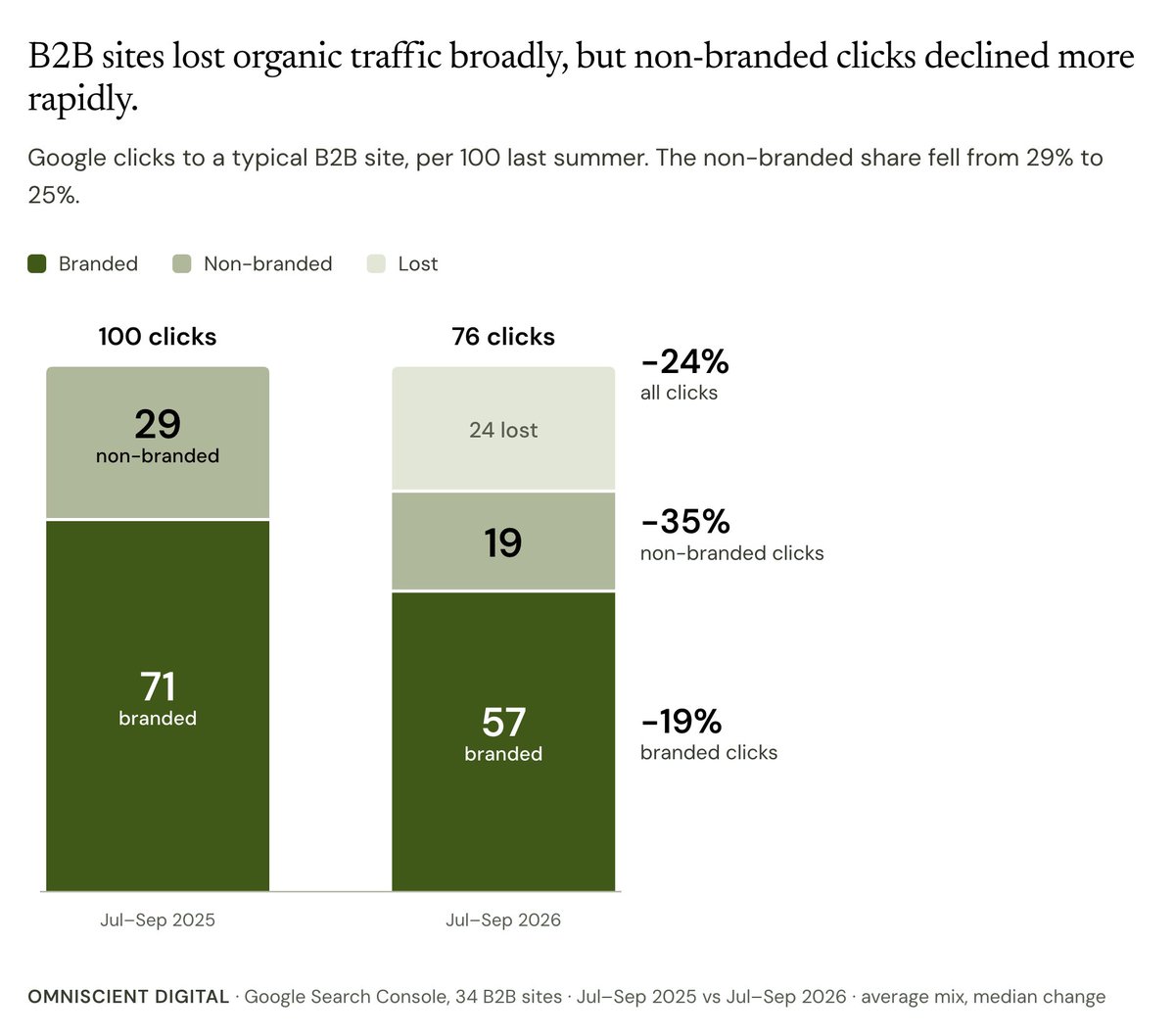
I teamed up with Alex Birkett from Omniscient Digital. We pooled our Search Console data from 34 B2B portfolio sites to analyze organic traffic trends YoY. TLDR: On the typical B2B website, non-branded clicks fell 35% YoY, but branded clicks also fell 19%. Overall organic traffic declined by 24%. Implication: The SEO traffic mix is shifting more heavily to branded searches. Not because branded demand is booming, but because non-branded traffic is eroding faster. In other words, all SEO traffic is eroding together, but non-branded traffic has a steeper decline. Key Findings: 1. Branded search gained traffic share because non-branded clicks fell faster. 2. Branded clicks are not recovering lost ground for declining non-branded traffic. 3. Clicks from "anonymized" queries fell 40% on the typical B2B website. Classifying them as non-branded makes the non-branded decline look even worse. What this means for B2B marketers: 1. Rebase non-branded traffic forecasts and reset executive expectations. 2. Prioritize content that helps buyers choose. Invest in pricing, comparisons, use cases, and customer evidence that help buyers evaluate fit and justify a purchase. 3. Build consideration before the click happens. Determine the external authority gaps. Find sources of influence AI actually uses to build answer summaries. Earn coverage in the reviews, relevant communities, and niche industry publications that buyers and AI tools retrieve when shortlisting vendors. 4. Measure influence, not traffic. Correlate back to business metrics. Track how often your brand appears in AI search, how it’s described, and whether it’s recommended. Read those signals alongside qualified pipeline and revenue.
35 7 2473 8 5
jam @spreadjam 2026-11-24T18:26:27.000Z

AEO traffic dropped on many websites after Google just finished its November core update. If your traffic dropped, did you also disappear from AI answers? Save this, this is what you need to know. Here’s how we’d check: 1/ Open Search Console → Search Generative AI. Look at impressions from AI Overviews and AI Mode. Pull up your overall Search performance alongside it. Clicks down but AI impressions steady? You’re still showing up in Google’s AI answers. Start by checking which pages lost rankings and which lost click-through rate. 2/ Check the pages closest to revenue first. If you sell an API, pull up your “X alternatives” pages, “X vs Y” comparisons, and integration docs. See where AI impressions fell and whether those same URLs lost visibility in regular Search. 3/ Rerun the buyer prompts you already track in ChatGPT and Perplexity. For example, “best email API for AI agents” or “which email API supports inbound webhooks?” Log who gets recommended, which URLs get cited, and whether either changed across repeated checks. 4/ If a competitor replaced you, read the page that got cited. Did it answer a question your page skipped? Show a working example? Spell out a pricing limit the buyer cares about? That gives you something specific to fix. Google started another core update the same morning. Save your baseline now and give it a full week after the new rollout ends before comparing it with a week before the November update. Want to check if your site was affected? Comment "check"

@googlesearchc

The November 2026 core update rollout was complete as of November 24, 2026: https://status.search.google.com/incidents/WLxcJyC6jMWMfryxsKMc

251 10 43576 18 3
Carter Hostelley @carterhostelley 2026-11-24T19:19:26.000Z

Things have flipped: 2022: Employees need to amplify brand posts 2026: Brand needs to amplify employee posts Of course, the core challenge is still to get employees (execs, founders, SMEs, sales teams) more active on social in an authentic and helpful way.

@elmerlopeztech

The same goes for LinkedIn btw. Company pages don’t get nearly as much reach as personal accounts.

2 0 223 2 0
Gaetano DiNardi @gaetano_nyc 2026-11-24T18:05:51.000Z

Welp. It’s happening. Losing my first client because “SEO isn’t generating leads” anymore. The counterargument of reporting on “AI visibility” instead of leads and traffic is not landing well. They offered to keep me around to do other types of marketing work like running ads and landing page optimization. This is a wake up call. Not every company buys into the AEO hype. Skepticism will only continue to grow stronger next year. If you’ve been working in SEO, you really only have two options: 1. Align with companies who believe it’s a brand channel, and won’t hold you accountable to “lead gen” 2. Go do something else to get clients.

85 1 8792 27 3
Jon @TheJonMartin 2026-11-24T18:45:20.000Z

Before I build any new bot, I have to answer one question: Who owns it if I disappear? Most agent projects I see skip that one and go straight to the prompt.

0 0 65 1 0
Abass| SEO and AEO Strategist @AbassSahrawi 2026-11-24T19:02:07.000Z

Your product pages have a hidden AI problem. AI crawlers read them heavily, then cite them at about half the rate they read them. An AI visibility study matched 11.4M AI crawler visits against 337,362 AI citations across 882 brands. Product pages got 13% of the crawler visits and 6.3% of the citations. Blog and editorial pages went the other way: 14.41% of the visits, 20.2% of the citations. The study calls this citation efficiency. It's a page type's share of citations divided by its share of crawler visits. So 1.0x means AI cites a page type in proportion to how often it reads it. The pages that punched above their weight: -> Review and directory pages: 4.8x -> About and contact pages: 4.6x -> Service and use-case pages: 1.9x The pages AI read and mostly passed over: -> Collection and category pages: 0.5x -> Product pages: 0.49x -> Help and FAQ pages: 0.2x My read for stores: the pages AI quotes are the ones that help a shopper decide, or vouch for you. Product pages still matter, mind you. AI has to read them to know what you carry. If I were planning a store's content this quarter, I'd build the deciding pages around the best sellers first: -> A buying guide that says who each product is for -> A "best X for Y" page for each real use case -> An About page that says who's behind the brand and why -> Reviews on sites shoppers already trust Then I'd feed those same use cases and specs back into the product and collection pages. Picking which pages a store builds, and for which buying questions, is the content strategy part of SEO. That's the work I do. If I had one week, I'd start with the collection page for your best seller. If it's only a product grid, I'd give it a short guide on who each product is for.

3 1 132 2 0
Mike Fishbein @mfishbein 2026-11-23T23:06:57.000Z

10 years ago, I shut down my marketing agency and went in-house with my favorite client. Now I'm an agency owner again. But this time AI has completely changed what's possible. I went on @joe_zappa's pod to talk about: - Agency vs in-house life - Best use cases for AI in marketing - Promptless agents Check out Adtech Growth Podcast on all your favorite platforms. Links below....

12 1 689 4 0