Investing visuals (@InvestingVisual)

Investing visuals @InvestingVisual 2026-11-25T09:10:30.000Z

Great post. Investing and trading are two entirely different approaches. Everyone has their own strategy, timeline and goals. No need to fight over which one works best. We all have our own preferences that fit our personal risk tolerance and time horizon.

@TheProfInvestor

Some people on FinX seriously need to understand the difference between INVESTING and TRADING. I'm seeing people attacking each other all over this platform. “You're an idiot if you came into this week 100% cash.” “You just missed a generational wealth opportunity.” Brother, do you even know the other person's strategy, timeframe, or risk tolerance? If you're an INVESTOR: I don't believe you should be sitting 100% cash waiting for the perfect bottom. Last week's correction was an opportunity to start scaling into quality stocks at discounted prices. Your goal isn't to predict where the market will be tomorrow. You're looking 6 months, a year, or several years ahead. If you're a TRADER: Completely different game. Last week's extreme oversold conditions offered an opportunity to position for a violent snapback. But that doesn't mean you go from 0% to 100% exposure overnight. We STILL don't have confirmation that the bottom is in. This could very well be a bear market rally, and another leg lower remains possible. As a trader, your priority is protecting capital, managing risk, and adding exposure progressively as the market confirms your thesis. If we reclaim important lost support levels, GREAT. That's one more reason to increase exposure. Investors should be focused on accumulating quality assets through corrections. Traders should be focused on navigating those corrections without getting stuck holding a bunch of bags. Two different approaches. Two different objectives. What bothers me is how easily people on this platform make others feel like they've missed out or done something wrong. They create FOMO, spread fear, and completely disregard the strategy someone else is following. Being in cash isn't automatically wrong. Being invested isn't automatically right. What matters is whether you're following your plan. Maybe this post reaches only a handful of people. But if it helps even 10 people stop second-guessing themselves because of some stranger on X, I'll be happy. Nothing but love for everyone out there. ❤️ Prof

14 1 4675 1 0
Mich_Kalek @KalekMich7668 2026-11-24T14:47:44.000Z

typical double counting, lmao

@InvestingVisual

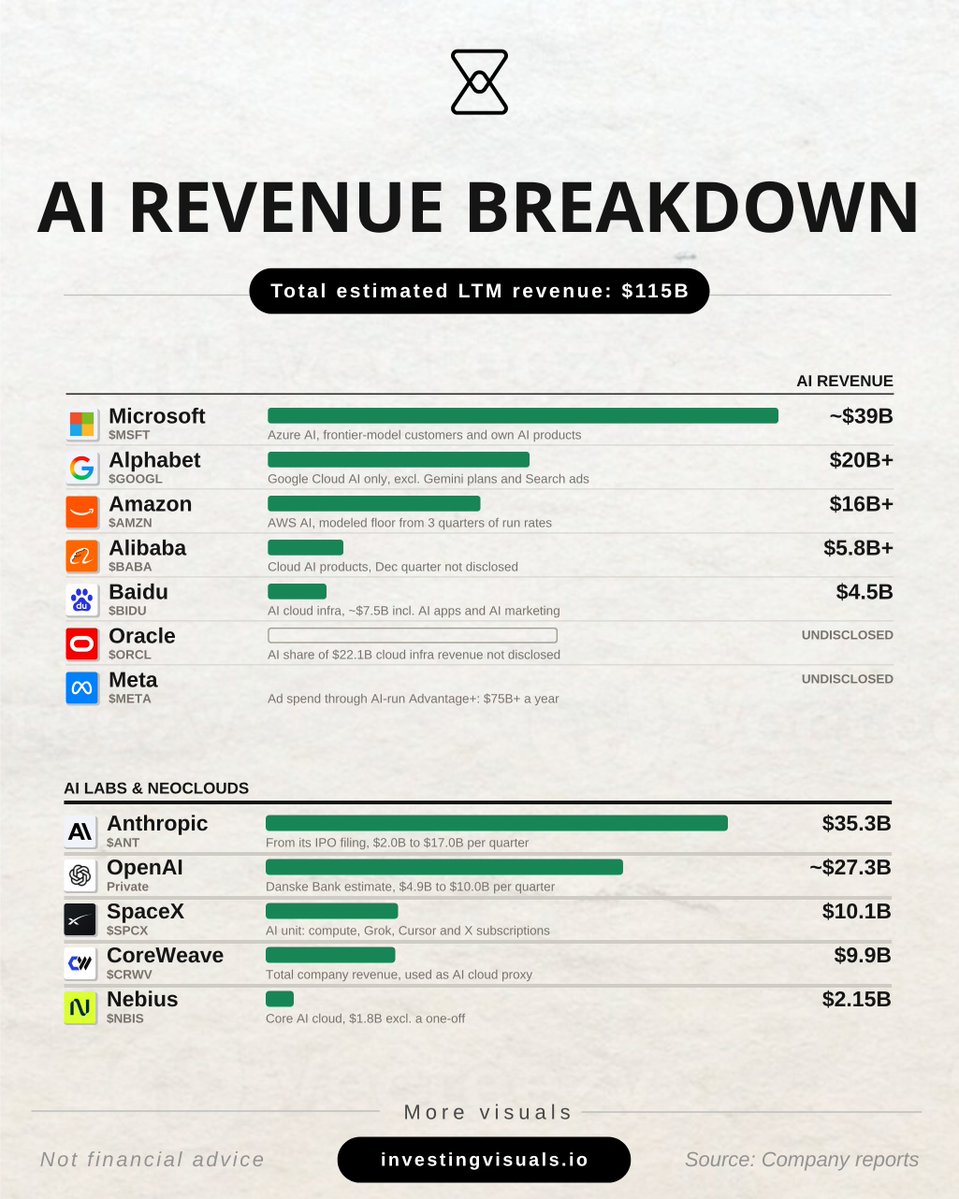
Thoughts on CapEx fears and AI ROI: Hyperscalers have committed hundreds of billions in CapEx so far, with hundreds of billions more to come. But would they commit so much capital, and continue to do so, if they saw poor ROI on their AI buildout CapEx so far? I personally don't think so. They are top-tier tech businesses, and they became that by critically evaluating where they do and do not invest. They wouldn't exist today if they had done a poor job of that. Yes, part of these investments is also driven by a race for technological dominance, but we've already seen very tangible results in their earnings reports: Estimated AI revenue: • $MSFT $39B • $GOOGL $20B • $AMZN $16B • $SPCX $10B I think this investment cycle has more similarities to the cloud infrastructure buildout in 2006 than people give it credit for. The scale of both the investments and the potential ahead is, however, much bigger today, backed by the 'insatiable' demand that hyperscalers and AI cloud businesses keep reiterating in their earnings reports. The main question is how much of that will eventually translate into free cash flow and net profits. I think that's the biggest uncertainty right now and something to track closely. That won't happen overnight. For comparison: AWS launched in 2006 and only showed its profits when $AMZN first reported it separately in 2015. AI is moving much faster than that, but it'll likely take a while to show up in the results. I do think that if Big Tech had seen poor ROI from the early results, they would've already cut their CapEx forecasts by now. Instead, they've maintained or even increased them. So either all of them are wrong, or they're positioning themselves to benefit from the opportunity that lies ahead. I'm personally betting on the second, but it's also important not to turn a blind eye to the associated risks. Curious to hear your view on this, so feel free to drop your thoughts in the comments!
0 0 511 1 0
Investing visuals @InvestingVisual 2026-11-24T14:25:00.000Z

Thoughts on CapEx fears and AI ROI: Hyperscalers have committed hundreds of billions in CapEx so far, with hundreds of billions more to come. But would they commit so much capital, and continue to do so, if they saw poor ROI on their AI buildout CapEx so far? I personally don't think so. They are top-tier tech businesses, and they became that by critically evaluating where they do and do not invest. They wouldn't exist today if they had done a poor job of that. Yes, part of these investments is also driven by a race for technological dominance, but we've already seen very tangible results in their earnings reports: Estimated AI revenue: • $MSFT $39B • $GOOGL $20B • $AMZN $16B • $SPCX $10B I think this investment cycle has more similarities to the cloud infrastructure buildout in 2006 than people give it credit for. The scale of both the investments and the potential ahead is, however, much bigger today, backed by the 'insatiable' demand that hyperscalers and AI cloud businesses keep reiterating in their earnings reports. The main question is how much of that will eventually translate into free cash flow and net profits. I think that's the biggest uncertainty right now and something to track closely. That won't happen overnight. For comparison: AWS launched in 2006 and only showed its profits when $AMZN first reported it separately in 2015. AI is moving much faster than that, but it'll likely take a while to show up in the results. I do think that if Big Tech had seen poor ROI from the early results, they would've already cut their CapEx forecasts by now. Instead, they've maintained or even increased them. So either all of them are wrong, or they're positioning themselves to benefit from the opportunity that lies ahead. I'm personally betting on the second, but it's also important not to turn a blind eye to the associated risks. Curious to hear your view on this, so feel free to drop your thoughts in the comments!

73 15 8934 3 2
Gab @GabGrowth 2026-11-24T11:14:15.000Z

$AXON invested $1.2B in Skydio bringing its stake up from 15% to 37%. In total, the stake is worth about $2B now, ~8% of Axon's market value. I think it's worth looking deeper into how it feeds into the Axon ecosystem and how large an opportunity DFR is. Will be the next deep dive!

39 0 3411 2 0
Javier Martin @liderarmente 2026-11-24T10:38:54.000Z

Hay dos cuentas de X en las que me estoy inspirando especialmente para crear @whyhumanoid Aprovecho para recomendarlas por aquí, por casualidad ambas son de temas de inversión en bolsa, pero para mi son las que mejor representan el estilo que quiero desarrollar con este proyecto. 1. Lin, aka @Speculator_io, creador de Fullstack Investor, una aplicación que ayuda a convertir el ruido en acción, en lo que a inversión en empresas se refiere. 2. Jan, aka @InvestingVisual un fenómeno en lo que a explicar la inversión en empresas de manera visual muy atractiva.

6 0 992 1 0
Investing visuals @InvestingVisual 2026-11-23T20:22:14.000Z

$NVDA stock performance ranked from best to worst years: 🟢 2001: +308% 🟢 2023: +239% 🟢 2016: +224% 🟢 2024: +171% 🟢 1999 (since IPO): +138% 🟢 2009: +131% 🟢 2021: +125% 🟢 2020: +122% 🟢 2006: +102% 🟢 2003: +102% 🟢 2017: +81% 🟢 2019: +76% 🟢 2015: +64% 🟢 2005: +55% 🟢 2000: +40% 🟢 2025: +39% 🟢 2007: +38% 🟢 2013: +31% 🟢 2014: +25% 🟢 2004: +2% 🔴 2011: -10% 🔴 2012: -12% 🔴 2010: -18% 🔴 2018: -31% 🔴 2026 (YTD): -33% 🔴 2022: -50% 🔴 2008: -76% 🔴 2002: -83% $1,000 invested at IPO would be worth $5,021,200 today (36% CAGR).

168 24 14329 1 2