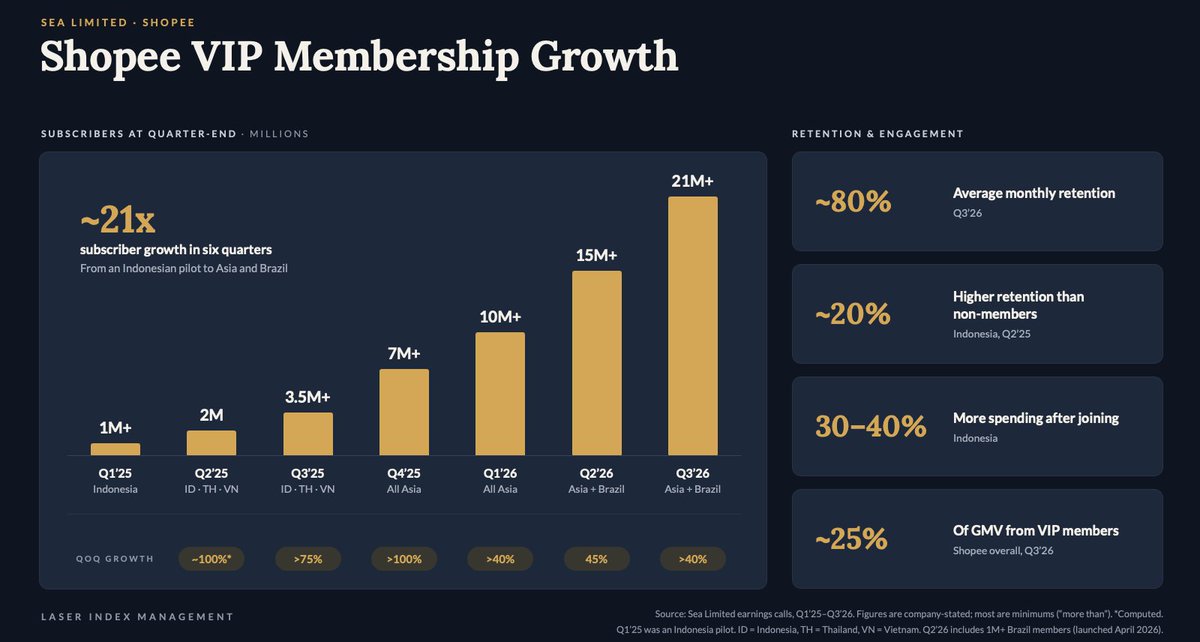
Aside from $SE simply being the most profitable version of itself with sustained 40-50% sales growth, its VIP program represents an annihilation of specifically the Shopee competition bear thesis.
I'll elaborate.
There are four elements that underpin stock value:
1. The amount of fcf/share a company generates
2. The rate at which it grows
3. The durability of said fcf/share (keep this in mind with respect to Shopee VIP)
4. How the first three in combination compare to our next best alternative, i.e., our opportunity cost, otherwise known as hurdle rate or required rate of return or discount rate (all these terms are synonymous). If you can get a guaranteed 50%/yr return, then you should stop reading this and go buy that and probably stop following me, because, logically, you should buy nothing else.
With respect to point 3, if a stock has low cash flow durability, it will persistently trade at a super depressed valuation (see cyclical memory stocks such as $MU as an example).
Despite Sea Ltd. holding 50%+ SE Asian e-commerce market share (higher market share than $AMZN $MELI in their respective regions), investors have worried about cash flow durability for SE's ecom segment. They've used the term "competition fears," but ultimately, this means cash flow durability and growth (2nd and 3rd points of stock value).
The argument has been that there's low switching costs in SE Asia, therefore low cash flow durability for Sea and Shopee.
The bears have argued that there's little differentiation among ecom vendors in SE Asia and low barriers for switching; therefore, SE's cash flows would always be in a state of peril; therefore, it should either not be owned or owned at such a low valuation as to compensate for its lack of cash flow durability created by overwhelming competition (so the argument goes).
However, today, with the massive success of Shopee VIP, in which SE Asian shoppers subscribe to what is essentially $AMZN Prime, this argument has been decimated.
“Second, Shopee VIP is growing fast. Membership across markets exceeded 21 million at the end of September, up more than 40% quarter-on-quarter, and the members contributed close to 25% of Shopee’s overall GMV.
The program is demonstrating stickiness, with monthly retention around 80%. Members show a consistent double-digit percentage uplift in spend on average after subscribing. With more sellers and partners investing alongside us in membership benefits, the program’s unit economics improved sequentially. We have also continued to enhance the program’s value proposition through new subscription tiers with more benefits.”
Forrest Li, CEO, Sea Ltd. Q3’26 Earnings Call
This data indicates that Shopee's cash flows are becoming more and more durable as shoppers invest in and commit to the platform via their VIP subscriptions, which act as consumer subsidies that further increase Shopee's differentiation.
And, with Shopee "wedged" (technical term w/ meaning) into consumers' wallets now, it can expand the value of its membership program via faster shipping and adjacent benefits, thereby locking these subscribers into its ecosystem, creating a loyal book of business, akin to $AMZN Prime subscribers, some of whom have been subs for decades now.
The net effect of this is higher cash flow durability over time, which suggests Sea's valuation should expand, all else equal, as more durable cash flows are worth more than less durable cash flows.
Of course, the market isn't efficient. It's not meant to be efficient. It's meant to try to kill you, and, if you survive, you're rewarded with more resources to extend your genetic line (or whatever because birth rates are collapsed).
And so Sea's valuation is now the lowest it's ever been at the precise point at which it responded powerfully to the bear's concerns over cash flow durability stemming from low switching costs/low commitments to a single platform. Totally in opposition to all logical and reason.
In short, ShopeeVIP creates an economic moat called "embedding, or switching costs," and this moat serves to increase cash flow durability, and higher cash flow durability pulls up on valuations, all else equal.
Shopee VIP program growth continues to boom.
@LASERindexmgmtAt the precise point at which $SE reached its greatest position of strength in the company's history as measured by product line diversity and profitability, the stock collapsed and now offers its most attractive earnings yield in the company's history.
In late 2022, we saw this play out for countless companies:
While from 2019-2021 these companies were less profitable with fewer successful products, and therefore were relatively quite risky, by late 2022 and 2023, these companies had built robust and profitable product portfolios, yet the market traded them to their lowest valuations in their companies' histories in many cases.
It was a staggering irony to witness:
Huge valuations while the businesses were far riskier from 2019-2021, then extremely depressed valuations as the businesses reached their zeniths of strength, which only increased in the last few years. With the idea that the market prices in the future to a company's valuation at any given time, the irony was almost unfathomable.
When a stock is risky, its valuation should be depressed, via which forward returns are high to compensate for risk.
When a stock becomes less risky, its valuation should expand, via which forward returns decrease as compensation for lower risk (see $AAPL over the last decade).
Forward returns are inversely correlated with starting valuations. Risk = return. Therefore, if a company becomes less risky via greater cash flow durability by virtue of multiple established and profitable products, its valuation should expand; not contract.
But the exact opposite happened: Companies became the best, least risky versions of themselves, and, at that exact point, they offered almost unbelievably high forward returns. Totally in opposition to all logic and reason.
In short, contrary to what SE's share price suggests, the company now operates from its greatest position of strength in the company's history as measured by product portfolio strength and profitability.
$GRAB $CPNG $MELI