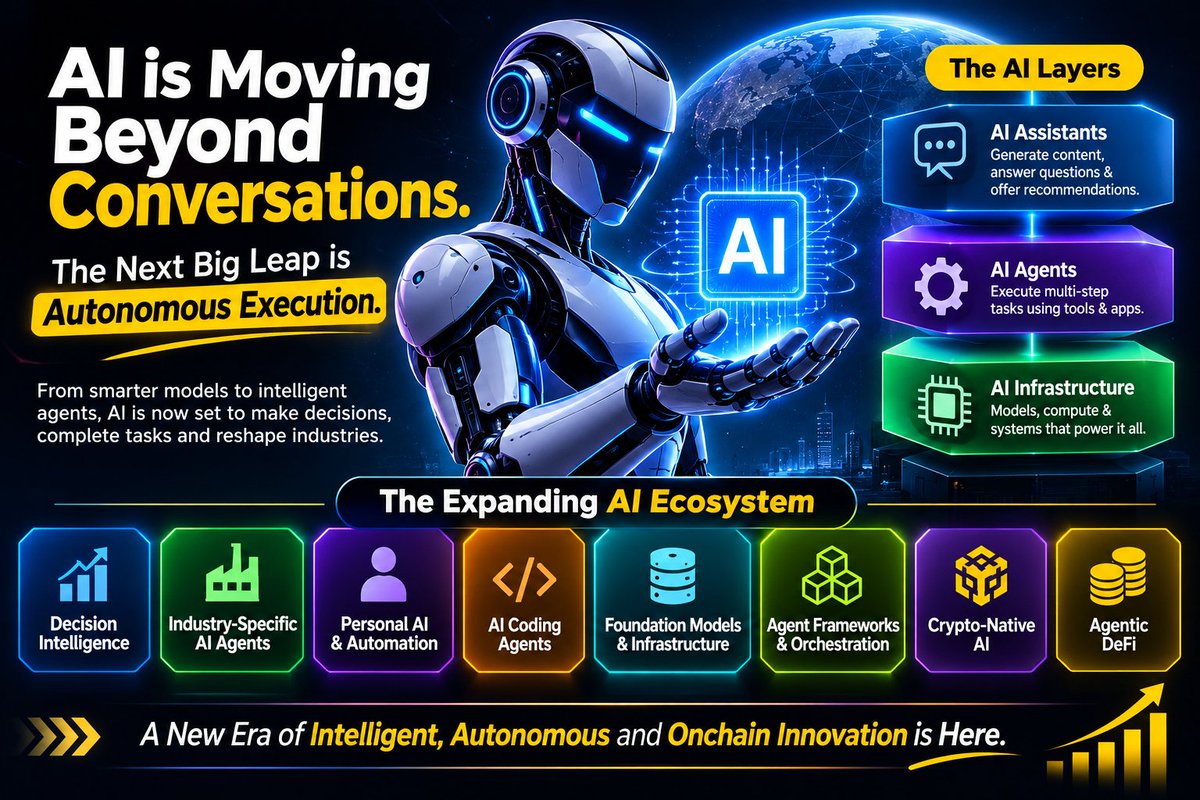
AI is moving beyond intelligent conversations. The next big leap is autonomous execution.
The first chapter of AI was all about developing more powerful models and smarter chatbots. But the industry is gradually moving in a different direction: building intelligent agents that can reason, make decisions, operate software, connect to external tools and complete tasks independently.
This evolution is already spreading across software engineering, architecture, content creation, business automation and even decentralized finance.
To understand where things are heading, it helps to look at the different layers shaping the AI ecosystem and the projects driving innovation
AI is evolving through three major layers:
1. AI Assistants
Tools designed to generate content, respond to questions, analyze information and offer suggestions.
2. AI Agents
Systems that go beyond recommendations by carrying out workflows, connecting to APIs, using applications and completing multi-step operations.
3. AI Infrastructure
The underlying models, computing resources and technical frameworks that make intelligent and autonomous systems possible.
The fundamental change is simple: AI is transitioning from something that tells you what to do into something that can actually do it. Mapping the Expanding AI Landscape
The ecosystem is taking shape across several important sectors:
- Decision Intelligence
- Industry-Specific AI Agents
- Personal AI and Automation
- AI Coding Agents
- Foundation Models and Infrastructure
- Agent Frameworks and Orchestration
- Crypto-Native AI
- Agentic DeFi
Not every AI application needs to be a conversational chatbot. Some are designed specifically to process information, evaluate possibilities, rank outcomes and support complex decisions.
Projects to watch:
- @levantolabs — Sage, focused on decision APIs for classification, ranking and information extraction.
- @liquidai — Building compact decision-focused models, including d1 and d1-ultra.
2. Industry-Specific AI Agents
AI is becoming increasingly specialized, with applications designed around the needs of particular industries.
Architecture and Construction
- @snaptrude
- @autodesk
- @TestFitInc
- @finch3d
Media and Content Creation
- @higgsfield_ai
- @descript
Personal AI and Workflow Automation
- @trymira
- @openclaw
- @ManusAI
- @gumloop
Business Automation
- @HappyRobot
The bigger picture is that AI is no longer limited to general-purpose assistance. It's becoming deeply integrated into professional workflows.
Software development is another area experiencing a major transformation.
Today's coding agents are moving beyond autocomplete and basic code generation. They can navigate entire codebases, identify bugs, modify files, execute tests and assist with complex development tasks.
Projects worth following:
- @cursor_ai
- @cognition
- @kirodotdev
- @Replit
- @Lovable
- @cline
This could significantly change how software is built, maintained and deployed.
4. Foundation Models and AI Infrastructure
Behind every capable AI application is an underlying layer of models, computing resources and deployment technology.
These projects are helping build that foundation.
Foundation Models
- @MistralAI
- @Alibaba_Qwen
- @GoogleDeepMind
- @Zai_org
- @MiniMax_AI
- @NousResearch
- @TIIuae
Inference and Deployment
- @GroqLLC
- @cerebras
- @togethercompute
- @FireworksAI_HQ
- @baseten
- @fal
As AI adoption expands, efficient inference, scalable computing and reliable deployment will become increasingly important.
Autonomous agents need more than intelligence. They need systems that allow them to communicate with tools, maintain context, coordinate operations and execute complicated workflows.
That's where agent frameworks and orchestration platforms come in.
Projects to explore:
- @LangChain
- @crewAIInc
- @pydantic
- @mastra
- @Letta_AI
These frameworks provide the building blocks for turning individual AI capabilities into coordinated systems.