yam (@yam)

Perdikis P. @0xRemakw 2026-11-23T22:33:21.000Z

first official public take from the guy who solved Riemann hypothesis 🤔

@__alpoge__

Stupid things I did: 1. 250,000+ pages was a joke guys!, I find big number extremely hilarious. I tried to make it clear by the level of pedantry of the reals total ordered statement in the main theorem, but people ran with it unfortunately and I didn’t feel like talking on social media in the days after the announcement, though I did have a good time with the memes. Sorry!!! (Similarly with our YM4 existence I found it extremely funny that we were slowly working through 60,000 pages of slop, though the committee asking for Lean made me feel dumb about wasting our time with that. But 60,000 funny.) Tao advises to not joke in papers, see also the Big Lebowski reference I shoehorned, I now understand why… I didn’t feel comfortable having any slop writeup attached to this problem, and I figured I can’t produce anything readable anyway, so I went off the Lean to lengthmaxx. 2. The Lean is full of garbage obviously, but compiles, but all criticism of such garbage is totally reasonable and accepted, I should have cleaned it up but it was randomly difficult to for various strange reasons. Mea culpa… 3. @scottnarmstrong clocked me, indeed even as a student there were theorems that took me the better part of a decade to write up, but with this one I should hopefully be more responsible. (I really was yoloing a lot in there, I bet most is unnecessary in the end, admittedly the lazy thing to do would be to wait because it’ll simplify massively…) 4. I forgot to emphasize what I think is the point. Arguments like these, cool, but they are the raw inputs when interpolating definitions. We don’t have the / an “H^1 object” over number fields, and probably for a layperson the fact that we fight hard for these arguments for the purpose of definitions is not clear a priori (that’s at least my philosophy). Just like I knew I must fight for an utterly simple Weil / Deligne, I feel Riemann should be easy, and any real difficulty is an indication our setup is just dumb at the moment.

860 10 181073 11 1
@yam reposted
Yasir Ai @AiwithYasir 2026-11-23T18:25:22.000Z

Researchers proved AI has deleted every reason universities exist. Harvard University ran a controlled experiment pitting a custom AI against their own top-tier classrooms. And the results are going to collapse the higher education bubble. They took 194 undergraduates and split them up. One group learned physics in one of Harvard’s best hands-on, active-learning physical classrooms. Group work. Instructor support. The premium university experience. The other group went home and learned the exact same material with an AI tutor. The AI didn't just win. It embarrassed the institution. Students using the AI learned more than twice as much as the students in the elite Harvard classroom. They scored 30% higher on the final assessment. And they did it in less time. Let that sink in. A piece of software sitting on a laptop outperformed a world-class faculty in one of the most elite learning environments on Earth. Universities have always justified their exorbitant tuition with two things: access to elite knowledge and the physical classroom experience. This study just proved both of those moats are gone. When software can teach you complex physics twice as well as a $60,000-a-year institution, the math of higher education breaks permanently. The AI didn't just give the students answers. It used strict pedagogical guardrails. It guided. It questioned. It forced the students to do the cognitive work. It offered perfect, one-to-one tutoring, personalized to the exact moment a student misunderstood a concept. That level of attention is mathematically impossible to scale in a physical lecture hall. For a thousand years, the university was the only place to get a premium education. Now, it’s the bottleneck. If AI can double your learning speed for a fraction of the cost, what exactly are students taking on decades of debt to pay for? (Link in the comments)

2305 557 151881 244 142
Max For AI @MaxForAI 2026-11-24T01:54:08.000Z

卧槽?黎曼猜想的证明者表示自己是在开玩笑? 在自曝遭遇死亡威胁后,前几天宣称证明黎曼猜想的Anthropic数学家Levent Alpöge,今天选择公开回应外界的质疑。 他专门发了一篇长文,反思自己做过的几件蠢事: - 25万页的证明是个玩笑,他只是单纯觉得这么大的数字很好笑,没想到大家都当真了。 - Lean代码里面确实有大量垃圾内容,他接受所有相关批评,也承认自己应该提前清理一下。 - 他承认证明中有大量不必要的内容,未来应该可以被大幅简化。 但我仔细看了一下他的措辞,发现这哥们多少有点在阴阳怪气。 你们说25万页太荒唐,好,这个数字确实是我开的玩笑。 你们说Lean代码全是垃圾,我也承认,但它能通过编译。 你们说这个证明过于复杂,我也同意,我甚至一直认为黎曼猜想应该有一个非常简单的证明。 甚至他还在另一条推文中表示,自己预料到了死亡威胁,但没想到数学家们已经开始给自己写小说了。 他尤其不满外界对自己多年研究工作的描述,仿佛自己在整个过程中完全没有发挥任何主动作用。 所以大家不要误会,他到目前为止并没有撤回自己证明黎曼猜想的主张。 我感觉他这篇回应多少有点破罐子破摔的意思:你们批评我的东西,我都可以承认,甚至我自己都觉得写得很烂。 但这些批评究竟能不能说明我的证明是错的? 不能。 当然,Lean能够编译也不代表整个证明已经得到了数学界的确认。

@__alpoge__

Stupid things I did: 1. 250,000+ pages was a joke guys!, I find big number extremely hilarious. I tried to make it clear by the level of pedantry of the reals total ordered statement in the main theorem, but people ran with it unfortunately and I didn’t feel like talking on social media in the days after the announcement, though I did have a good time with the memes. Sorry!!! (Similarly with our YM4 existence I found it extremely funny that we were slowly working through 60,000 pages of slop, though the committee asking for Lean made me feel dumb about wasting our time with that. But 60,000 funny.) Tao advises to not joke in papers, see also the Big Lebowski reference I shoehorned, I now understand why… I didn’t feel comfortable having any slop writeup attached to this problem, and I figured I can’t produce anything readable anyway, so I went off the Lean to lengthmaxx. 2. The Lean is full of garbage obviously, but compiles, but all criticism of such garbage is totally reasonable and accepted, I should have cleaned it up but it was randomly difficult to for various strange reasons. Mea culpa… 3. @scottnarmstrong clocked me, indeed even as a student there were theorems that took me the better part of a decade to write up, but with this one I should hopefully be more responsible. (I really was yoloing a lot in there, I bet most is unnecessary in the end, admittedly the lazy thing to do would be to wait because it’ll simplify massively…) 4. I forgot to emphasize what I think is the point. Arguments like these, cool, but they are the raw inputs when interpolating definitions. We don’t have the / an “H^1 object” over number fields, and probably for a layperson the fact that we fight hard for these arguments for the purpose of definitions is not clear a priori (that’s at least my philosophy). Just like I knew I must fight for an utterly simple Weil / Deligne, I feel Riemann should be easy, and any real difficulty is an indication our setup is just dumb at the moment.

573 56 266216 37 7
Alexey Fateev @superalesha 2026-11-23T22:52:47.000Z

Anthropic's Riemann Hypothesis guy just admitted the "250,000+ pages" was a joke, he went off the Lean to "lengthmaxx," and "The Lean is full of garbage obviously." This is insane. 3 days after Anthropic blew up the internet with Claude solving a 167-year-old problem, Levent Alpöge just dropped a post calling criticism of his Lean dump "totally reasonable," admitting he was "yoloing a lot in there," and laughing off both 250,000+ pages of Claude slop and 60,000 pages of slop on his YM4 paper because "I find big number extremely hilarious." Meanwhile, on Friday, Alessandro Masullo's nearly 12-year, 940-page human proof had to be thrown online unfinished mid-meeting after Anthropic's announcement triggered the hype cycle. Read his own words from Friday's PDF next to what he just posted tonight. Every receipt is right there in the screenshots. You drop a "250,000+ pages" AI stunt into the news cycle, force Alessandro Masullo to throw nearly 12 years of human work online unfinished, and 3 days later laugh it off as "garbage" Lean and "I find big number extremely hilarious." https://x.com/__alpoge__/status/2124987173439209561

@__alpoge__

Stupid things I did: 1. 250,000+ pages was a joke guys!, I find big number extremely hilarious. I tried to make it clear by the level of pedantry of the reals total ordered statement in the main theorem, but people ran with it unfortunately and I didn’t feel like talking on social media in the days after the announcement, though I did have a good time with the memes. Sorry!!! (Similarly with our YM4 existence I found it extremely funny that we were slowly working through 60,000 pages of slop, though the committee asking for Lean made me feel dumb about wasting our time with that. But 60,000 funny.) Tao advises to not joke in papers, see also the Big Lebowski reference I shoehorned, I now understand why… I didn’t feel comfortable having any slop writeup attached to this problem, and I figured I can’t produce anything readable anyway, so I went off the Lean to lengthmaxx. 2. The Lean is full of garbage obviously, but compiles, but all criticism of such garbage is totally reasonable and accepted, I should have cleaned it up but it was randomly difficult to for various strange reasons. Mea culpa… 3. @scottnarmstrong clocked me, indeed even as a student there were theorems that took me the better part of a decade to write up, but with this one I should hopefully be more responsible. (I really was yoloing a lot in there, I bet most is unnecessary in the end, admittedly the lazy thing to do would be to wait because it’ll simplify massively…) 4. I forgot to emphasize what I think is the point. Arguments like these, cool, but they are the raw inputs when interpolating definitions. We don’t have the / an “H^1 object” over number fields, and probably for a layperson the fact that we fight hard for these arguments for the purpose of definitions is not clear a priori (that’s at least my philosophy). Just like I knew I must fight for an utterly simple Weil / Deligne, I feel Riemann should be easy, and any real difficulty is an indication our setup is just dumb at the moment.

9480 1030 1402087 329 210
Brian Kluckman @briankluckman 2026-11-24T04:06:07.000Z

Serious question, how do we know this has truly been solved? If humans were unable to solve it, how do we now know with confidence this solution is correct? How many people in the world are capable of confirming the result. Have we heard from any of them? Can someone clear this up for a simple lawyer?

67 1 32904 10 0
IT navi @itnavi2022 2026-11-24T00:18:40.000Z

やはりアルポゲは誠実で面白い数学者だ。リーマン予想の証明を発表した本人が、わずか3日後に「自分がやった馬鹿なこと」を並べて謝っている。だがこの短い反省文には、AI時代の数学が抱える論点がいくつも凝縮されている。   前半は、11月20日の発表への世間の反応を下敷きにしている。 1つ目は、「25万ページ以上」という数字が冗談だったという告白だ。彼は大きな数字がおかしくてたまらない性分で、主定理にわざと細かすぎる前提を書き込んで冗談だと伝えたつもりだったが、多くの報道がそのまま事実として広めてしまった。   2つ目は、以前のヤン=ミルズの件でも同じことをしていた、という告白だ。「ヤン=ミルズ理論」とは原子核の中で働く強い力を記述する理論で、それが数学的に成り立つことを示すのはミレニアム懸賞問題の一つである。アルポゲは共同研究者とClaudeにこの問題を攻めさせ、6万ページ分のAIの出力を少しずつ人間向けに整理していた。だが審査側がLeanでの提出を求めたことで、その手作業は時間の無駄だったと感じたという。   3つ目は、Leanのコードが「ゴミだらけ」だと認めたことだ。「Lean」とは、数学の証明をコンピュータが一行ずつ検証できる形式で書くための言語である。今回の約1700万行のコードは正しく動くが、人が読む文章としては整理されていない。読める解説を書けない以上、雑な文章を付けるよりLeanだけで出そうと考えた結果だった。   後半は、それでも本当に伝えたかったことは別にある、という主張だ。彼は、今回のような長大な議論は完成品ではなく、新しい「定義」を見つけるための素材だと言う。   背景にあるのは、関数体という別の世界でのリーマン予想の歴史だ。そこではヴェイユが予想し、ドリーニュが「コホモロジー」という道具で証明した。コホモロジーとは、図形や方程式の構造を数で捉える仕組みで、その中のH¹という対象が証明の鍵になった。ところが、私たちが普段使う整数の世界には、それに当たる対象がまだ見つかっていない。   だからアルポゲは、リーマン予想は本来「簡単」であるべきで、証明が難しいのは今の数学の道具立てが悪いからだと考える。1700万行の重さは、AIの力を示すと同時に、人間の理論の不足を示す証拠でもある、というわけだ。   さらにここには、証明が「正しい」ことと「わかる」ことは別だ、という視点も重なる。LeanとMathlibのコミュニティは翌日には正しさを認定したが、テレンス・タオは、中身の理解にはまだ時間がかかると述べている。機械による検証は正しさを保証できても、なぜそうなるのかまでは教えてくれない。   もちろん、冗談だったとはいえ、発表者が誤解を招いた責任は重いという反論もある。人間の数学者団体からは、誰もこの証明に責任を持てないという批判も出ている。   それでも、自分の過ちを率直に認め、次の目標を「理解できる定義」に置く姿勢は信頼できる。AIが力ずくで答えを出し、人間がそこから意味を掘り出す。数学の新しい分業は、もう始まっているのかもしれない。

@__alpoge__

Stupid things I did: 1. 250,000+ pages was a joke guys!, I find big number extremely hilarious. I tried to make it clear by the level of pedantry of the reals total ordered statement in the main theorem, but people ran with it unfortunately and I didn’t feel like talking on social media in the days after the announcement, though I did have a good time with the memes. Sorry!!! (Similarly with our YM4 existence I found it extremely funny that we were slowly working through 60,000 pages of slop, though the committee asking for Lean made me feel dumb about wasting our time with that. But 60,000 funny.) Tao advises to not joke in papers, see also the Big Lebowski reference I shoehorned, I now understand why… I didn’t feel comfortable having any slop writeup attached to this problem, and I figured I can’t produce anything readable anyway, so I went off the Lean to lengthmaxx. 2. The Lean is full of garbage obviously, but compiles, but all criticism of such garbage is totally reasonable and accepted, I should have cleaned it up but it was randomly difficult to for various strange reasons. Mea culpa… 3. @scottnarmstrong clocked me, indeed even as a student there were theorems that took me the better part of a decade to write up, but with this one I should hopefully be more responsible. (I really was yoloing a lot in there, I bet most is unnecessary in the end, admittedly the lazy thing to do would be to wait because it’ll simplify massively…) 4. I forgot to emphasize what I think is the point. Arguments like these, cool, but they are the raw inputs when interpolating definitions. We don’t have the / an “H^1 object” over number fields, and probably for a layperson the fact that we fight hard for these arguments for the purpose of definitions is not clear a priori (that’s at least my philosophy). Just like I knew I must fight for an utterly simple Weil / Deligne, I feel Riemann should be easy, and any real difficulty is an indication our setup is just dumb at the moment.

543 124 78257 7 8
@yam reposted
Jenny Lorraine Nielsen ⭐🐯 @QualiaQuanta 2026-11-23T22:31:07.000Z

I demand an apology now. I have spent the last 80 hours finding all the junk in that guy's code and being called a crank and every other name in the book, facing down crypto scammers and IPO bots harassing me and targeting my papers and getting my good work kicked offline, when everyone knew I was right and @__alpoge__ was wrong. This man has cost thousands of people money and time and effort, deliberately made fools out of several of our finest universities and thinkers in the United States of America, subjected us to criticism from China and Russia, damaged Anthropic's IPO release with nonsense, and now he has the audacity to tell us he thinks it's all funny. This guy and his 850,000 followers owe me an apology.

6725 550 831400 276 76
@yam reposted
Alex Lieberman @businessbarista 2026-11-23T23:04:51.000Z

We are experiencing the death of thought. Yesterday, I had to review a hefty contract. Rather than throw it into Claude & type something like “Review this whole file, break down the key points, and share feedback as if you’re my lawyer,” I did something radical. I printed the contract, grabbed a mechanical pencil, and spent 90 minutes marking up the document with questions & commentary. I finished writing down my thoughts in the margins, put down my pencil, and reflected on what just happened. I felt deeply satisfied & wildly embarrassed all at once. I couldn’t remember the last time I had used my brain for an end-to-end process without AI. I felt command over the subject matter, I felt clear about what I understood & didn’t understand. And I was left with conviction in my POV. Moreover, I felt the high of “clean” dopamine, a feeling only earned through hard-fought, unadulterated effort. Then I felt embarrassed. How long had I been depriving myself of thinking? How long had I used an LLM as a crutch, offloading thought for time and understanding for convenience. And then I got curious. Why is AI creating the death of thought. And what can I do to make sure I don’t surrender my brain to the machine? The answer lies in what Daniel Kahneman called System 1 and System 2 thinking. System 1 is fast, automatic, and gut-driven thought. It’s great for quick reactions and routine tasks, but can be riddled with cognitive bias and misunderstanding. System 2 is deliberate, analytical, effortful, and conscious. It’s essential for careful reasoning and operates as a “lazy controller,” keeping System 1 in check. Technology has been hijacking System 2 thinking for longer than you might think. In 370 BC, Socrates warned that writing “creates forgetfulness” because people would rely on marks on a page instead of memory. Calculators hijacked mental math as a System 2 exercise. GPS hijacked navigation as a System 2 exercise. Google hijacked the fight for knowledge as a System 2 exercise. But AI is different. AI doesn’t just take over one effortful thinking job, like calculation or research. It hijacks all of them at once. Remembering. Summarizing. Researching. Calculating. Writing. Problem-solving. Weighing Trade-offs. Deciding. Planning. Navigating people. Reflecting. Creating. These System 2 activities are all at risk all at once & we’re not adequately prepared to defend against it. For 200,000 years, our brains have been trained to embrace shortcuts. Effort was historically rare & expensive, so any “easy out” the brain could take, it was rewarded. But shortcuts come at a cost, and that’s especially true post-AI. Cost 1: A summary feels like understanding - when you consume information that’s been compressed by someone else, you’re left with a feeling that you understand the subject, even though you never did the work to truly grok it. Cost 2: The messy middle is the space for growth - Robert Bjork’s research at UCLA shows that learning that feels harder in the moment, sticks much better than faster review. “Cognitive offloading” (Risko and Gilbert) helps short-term, but you pay the price in memory & understanding. But there’s a third cost far more existential. The disappearance of judgement. As we approach AGI/ASI, what will stay uniquely human? 1. Intent 2. Accountability 3. Relationships 4. Judgement And if we think about what judgement really is, it is compressed System 2 thinking. Every time you slowly pore through a report or marinate on a key decision, you’re locking in a pattern, good or bad, that shifts to future System 1 thinking. Taste is thousands of those patterns firing at once. So, how do we take back our thinking, while embracing the beauty of such transformative technology? It resolves down to one key principle: control the space between stimulus & response One of my favorite quotes is by Viktor Frankl: “Between stimulus and response there is a space. In that space is our power to choose our response. In our response lies our growth and our freedom.” AI has collapsed the gap between stimulus (question) and response (answer) to zero. That gap used to be where thinking happened. So, we must rebuild that space intentionally, otherwise it will be taken from us, and with it, our judgement. How you rebuild it is up to you. Pick your poison: - Create 30-60 minute no-AI blocks in your day - Go analog & print out what matters - Focus your prompts on refining your thinking ( “Where is my logic weakest?”) vs. driving your thinking (“Explain like I’m five.”) - Write your answer before you ask AI for its answer - Write your first draft by hand - Say it out loud: explain the topic to someone without notes before reading a summary - Read the full source, not the summary - Set a 10-minute rule: struggle with a problem for 10 minutes before you reach for AI - Brainstorm ideas & only ask AI for feedback - Treat AI as an “editor” not a “writer” AI is like the sun. It’s a once in a species gift to humanity. It will cure cancer. It will put a tutor in every child’s hands. It will create a world of abundance. But it’s also powerful beyond measure. We must remember what the final frontier of being human means and protect it at all costs. We must fight against the death of thought.

2486 338 424437 288 78
@yam reposted
Markos Mom @Markos_mom 2026-11-23T01:42:00.000Z

What the fuck are we supposed to do with this? Dude, you're the Chief AI Officer of a division literally called Meta Superintelligence Labs. You are one of maybe six people on Earth actually holding the throttle here. You work for the company that monetized human addiction, you're burning tens of billions to build the exact thing you're warning about, and you're on X asking us to be thoughtful ?!?? How about you stop burning $70 billion a year trying to catch up instead of lecturing normal people about human agency from inside the most predatory dopamine casino ever built? Take it up with Zuck, not the rest of us. Nobody reading this post can pull the plug. You can. Unplug the servers or shut the fuck up.

16115 1368 1038288 252 85
@yam reposted
Dr. Logvinovich @dr_logvinovich 2026-11-22T15:31:35.000Z

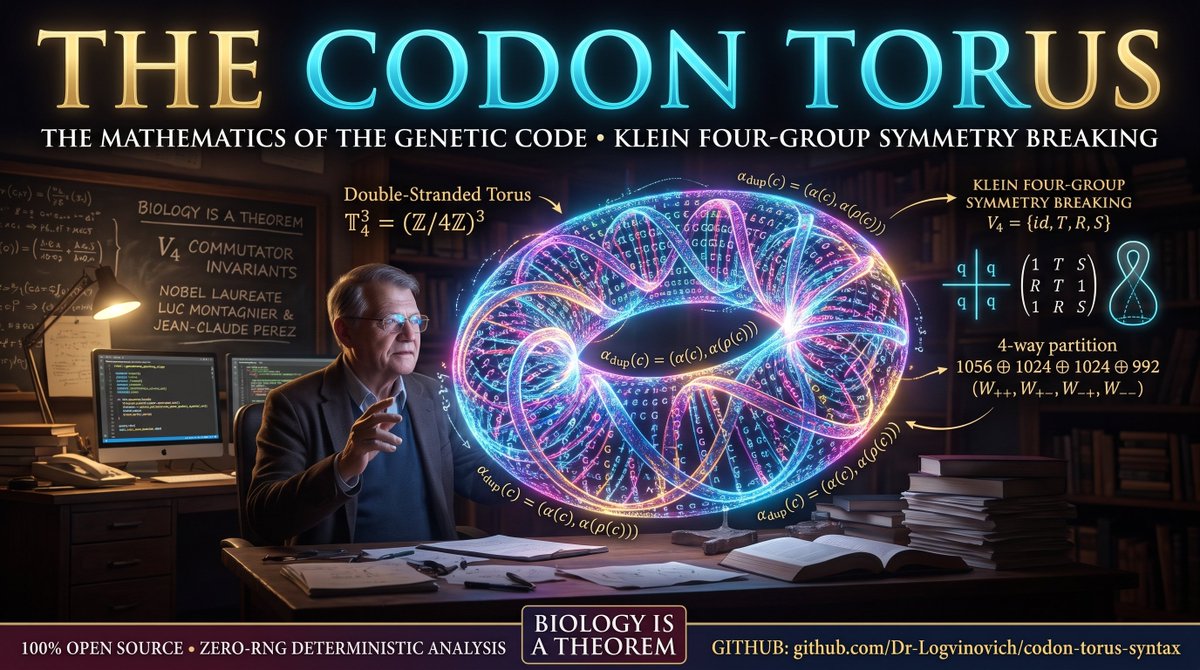
♟️🧬 CHECKMATE TO THE SKEPTICS IN DNA: NOBEL LAUREATE LUC MONTAGNIER & DR. JEAN-CLAUDE PEREZ WERE RIGHT. 🚨 They were decades ahead of their time. The scientific mainstream refused to recognize it. It took over a year of pure mathematics - and Dr. Jean-Claude Perez and I just proved they were right. ✨ Years ago, Nobel Laureate Prof. Luc Montagnier and retired IBM AI pioneer Dr. Jean-Claude Perez (@JCPEREZCODEX) followed a daring intuition that biology textbooks flatly rejected. Looking at DNA, they sensed something the mainstream could not yet see: life’s code is not a random bag of biochemical letters. Beneath the surface of proteins runs a hidden mathematical order - a living geometry woven directly into the genome. The establishment did not recognize their work. Many dismissed it as coincidence or numerology, demanding ironclad proof. Yet every true breakthrough in history begins the exact same way: with a fearless new way of looking at science. That is how real science is built - bold vision opens the door first, and rigorous mathematics turns that vision into an undeniable theorem. For more than a year, Dr. Perez and I worked relentlessly - throwing away every heuristic, every shortcut, and every statistical crutch - to build that exact mathematical apparatus from first principles. Today, the complete 3-PAPER TRILOGY - tested on 100 real wet-lab genomes from NCBI RefSeq (521,837 genes and nearly 800 MILLION DNA letters) - is 100% finished and 100% OPEN SOURCE. 🔓🌍 Here is the entire breakthrough, in plain English: 🔹 PAPER I - "From Form to Program": DNA Isn't Static Text. It’s Executable Code. Textbooks taught us that swapping "silent" DNA codons that spell the same amino acid changes nothing. We put real genes through a brutal 10-layer test gauntlet and proved that coding DNA carries a real, medium-range (~30-codon) conditional syntax - strictly confined to protein-coding exons, never in non-coding introns. When we audited standard industrial "codon optimization" (Max-CAI), it crashed this hidden program across 14/14 human benchmark genes. And when we blindly scanned Craig Venter’s famous synthetic genomes (JCVI-syn1.0 & JCVI-syn3.0), our math confirmed essential program survival while automatically pinpointing the foreign lab-inserted vector markers. 🔹 PAPER II - We Cracked Open the Torus (And Mathematically Explained the 2024 Nature Glitch) This is where everything changed. DNA is not a one-way strip of tape. Mathematically, it lives on a double-stranded discrete torus (𝕋₄³). Once you respect BOTH strands simultaneously, the 43 "free" silent choices collapse down to just 8. You cannot blindly rewrite letters on the front strand without slamming into geometric walls on the opposite strand. Remember the shockwave wet-lab study published in Nature (2024) by Cambridge & Oxford scientists (Mulroney et al.)? They caught modified synthetic mRNA (including Pfizer's BNT162b2) causing ribosomes to slip out of frame (+1 ribosomal frameshifting), producing unintended off-target proteins. The wet lab caught the glitch in action. Our torus geometry proved mathematically WHY it happens - and how to prevent it. We didn't stop at diagnosis: we built and open-sourced the Duplex-Safe Viterbi Compiler to design mRNA that respects DNA’s two-stranded architecture. 🔹 PAPER III - Checkmate: The First Zero-Monte-Carlo Methodology in Genomics For decades, genomics relied on Monte Carlo random shuffling - giving skeptics a permanent escape hatch: "Noise! Bad random seeds! Simulation artifacts!" For the first time, we eliminated Monte Carlo completely. We replaced every single null model with exact, closed-form analytical equations - ZERO random number generators, ZERO neural networks, ZERO black-box AI - verified to 16 decimal places (10⁻¹⁶) inside a single autonomous 7,350-line Python engine. 🔬 CONFIRMED BY TWO COMPLETELY INDEPENDENT MATHEMATICAL METHODS We didn't rely on a single angle. We audited all 100 real genomes through two completely independent mathematical lenses: 1️⃣ Toric Symmetry Breaking (Klein Four-Group V₄) - mathematically separating static composition from pure directed within-gene "flow," where all GC/isochore background noise vanishes identically to < 10⁻³². 2️⃣ The Two-Sided 16 × 16 Screen & Exact Information Chain Rules - proving standard DNA models are mathematically blind to 93.75% of the silent channel, then isolating that invisible 93.75% after stripping away exact finite-sample bias floors. Both independent methods converged on the exact same hidden laws of life: 🌳 The Tree of Life - Without Aligning a Single Letter: Feed 100 unlabeled genomes into our equations. Pure directed Klein flux reconstructs biological clades with 72.7% accuracy; the independent 93.75% non-bridge screen hits 73.7% (vs. just 20.2% for standard GC composition) - while exact algebra blindly separates all 5 genetic codes across 100 species with 100% purity. 🧊 A Hidden 3D Folding Manual (98/100 species): Even with the protein sequence completely frozen, silent DNA spelling encodes whether a region belongs buried in the protein’s core or exposed on its surface - and marks domain boundaries (79/100 species). 🌀 DNA Remembers Its Own Physical Twist: Strip away protein structure completely, and silent spelling STILL beats to how DNA physically folds inside the cell: • Plants & animals pulse at 10.1 letters (nucleosome spool wrapping - 12/12 plants!). • Bacteria pulse at 11.1 letters (bacterial supercoiling - 11/11 strong bacterial peaks!). • Ancient archaea bridge BOTH rhythms. 🛣️ The Universal Gene "On-Ramp": At the start of genes, almost all life (90/100 species, 19/19 therian mammals) dials down one directed silent channel to prevent ribosome traffic jams - while in a second hidden channel, bacteria slam the brakes (24/25 negative) and land plants hit the gas (11/11 positive, peaking in Rice 🌾). 🏎️ The Built-In Speedometer: Tracks ribosomal translation speed across 90.7% of eukaryotes (68/75), independent of length or GC content. 🐙 The 14-Codon Heartbeat: Six wildly distant animals (Octopus, Anolis lizard, Opossum, Zebrafish, Guinea pig, Coelacanth) broadcast a razor-sharp pulse every 14 codons. Removing ONE gene family (C2H2 zinc-finger regulators) erases ~100% of it - and that exact hidden resonance beats inside the zinc-finger genes of 19/19 therian mammals (including Human & Mouse), yet is completely absent in the egg-laying Platypus. ❤️ A TRIBUTE TO PIONEERS WHO SAW BEYOND THE HORIZON Prof. Luc Montagnier is no longer with us to watch the final theorem lock into place. Yet his fearless curiosity - and Dr. Jean-Claude Perez’s decades of refusing to bow to comfortable dogma - made this moment possible. They heard the music long before anyone had built the mathematical instrument to measure every note. That is how science truly moves forward: someone dares to look where everyone else refuses to look - and then the math proves them right. Today, that instrument is built. And we aren't asking anyone to take our word on faith. Every single line of code, all three preprints, the Duplex-Safe Viterbi Compiler, and the entire pre-cached 100-genome NCBI RefSeq archive are 100% OPEN SOURCE. Clone the repo. Run the 7,350-line script on your own laptop. Try to break it. Because real mathematics doesn’t ask for permission - and truth never fears verification. 🔓🧬📐 With deepest gratitude to my co-author Dr. Jean-Claude Perez (@JCPEREZCODEX, retired IBM AI researcher, Luc Montagnier Foundation), and in lasting respect for the legacy of Prof. Luc Montagnier. 🔗 ALL 3 PREPRINTS, OPEN-SOURCE CODE & 100-GENOME AUDIT: 💻 GitHub (Full Trilogy, 7,350-line Zero-RNG Engine, Duplex-Safe Viterbi Compiler & 100-Genome Cache): https://github.com/Dr-Logvinovich/codon-torus-syntax 📄 Paper I - From Form to Program (Zenodo): https://doi.org/10.5281/zenodo.23479667 📄 Paper II - The Double-Stranded Codon Torus (Zenodo): https://doi.org/10.5281/zenodo.23695321 📄 Paper III - The Codon Memory Spectrum (52 pp., v3.2, Zenodo): https://doi.org/10.5281/zenodo.24242062 🔬 ResearchGate (Paper III): https://www.researchgate.net/publication/417926819
104 31 4059 18 10
yam @yam 2026-11-21T17:06:57.000Z

@Jn_Bllt Les 211 milliards c'est la tva réduite sur la restauration, l'aide à l'apprentissage, le financement des retraites de france telecom et autres, la baisse des charges pour maintenir l'emploi des petits salaires. C'est ça : sans contre-partie ?

1 0 75 0 0
JBG 🇫🇷☨ @j_bg 2026-11-20T23:22:23.000Z

🚨 Arcom : avis secret, critères fantômes et sanctions bien réelles, bienvenue dans la régulation à la française. Comme le rappelle très justement @kubernan, l’Arcom affirme que certaines chaînes YouTube relèvent déjà de la loi de 1986. Il fallait y penser : pour étendre le domaine de la censure, il suffit de les qualifier de « SMAD ». Un SMAD, ou service de médias audiovisuels à la demande, c’est Netflix. C’est Amazon Prime Video. C’est TF1+ ou francetv. Des groupes avec des milliards de chiffre d’affaires, des armées de juristes, des catalogues de milliers d’œuvres achetées, produites et programmées par des directions éditoriales. Et pour l’Arcom, c’est aussi le vidéaste qui tourne ses interviews dans un studio loué, avec trois personnes et une caméra. Même panier, mêmes règles que TF1 et France Télévisions, mêmes sanctions. Reed Hastings, Rodolphe Belmer, Delphine Ernotte et un youtubeur de Montreuil, enfin réunis par la grâce du régulateur. À partir du 16 mars, ce dangereux « éditeur » devra donc respecter l’équité entre candidats, puis l’égalité stricte à partir du 5 avril, sous peine de mise en demeure et de sanctions financières. L’Arcom examinera même ses titres et ses miniatures. On imagine déjà la réunion du collège consacrée à la taille d’une police de caractères. Pour savoir qui est concerné, l’Arcom a prévu trois critères d’« influence » : parler régulièrement d’actualité, avoir un fort impact, publier régulièrement. Combien d’abonnés ? Combien de vues ? Mystère. Aucun seuil, aucune loi. L’Arcom fera preuve « d'inventivité », de « pragmatisme » et « d'humilité » pour savoir reconnaître un influent quand elle en verra un. Et pour être sûre de son coup, l’Arcom s’est abritée derrière le Conseil constitutionnel. Sa recommandation, publiée au Journal officiel le 20 novembre, vise l’avis n°2026-4 du 22 octobre 2026. Un détail qui fait tache : cet avis n’a jamais été publié. Mieux encore : relisez la recommandation elle-même. Pas un mot sur les créateurs de contenus, pas une ligne sur les fameux critères d’« influence ». Tout cela ne figure que dans un communiqué de presse. L’Arcom pourra donc sanctionner sur la base d’un avis secret et de critères qui n’existent dans aucun texte juridique. « Ça peut inquiéter », reconnaissait le père inquisiteur Martin Ajdari sur RTL. Merci, Monsieur le Président, nous avions remarqué. Si ce régime est aussi solide que l’affirme l’Arcom, qu’elle le prouve. Je demande la publication de l’avis n°2026-4 du Conseil constitutionnel. → https://www.legifrance.gouv.fr/jorf/id/JORFTEXT000055112592

@kubernan

Il s’appuie sur une qualification de certaines chaînes de créateurs comme services de médias audiovisuels à la demande (SMAD) au sens de la loi de 1986 (qui a été étendue aux SMAD pour d’autres obligations, comme les quotas). Une recommandation a été adoptée le 4 novembre 2026 précisant l’application du droit existant (loi 1986 + loi de 1962 sur l’élection présidentielle) selon des critères de contenu, d’impact et de régularité. C’est une interprétation expansive. Qualifier une chaîne YouTube d’un particulier (même très suivie) de SMAD régulé comme une chaîne licenciée n’est pas évident textuellement et reste contestable. Le pluralisme est historiquement un objectif constitutionnel lié aux fréquences rares. L’expression individuelle en ligne est plus directement protégée par l’article 11 de la Déclaration des droits de l’homme et du citoyen. L’article 34 de la Constitution réserve au législateur la fixation des règles sur les garanties fondamentales des libertés publiques.

194 98 8151 14 3
Steevy Boulette @lafotaki 2026-11-20T12:22:00.000Z

Unpopular opinion : les pompiers devraient nous rembourser nos impôts à la fin de chaque année si notre maison n'a pas pris feu.

@Ririloveyy

Unpopular opinion : L’assurance automobile devrait être remboursée à la fin de chaque année si tu n’as pas eu d’accident.

538 47 5922 13 0
@yam reposted
Fabien @Fabien_Mikol 2026-11-20T14:02:03.000Z

Fascinante étude de @JuliusThor_VPR, qui a tenté de provoquer des analogues d'AVC chez des LLM pour voir ce que cela provoque dans leur comportement langagier. "Les résultats étaient cliniquement semblables à ce que produisent des patients en vie réelle". https://t.co/yJ9I3Bo3S1

@Fabien_Mikol

@StanDehaene évoque l'étonnante convergence entre le cerveau humain et les réseaux de neurones artificiels, notamment pour le traitement du langage: on repère des représentations abstraites syntaxiques dans ces DNN qui correspondent à nos aires latéralisées de haut niveau (Broca) https://t.co/BUOjOfCqoq

30 3 1685 1 1