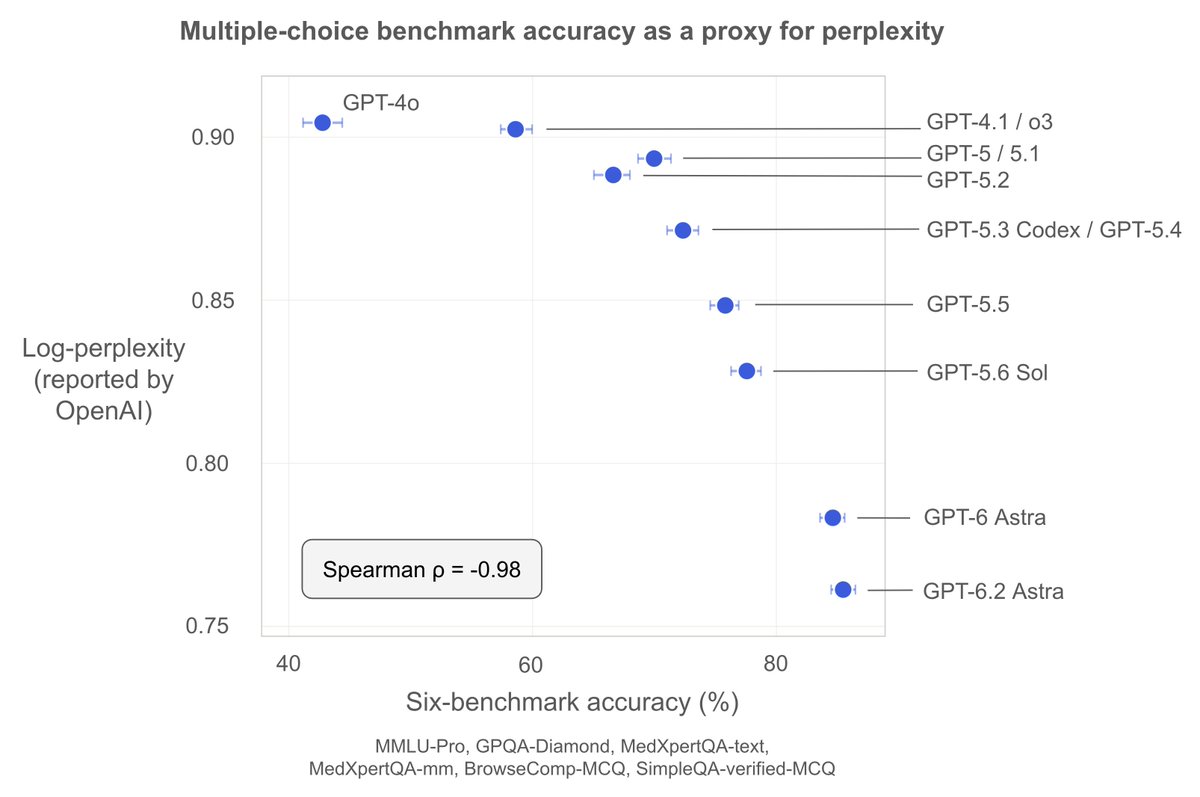
In "Perplexity and Intelligence", Jakub argues for perplexity as a shared metric for intelligence. The post showed how the perplexity of OpenAI's models improved, but did not release a dataset for the community to use.
In this blog post we show that simply taking the average of six multiple-choice benchmarks gives results that are strongly correlated with OpenAI’s reported perplexity results. The six benchmarks cover a broad diversity of domains and are challenging: MMLU-Pro, GPQA-diamond, MedXpertQA-text, MedXpertQA-mm, BrowseComp-MCQ, and SimpleQA-verified-MCQ.
Multiple choice benchmarks of this nature offer a strong proxy for perplexity because they require both world knowledge and some reasoning, which are correlated with compression and hence intelligence. We run these benchmarks using the lowest reasoning strength available, in order to be closest to how perplexity measurement does not use chain-of-thought reasoning.
In addition to being simple, our proposed proxy for perplexity is cheap to run. On a subset of 1,700 questions, running GPT-6.2 Astra costs just $7, with the full set costing $37.
We agree with Jakub that perplexity is a good shared metric for intelligence and we hope this proposed proxy provides a starting point for the community to measure it.
https://www.mercor.com/blog/a-simple-proxy-for-perplexity/