Vasudev Bailey, PhD (@vasudevbailey)

Vasudev Bailey, PhD @vasudevbailey 2026-11-26T06:39:05.000Z

Such incredible stuff here. Worth a pause and read 👏

@iScienceLuvr

Today we release ReadyNeuro, the largest open fMRI pretraining dataset! fMRI lets us watch brain activity in a noninvasive way. Foundation models trained on fMRI could help us better understand neurodegenerative diseases and mental disorders. Previous fMRI foundation models (including our own CortexMAE) have been data-limited, training on datasets with limited scale and diversity. We've turned OpenNeuro, the largest archive of fMRI scans, into a pretraining-ready corpus. We pretrained CortexMAE-ReadyNeuro on this dataset, beating HCP-YA pretraining on 3 out of 7 tasks. We release all of it open-source to enable further fMRI pretraining research.

3 0 423 1 0
Neurofounders @neurofoundersco 2026-11-18T18:54:28.000Z

Hey neurotech community! We are pretty new to X, and I (Dominic) have no clue how it works. Shouldn't be harder than neuroscience, right? Could you help us out by tagging the best accounts to follow in the neurotech community!

24 0 2534 6 1
@vasudevbailey reposted
Tanishq Mathew Abraham, Ph.D. @iScienceLuvr 2026-11-17T18:56:36.000Z

Very interesting NON-INVASIVE mind-reading demo from Alljoined! Real-time decoding of what a person is attending to, using EEG! Before founding Alljoined, @jonxuxu worked with us on MindEye2, great to see members of the "MedARC mafia" do amazing things!

@alljoined

Introducing AIR-O, a model that decodes what a person is attending to directly from brain scans. Using only noninvasive brain data, we can generate an image from scratch in real time that depicts where a person is focusing their attention. This is the first of a new generation of algorithms that can read the shape of thoughts directly from brain activity.

105 7 7507 6 1
@vasudevbailey reposted
Alljoined @alljoined 2026-11-17T17:00:00.000Z

The signal we're using in this demo is 10x weaker than what Neuralink is using today. Brain activity is very hard to read non-invasively because neurons emit very small voltages and by the time it propagates outside the skull it’s almost all noise. But we believe that deep learning can extract signal from this noise and our deep learning models make sense of the smallest fluctuations to create a representation that computers can use.

185 10 18376 4 1
Vasudev Bailey, PhD @vasudevbailey 2026-11-17T17:08:04.000Z

This is 🤯. Great stuff @jonxuxu

@alljoined

Introducing AIR-O, a model that decodes what a person is attending to directly from brain scans. Using only noninvasive brain data, we can generate an image from scratch in real time that depicts where a person is focusing their attention. This is the first of a new generation of algorithms that can read the shape of thoughts directly from brain activity.

2 0 185 0 0
Archie McKenzie @archiemckenzie_ 2026-11-10T16:44:18.000Z

General Translation has raised $27m led by @martin_casado at @a16z to localize the world’s best companies. Today, @generaltxn serves Ramp, Cursor, and Sierra by translating apps, sites, docs, slide decks, and even product videos into dozens of languages. a16z invested alongside @upfrontvc, Peter Thiel, Fei-Fei Li, and more. 🧵

656 63 170432 174 51
@vasudevbailey reposted
Paul Graham @paulg 2026-10-08T01:47:16.000Z

Amazon banning agents is the first opportunity I've seen since Amazon was founded for a startup to create an Amazon competitor. People will want agents to buy stuff for them. It will be one of the main use cases. And they won't want to use some Amazon-supplied agent to do it.

12919 675 6164541 1502 672
@vasudevbailey reposted
Anish Moonka @anishmoonka 2026-09-13T08:30:00.000Z

Stretching before exercise does not prevent injuries. A 2014 meta-analysis of 26,610 participants in the British Journal of Sports Medicine found that stretching had no effect on injury rates at all. Strength training cut injuries by a third. The study was led by Jeppe Bo Lauersen at the University of Copenhagen. His team pooled every randomised trial that tested whether exercise-based programmes could prevent sports injuries, and compared the results by type: stretching, strength training, balance work, and combinations. Stretching reduced nothing. Strength training reduced injuries by 33 percent and cut overuse injuries, the ones that build up slowly over weeks, by nearly half. The reason stretching fails is that it addresses the wrong problem. A muscle tear happens when a muscle is asked to produce more force than it can handle. Making a muscle longer does not make it stronger. Strength training does, and it also thickens tendons and stiffens the connective tissue around joints, all of which protect against the sudden loads that cause tears and sprains. The finding goes against what every gym teacher, track coach, and physical therapist has said for fifty years. But the data is not close. Across every trial, every sport, and every injury type, stretching before exercise had zero detectable effect on whether the person got hurt. This does not mean flexibility has no value. It means the five-minute hamstring stretch before a run is doing nothing for injury prevention, and replacing it with five minutes of bodyweight squats and lunges would be measurably better. The body does not need to be looser before it works. It needs to be ready to handle load, and that is a strength problem, not a flexibility problem. https://pubmed.ncbi.nlm.nih.gov/24100287/

722 133 416547 35 35
Vasudev Bailey, PhD @vasudevbailey 2026-09-07T21:58:06.000Z

@noahrshinn genuinely one of the best products I’ve used in the first few weeks since maybe @vladtenev From meeting invites to fighting for lost hotel points to hard to get restaurant res…suddenly feel like I got more time to do useful stuff. 👏

3 0 466 2 0
@vasudevbailey reposted
Daniel Tawfik @dantawfik 2026-08-20T19:00:08.000Z

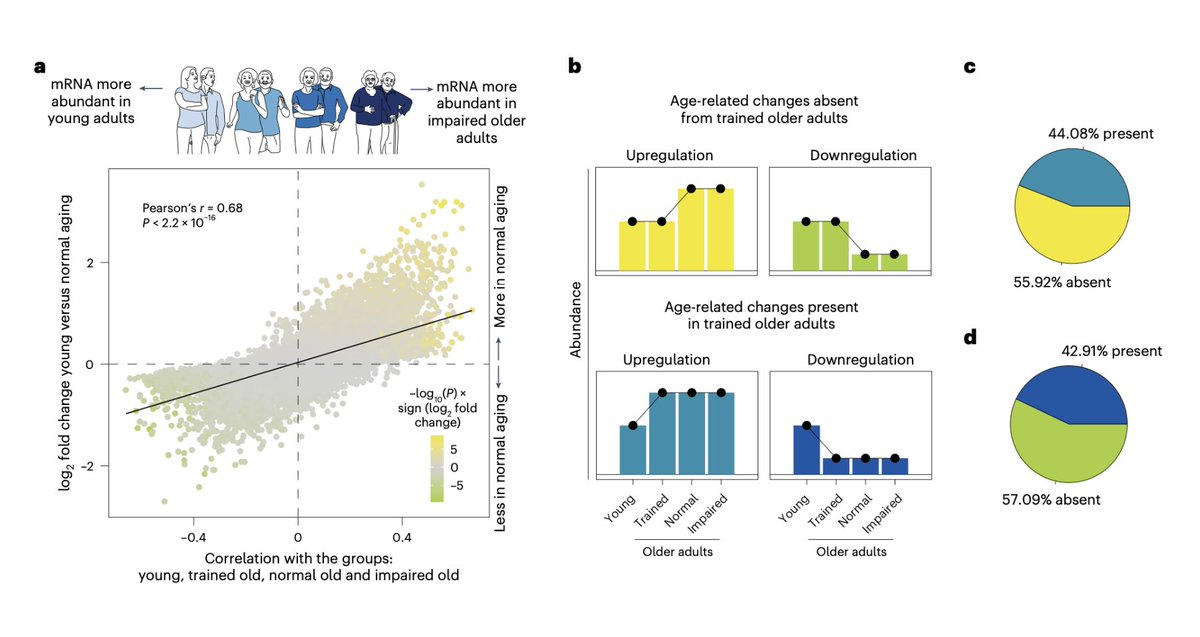
Most exercise and aging studies can't answer a basic question: is muscle deterioration from aging itself, or just from decades of moving less? A new Nature Aging study solved this by recruiting older adults who moved as much as people in their twenties. The researchers from Amsterdam UMC and Maastricht University recruited four distinct groups: young adults in their twenties, older adults whose daily step counts and high-intensity activity matched the young group, older adults who had trained consistently for years (three structured hour-long sessions per week for over a year), and older adults with early physical impairment. They took muscle biopsies before and after a one-hour cycling session, then measured over 24,000 gene transcripts, 135 metabolites, and 1,383 lipid species. By matching activity levels between young and older groups, any molecular differences couldn't be blamed on the older adults simply moving less. This isolated aging from inactivity for the first time at this molecular depth. Key findings: • The defining molecular signature of muscle aging is an energy crisis. Comparing young adults to activity-matched older adults, 1,106 genes were downregulated with age. These genes build the mitochondrial machinery that produces cellular energy: ATP synthase, cytochrome c oxidase, and NADH dehydrogenase subunits. Mitochondria are the power plants of cells, converting nutrients into ATP, the energy currency cells use to function. When these genes decline, cells lose their ability to generate energy efficiently. • NAD+ levels declined and triglycerides accumulated inside aging muscle. NAD+ is a molecule required for energy production and cellular repair. Lower NAD+ means less capacity to convert fuel into usable energy. Triglycerides are stored fats, their accumulation inside muscle indicates unburned fuel piling up as the tissue loses its ability to process it. • More than half the molecular signature of muscle aging was absent in trained older adults. Specifically, 57.1% of age-related gene downregulation and 55.9% of upregulation were missing in the trained group. Their muscle resembled young adults far more than their chronological age would predict. • The changes training preserved were specifically the energy metabolism ones. Genes like NDUFS1 and COX5A, which were depleted in normally active and impaired older adults, sat at youthful levels in the trained group across all five mitochondrial respiratory complexes. The single most prominent feature of muscle aging turned out to be the single most preventable. • Being generally active was not enough. Structured training was the difference. The normally active older adults walked as much as young adults, and their energy metabolism genes declined anyway. What preserved the youthful molecular profile was structured, sustained training. Filling a step counter and being genuinely trained are not equivalent at the molecular level. • Roughly half of muscle aging persisted regardless of training. Changes in genes controlling synaptic transmission (how nerves communicate with muscle) and WNT signaling (a pathway regulating tissue maintenance and stem cell function) appeared in all older adults, trained or not. This unavoidable half is where drugs will have to work. • The fittest muscle mounted the largest inflammatory response to exercise. All groups activated stress and immune genes after exercise, including IL6, IL1B, and TNF. But the magnitude scaled with fitness. Trained older adults most closely resembled young adults in their response, followed by normally active, with impaired older adults showing the most blunted response. The stress response to exercise appears to be the mechanism of adaptation, not damage to be minimized. This raises a concern about anti-inflammatory longevity strategies. If the inflammatory stress response is how exercise produces its benefits, chronically suppressing inflammation may blunt the adaptation that exercise depends on. It doesn't mean inflammation is beneficial in general, but the timing and context matter. A separate discovery: the proteasome appears to regulate NAD+. The proteasome is the cellular machinery that breaks down damaged proteins. When researchers inhibited it, NAD+ levels rose in both muscle and liver cells to a degree comparable to NAD+ precursor supplements. This opens a new route to understanding NAD+ decline that operates through protein turnover rather than just supplying more raw material. The study draws a clear line between what lifestyle can address and what will require therapeutics. The energy metabolism decline, mitochondrial deterioration, and NAD+ depletion that define muscle aging are largely preventable through structured training. The synaptic and signaling changes that persist in all older adults represent the unavoidable half where drugs will need to work. The decisions made about structured training in midlife determine which molecular trajectory muscle follows in later decades. Half of muscle aging is optional. The other half isn't. Knowing which changes belong to each category is knowing where behavior ends and biology takes over.
851 174 75177 36 19
@vasudevbailey reposted
Vinod Khosla @vkhosla 2026-07-19T01:48:11.000Z

It's sad to see how much we are hurting the USA in future competitiveness and talent! Most people don't realize how much of tech innovation and hence GDP growth comes from foreign talent in the USA. Innovation and GDP growth is sure to decline.

@HooverInst

US visas issued to international students fell by roughly a third in 2025. Today, DHS finalized changes to a rule known as "Duration of Status" — a move that will help lock that decline in place. The fallout for the STEM workforce, innovation, and economic growth could be severe. A sustained one-third decline in foreign STEM graduates entering the US labor force would shrink the high-skill STEM workforce by 6.2% overall and by 11.5% at the PhD level. Over a decade, that would cut annual US GDP by $240 billion to $481 billion, comparable to losing an entire state's economy. That's the estimate from @AmyMNice, in a guest research brief for Hoover's Immigration Initiative, drawing on research she co-authored with @m_clem and @JeremyLNeufeld. Read the full brief: https://www.hoover.org/research/breaking-front-door-international-stem-talent-pipeline-will-erode-americas-competitive

1560 132 277902 229 21
@vasudevbailey reposted
Derek Thompson @DKThomp 2026-05-31T15:38:25.000Z

This has quietly been a miracle month in medicine. In the last 5 weeks we’ve got news on: - retatrutide, the triple agonist GLP-1 from Lilly, basically melting fat and body-wide inflammation at record levels - RevMed’s new pancreatic cancer drug showing unprecedented abilities to extend life - small trial of a one-and-done PCSK9 gene editing therapy for slashing LDL cholesterol - Mayo’s AI-assisted radiology showing vastly improved cancer detection - this new therapy for metastatic solid tumors This stuff is at varying levels of evidence. Retatrutide is ~100% on its way, other stuff needs more clinical trial data. But put it together and we’re maybe on the verge of majorly reducing the mortality of heart disease and cancer, the two leading causes of death in America.

@cremieuxrecueil

This is actually insane. 97% of people taking the standard of care for metastatic solid tumor got worse by seven years. But with lorlatinib, that number was only 45% in the same time! This is an ENORMOUS jump in the quality of cancer care. https://t.co/pDQsf7SoyR

11713 1909 2937192 213 154
Anish Koka, MD @anish_koka 2026-05-25T17:01:05.000Z

Why in heavens would you permanently gene edit something that there are cheap , safe, effective reversible options for? Especially bc the PCSK9i story is that despite very low LDLs you still have a 13% residual risk of a coronary event? This is a salvage operation for a therapy that is almost no value except for hyper rich influencers who while not salivating over unneeded gene therapies are getting stem cell infusions from Himalayan mountain goats.

@cremieuxrecueil

Eli Lilly has done it. They've gone and made what seems to be a powerful, permanent gene therapy for LDL cholesterol. That means they'll be able to effectively prevent most heart disease with a single infusion! https://t.co/vkiRyT1m4G

184 14 98461 61 4
@vasudevbailey reposted
Afshine Emrani MD FACC @afshineemrani 2026-05-26T02:15:40.000Z

1/5 I'm a cardiologist. I have spent twenty years watching cholesterol destroy arteries, trigger heart attacks, and kill people I care about. Today, Eli Lilly presented data that may begin to end that era. VERVE-102. A single infusion. One dose. It uses base editing to permanently turn off the PCSK9 gene in your liver. Presented today at the European Atherosclerosis Society Congress: 88% reduction in PCSK9. 62% reduction in LDL cholesterol. Sustained up to 18 months. No treatment-related serious adverse events. One infusion. Not daily pills you forget to take. Not monthly injections. One dose — and your cholesterol may stay low for the rest of your life.

6761 877 1875116 280 187