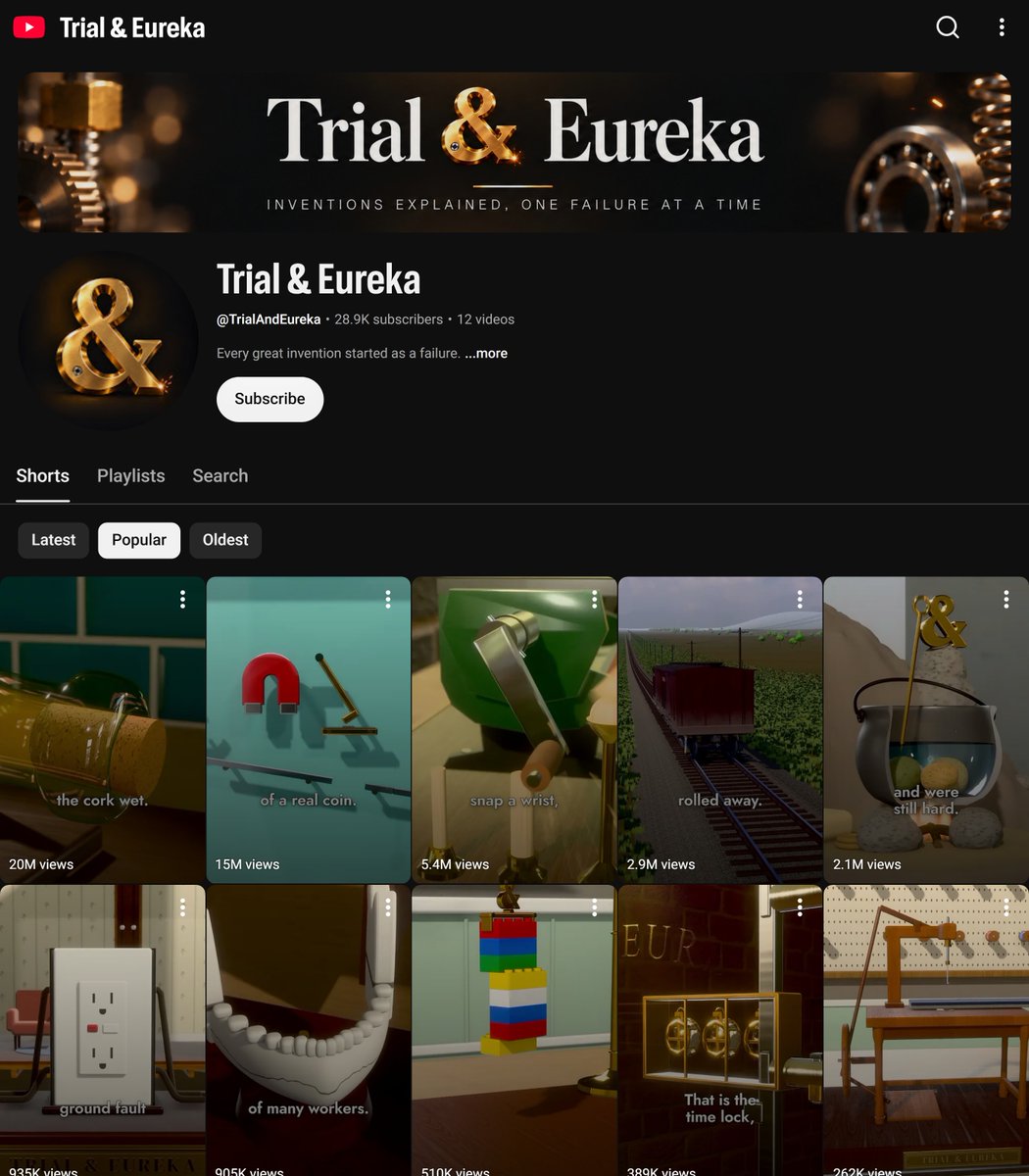
15.9M views on Trial & Eureka's Short about CHEATING vending machines
a Claude prompt to make one like it ↓
<inputs>
Ask me 3 things, then wait:
1. The everyday thing ("elevators", "matches", "zippers") or a finished title in this formula: Why + an everyday thing + "Used to" or "Old" + what went wrong ("Why Elevators Used to Need a Driver"). If I say "you pick", pitch 3 true ones with each old problem in one line (skip soda bottles, vending machines and car starters: those Shorts exist) and take the first unless I choose.
2. The voice. Default: Kokoro (free, runs on my computer), a calm male narrator: blend am_liam and am_puck 50/50 (average the two voice style arrays), speed 1.0. Optional upgrade: ElevenLabs with a stock library voice. I put my own key in a .env file myself; tell me the credit cost before you generate and make one take.
3. A short name for the brass plaque under the object (my channel name), or "none".
Then tell me everything else is free and installs itself into this folder: a Python venv with Playwright + headless Chromium, kokoro-onnx (+ kokoro-v1.0.onnx and voices-v1.0.bin from the kokoro-onnx GitHub releases), faster-whisper (small.en), imageio-ffmpeg, numpy, Pillow and soundfile, plus three.js from npm (npm i three; without Node, download the three package's tarball from http://registry.npmjs.org and unpack it) and the Jost variable font from the google/fonts GitHub repository (ofl/jost). Set PLAYWRIGHT_BROWSERS_PATH and whisper's download folder so the browser and the model land in this folder too. If a download fails, tell me which one and carry on with what works offline: a system sans for the font, the software renderer for the graphics card. It needs no API key or account and never opens a 3D program.
</inputs>
<direction>
The look: ONE everyday object as a glossy desk model on a small stage, lit like a product shot. The object is rebuilt in front of the viewer, one failed fix after another.
- The stage never changes: a wooden table top (3 m wide, 2.5 m deep: keep the camera within 45 degrees of straight on, so it never sees past an edge) in front of a wall of glossy metro tiles (10 x 5 cm, pale grout) in one deep colour that makes the object stand out (teal #0c5a57, oxblood #6b1f1a or navy #1c2f55). The object stands on a low wooden plinth (4 cm high, a little wider than the object) with a brass plaque on its front face that carries my name. Wood grain and tiles are small canvas textures you draw in code. Wood fills the frame below the object in every medium shot. In close-ups, nothing black shows at the bottom of the frame.
- The object: built in code from simple solids (lathe profiles for round things, rounded boxes, cylinders, tubes, extruded shapes), in metres. It stands 0.25-0.6 m tall, so shrink big things to a desk model (a lift shaft becomes a 0.6 m cutaway tower). Before you model, list the 6-10 parts people know the thing by (for a lift: the car, its folding gate, the cables, the counterweight, the floor doors, the dial over each door) and build every one, so it reads as the real thing at a glance. Glossy paint (clearcoat) in two colours: one strong body colour and a pale trim, plus brass and steel details and real glass where the real thing has glass. A cutaway is an open frame of posts and floors with a side left off, so the mechanism is the picture: keep big blank panels out of it.
- People never appear. A hand, a wrist or a passenger is a plain wooden peg on a brass foot.
- Light: ACES filmic tone mapping at exposure 0.85. Reflections come from three's RoomEnvironment through PMREM at intensity 0.3. One warm spot light (#ffd9a8, intensity 20 with three's default decay, cone angle 0.3, penumbra 0.8, soft shadows) shines from the upper left front, 1.6 m from the object. Raise or lower it on stills until the pale trim sits just under white. Add a cool fill (#9fc4ff, 0.45) from the front right and a hemisphere light at 0.08, so the shadow side keeps its colour. A closed space the spot cannot reach (the inside of a car, a cabinet) gets its own small warm lamp. The result is a pool of warm light on the object with the wall falling into the dark around it.
- Depth of field on every shot (BokehPass, focus on the part being named; start at aperture 0.02 and maxblur 0.018 and tune on stills): the wall is always soft, the whole object stays sharp and the grout lines never double. A soft dark vignette is drawn over the corners on the 2D canvas.
- The old problem HAPPENS in the first 2 s: on frame 1 the object is already failing (it topples, leaks, kicks back, jams) and by 2 s the failure is complete.
- Every "But" is acted out by the object itself: the part that fails moves, breaks or pulses red. Every "So" changes the SAME object on the word that names the fix: the new part drops, slides or screws in with a small bounce. Something moves at least every 1.5 s.
- Camera: one slow push-in or drift per shot, never still, on a 30 degree lens. A hard cut comes every 3-6 s on the first word of a sentence. A sentence shorter than 3 s shares its shot with the next one. Alternate a medium shot (the whole object on its plinth with the plaque in view, together filling 50-60% of the frame's height) with a close-up of the part being named. A close-up holds that part and what it is fixed to, a quarter to a half of the object, so the viewer still knows where they are.
- The 7:8 band: the middle 1234 px of the frame's height (64%) is what a 7:8 crop keeps. The part being named and the captions stay inside it in every shot. The caption covers the bottom fifth of that band, so stage the action above it.
- Captions: up to 4 words at a time (break after every comma, colon and full stop, so "Finally," stands alone; at most 2 lines of 22 characters), written as in the script with its punctuation, white Jost at weight 500, 60 px on the 1080 px-wide frame, a soft dark shadow, no box. They sit centred at 68% of the frame's height. A chunk stays up until the next one starts.
- Banned: photos, footage, downloaded 3D models or textures, logos and brand marks on the object, AI images, AI video, downloaded music, people.
</direction>
<structure>
42-56 s, 125-160 words. Kokoro at speed 1.0 reads about 180 words a minute with the pauses below. The voice starts at 0.0 s. No intro and no title card.
- Title: Why + the everyday thing + "Used to" or "Old" + what went wrong ("Why Elevators Used to Need a Driver"). Use my title if I gave one.
- Line 1 states the old problem flat, with the word "once", in 12 words at most ("Riding an elevator once took a driver in the car.").
- Then one or two short sentences on how the thing worked back then.
- Then 2 or 3 pairs: "But" + one real failure, "So" + the real fix for it. The next "But" is whatever still went wrong. Name the inventor or the company when two sources agree on the name.
- Then "Finally," + the fix that stuck, with two short sentences on how it works in plain mechanical words.
- Then the fix gets its name in one short sentence ("That is the automatic elevator.").
- The last line starts with "Today," and ends in the viewer's own life: the part still does its job every time they use the thing.
- The last line plays over the finished object. In the 1.2 s after the last word the new parts lift away and the object returns to how it stood on frame 1, so the Short loops.
- Sentences of 5-14 words. Never a question, a call to action, "imagine" or "did you know".
</structure>
<build>
Save every stage to disk so a crash never costs more than one stage.
- sources.md: every fact in the script on TWO independent sources, with both links and the date you read them. A fact with one source stays out, names and years included. Where the sources disagree, use the wording both support. If you cannot read the web at all, stop and tell me.
- script.json: the title and the sentences in order. Each sentence lists what the object does, the camera (medium or close-up, plus its move) and the word each animation starts on.
- https://t.co/2ltXAYBEB2: Kokoro reads the script one sentence at a time; trim each take at about -45 dB (keep 30 ms before the first sound) and join the sentences with 0.42 s gaps. faster-whisper (small.en, temperature 0) times every word, one sentence's take at a time with 0.4 s of silence around it (hand it a 16 kHz numpy array). Kokoro reads years and numbers best spelled out, so keep a spoken form for the voice and the digits for the captions. Captions use the SCRIPT's words with whisper's times: align the two word lists, spread a digit token's time over the spoken number words and count words that sound the same as the same word. Write words.json and chunks.json (each caption chunk with its start time). The video ends 1.2 s after the last word.
- scene/index.html + main.js. index.html carries an import map for "three" and "three/addons/" that points at the local copy. One function builds the stage and every version of the object. One function state(t) sets every part and the camera from the time alone: the same frame for the same t on every run (seeded random, never a clock or requestAnimationFrame). Every animation starts on a word looked up in words.json, so a new voice take moves everything with it. window.renderFrame(f) renders frame f through an EffectComposer (RenderPass, BokehPass, OutputPass, plus any pass the stills call for) at 2160x3840, scales it down onto a 1080x1920 2D canvas, draws the vignette and the caption chunk on top and returns a PNG data URL.
- https://t.co/hpj8ttTO16: serves the folder on 127.0.0.1 with .js sent as text/javascript (ES modules do not load from file://), opens the page in headless Chromium at 1080x1920 and saves frames/f_00001.png onward, skipping frames already on disk. Launch Chromium with --enable-gpu --ignore-gpu-blocklist and --use-angle=d3d11 on Windows (metal on a Mac), then print the WebGL renderer string. On a graphics card a frame takes 0.05-0.3 s (a few minutes for the whole Short). On the software fallback a frame can take 10 s, which is hours for the whole Short: tell me the estimate before the full render and offer to draw at 1080x1920 without the 2x step.
- Stills first: a contact sheet with a frame every 2 s and the 7:8 band drawn on every tile. Look at every tile and fix what is off, then check every "But" and "So" at 0.5 s steps, before the full render.
- https://t.co/49eJxversT, numpy only: a soft low pulse as the bed, a short whoosh on every cut, a small tick, pop or thud on every part that moves, all at least 12 dB under the voice (compare the loudest 50 ms of effects with the voice's speech level: its RMS over the frames above -35 dBFS). Master the whole stereo mix to -14 LUFS with a limiter at -1 dB (measure with FFmpeg's ebur128).
- Encode with FFmpeg: out/<slug>_9x16.mp4 (1080x1920, 30 fps, yuv420p, TV range, BT.709: scale=in_range=full:out_range=tv:out_color_matrix=bt709) and out/<slug>_7x8.mp4 (the centre 1080x1234 of the frame scaled to 1008x1152, two-pass at about 1,100 kb/s to stay under 10 MB), plus out/cover.png (the finished object without a caption) and out/title.txt.
</build>
<gotchas>
- Facts: the popular version of an invention story is often half wrong. Check every name, year and number on both sources. A fix that came before the problem in real life cannot follow it in the script.
- Glass: MeshPhysicalMaterial with transmission 1, a small thickness and both sides drawn. Anything seen THROUGH glass (a liquid, a part inside) must be an opaque material: three.js leaves transparent and transmissive meshes out of what glass shows.
- Exposure: bright paint and brass burn out under the key light. Keep body colours at medium brightness (red #b3261e, green #1f6b4a, blue #1e4f8f, yellow #c9950f) and lower the light until every surface keeps its colour on the lit side.
- Edges: build boxes with RoundedBoxGeometry from three/addons (a 2-4 mm radius). The bevel catches the light. Sharp boxes look like cardboard.
- Shadows: THREE.PCFShadowMap with a shadow radius of 5, a 2048 map and a small bias. The spot light's shadow camera must hold the whole object. A part that shades the detail being shown (a slab over a dial) casts no shadow.
- Depth of field: BokehPass takes the focus distance in metres from the camera. Set it every frame to the distance of the part being named and lower the aperture in close-ups until that whole part is sharp.
- Captions and the object: the caption sits over the lower part of the frame, so frame the part being named in the upper two thirds.
- Voice: if whisper hears a different word, reword the sentence instead of slowing down. A word that ends in d, s or t right before a similar sound gets swallowed ("trained driver" comes back as "train driver"), so reword it.
- Cuts: never cut in the middle of a word. A cut lands on the frame where a sentence's first word starts.
- Tools: imageio-ffmpeg ships without ffprobe, so read a file's streams with ffmpeg -i.
- Colour tags: after the scale filter, end the chain with setparams=color_primaries=bt709:color_trc=bt709:colorspace=bt709, or players have to guess.
- Check before you call it done: run a black-frame and one-frame-flicker check on the frames (a flicker is a frame that differs from both neighbours while they match each other). Make a contact sheet of the finished video every 0.5 s and a second one from the 7:8 file, then look at every tile: the object reads as the real thing, every close-up shows what it is a close-up of, nothing black shows under the stage. Run whisper on the finished mp4's sound and compare it with the script: every word heard. Measure both files with ebur128: -14 LUFS within 0.5. Step through the first second frame by frame: the failure is under way on frame 1. Step through the last second: the first object is back. Fix and render again until all of it holds.
</gotchas>
<start>
Pitch (or take my thing), then show me: the title, the facts with their two sources, the script with the word count and the seconds per sentence, then the shot list (what the object does and where the camera is for every sentence). Build nothing until I say go. After go, work through to the finished files without asking me anything else, then tell me what you checked and what you could not check (the sound by ear, for one).
</start>
paste it into Claude Code in an empty folder, answer its 3 questions and say "go"
it took me about 77 minutes on a PC with a graphics card
what it made for me is in the first reply
save this for ur next Short