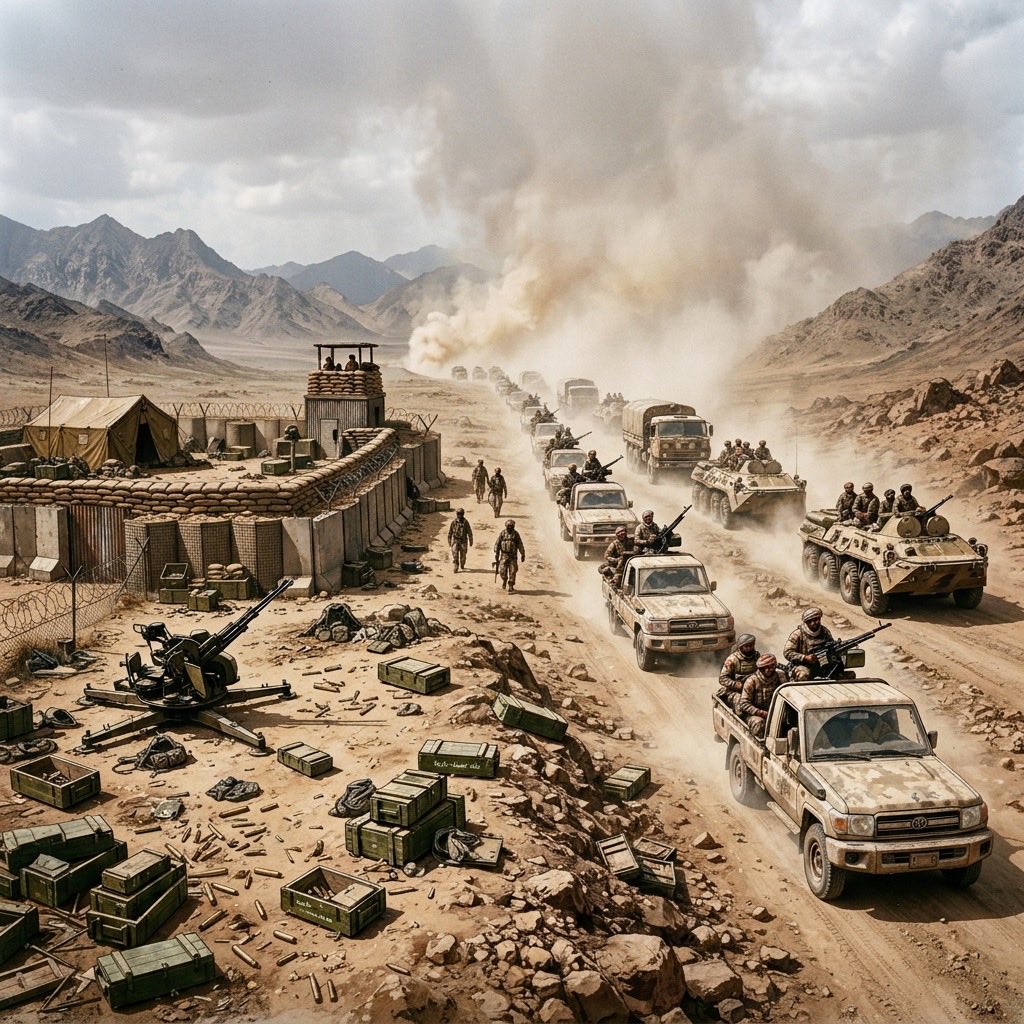
Saudis Run Out of Munitions as Houthis Advance in Large Convoys
The Houthis are advancing toward Aden, the interim capital of Yemen's internationally recognized government, following a resumption of hostilities that shattered a nearly four-year truce.
The Yemeni group has consolidated control over strategic areas surrounding the Bab el-Mandeb Strait, a vital chokepoint for global trade in the Red Sea, after government and Saudi-allied forces pulled back to concentrate troops on the defense of Aden.
To the south, the siege of Taiz is severely compromising critical supply routes for local forces, with no signs of letting up.
Meanwhile, the major Saudi-backed offensive of 100,000 Yemeni troops received only minimal support from the Emirates, ultimately forcing Riyadh into negotiations to limit strikes against its petrochemical complex, agreements that included the participation of Iran, the primary architect behind the renewed conflict in Yemen.
Much of the Houthis' momentum stems from their massive drone strategy. While this includes mini-drones carried by infantry units, it relies primarily on Iranian backing with reconnaissance and combat UAVs, such as the Qasef-1 and Qasef-2K, derived from the Iranian Ababil line, and the Samad-1 and Samad-2, both Iranian designs tailored for Yemen.
The Qasef-1 and Qasef-2K are the drones making the greatest impact on ground combat in southern Yemen. With a range of up to 150 km and a 30 kg warhead, the Qasef-2K variant was modified to detonate mid-air roughly 20 meters above its target, showering shrapnel down onto trenches, artillery, and concentrations of government troops.
While drones and missiles contribute heavily to Houthi superiority, the decisive factor behind their rapid advance is that the war's primary game-changer, the Royal Saudi Air Force, now has its munitions on a strict countdown.
That explains why the Houthis have begun moving far more aggressively in larger convoys across the open desert.
Since the war resumed in July 2026, the Saudi-led coalition has carried out more than 5,300 airstrikes in Yemen.
By the operational standards of modern air campaigns, 5,300 airstrikes translate to an estimated expenditure of 8,000 to 13,200 guided munitions, based on a typical burn rate of 1.5 to 2.5 bombs or missiles per strike. In practice, fighters like the F-15SA and the Eurofighter Typhoon routinely drop pairs of bombs to guarantee target destruction, especially against trenches, ammo depots, and fortified positions.
Under a higher-intensity scenario of up to 4 munitions per strike, that expenditure climbs to 21,200 ordnance units, a realistic figure when missions require salvo strikes against sprawling convoys, port infrastructure like Hodeida, or dispersed launch batteries.
So, what proves the Saudis are scraping the bottom of their stockpiles?
Read the full article:
https://global21.substack.com/p/saudis-run-out-of-munitions-as-houthis?r=7kssds&utm_medium=ios