Josh Sum (@joshsum_)

Josh Sum @joshsum_ 2026-09-15T16:43:08.000Z

today we launch @morphic_io: the sovereign AI platform around one core principle. human knowledge is our most precious asset and needs to compound for the people contributing it. we unlock our potential only when experience does not walk out the door every time someone leaves

370 45 377384 107 57
verrsane @verrsane 2026-11-28T00:18:49.000Z

Nerds need to stop building second brain or sandbox startups and actually start helping enterprises become AI native/save time/money with their product Like literally drive down to Texas and start with the million dollar brick and mortar companies But thenwhen nerds start doing this they start building towards becoming an AI platform and that’s when everything goes downhill

182 6 8799 26 0
himanshu @himanshustwts 2026-11-27T20:27:57.000Z

> be an AI-enabled holding company > raise VC money to buy existing businesses > start creating RL gyms and datasets from acquired enterprise data > sell to labs with good margin funny this has become mandate of heaven to lure VCs.

280 6 18583 13 2
Josh Sum @joshsum_ 2026-11-28T02:53:32.000Z

working toward this but a lot tougher to execute on that it seems > a lot of steps (vcs might not get/trust it) > needs a triple miracle (buy good companies, actually grow the portfolio, sell data) > successfully selling their data is not guaranteed ^ still a legendary opportunity so we’re doing it

2 0 372 0 0
@joshsum_ reposted
Josh Sum @joshsum_ 2026-11-25T17:36:46.000Z

I spent an hour with a $5B private-equity backed insurance group They’ve run 4 AI pilots in the last 18 months. 2 are still technically live but none of them show up in the P&L When I asked why, the answer I got was “the data isn’t ready” But after an hour, it was clear the data wasn’t the problem Every pilot was scoped from the SOP, not from how the work actually happens > On paper, a commercial submission comes in, gets validated, and goes out to carriers. > In practice, it arrives as a scanned ACORD, a forwarded email thread, and a broker who has to make a call to fill in the missing fields. 40% of submissions end up with exceptions but the pilots were built for the other 60% when nothing goes wrong ... ... and still fail for a good number of those cases The pilots also automated the step that demos best. Extracting fields from a PDF looks great in a meeting and saves a few minutes per file. But the cycle time lives in the handoffs: chasing missing information, re-keying into the AMS, waiting on underwriting, coordinating the COI etc. Shaving minutes off each day from a 9-day process still leaves you with a 9-day process. Each pilot was also a sidekick, a chat window that someone had to remember to open -> and each one lived in its own app with its own login, outside the AMS, Outlook, and carrier portals the team actually works in So adoption faded really fast. Finally, nobody on the business side owned any of it. When something broke, the work quietly went back to being manual. What they want now is much clearer. Background agents that pick up submissions, verify policy details, coordinate endorsements and renewals, prepare COIs, and keep the AMS in sync. All of it runs inside their existing systems, every action is permissioned and logged, and people only step in for the judgment calls. Insurance doesn’t need a smarter model or more platforms What it needs are agents that handle the work, on the platforms where it happens -> starting with one workflow, delivering value, before expanding to the rest. That's how we're building with Morphic for insurance
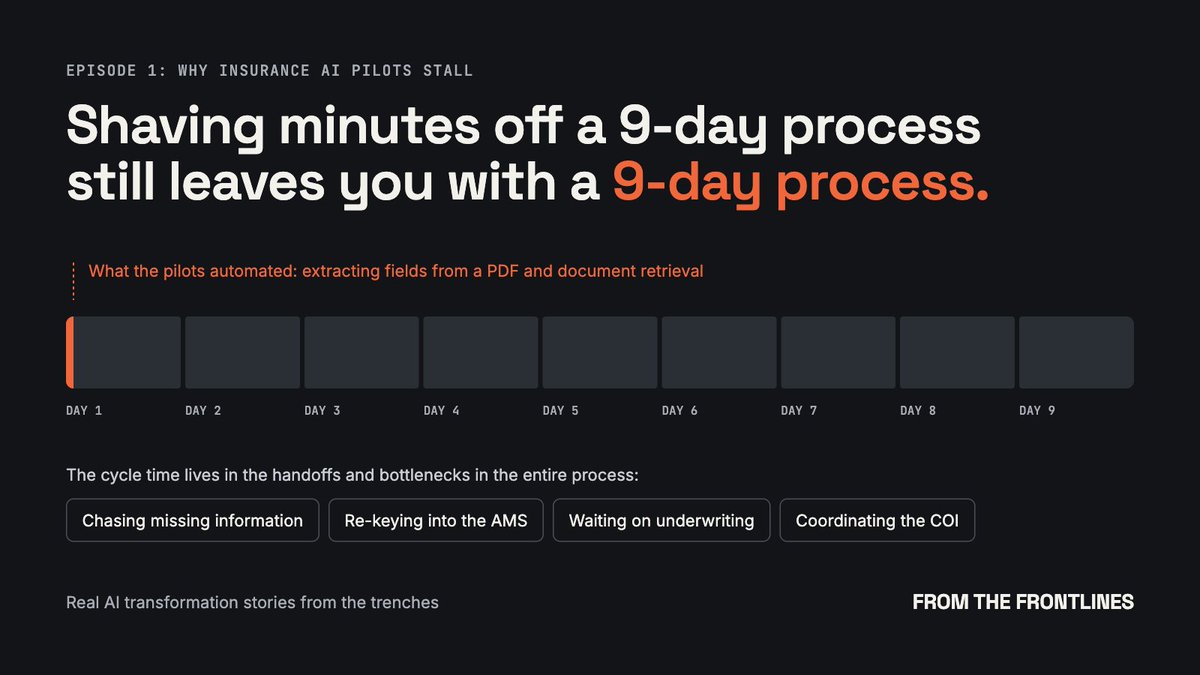
Episode 1: Why insurance AI pilots stall
Shaving minutes off a 9-day process still leaves you with a 9-day process.

What the pilots automated: extracting fields from a PDF

The cycle time lives in the handoffs:
Chasing missing information
Re-keying into the AMS
Waiting on underwriting
Coordinating the COI

Agents that handle the work, on the platforms where it happens.
21 3 847 13 0
Nikunj Kothari @nikunj 2026-11-27T14:45:00.000Z

The greatest tragedy right now in Silicon Valley that NO one wants to talk about is how some startups are "reselling" compute and calling it revenue.. not inference, just straight up selling compute to other companies. And, no their primary business is NOT selling compute. In this era, where everyone wants to show high "annualized run rate" growth as that's the story that gets marked up, companies are now being even more creative in how to lump "revenue" into a month. It started with GMV-like revenue with low margins, then inference at negative gross margins and now straight up reselling compute. All lumped into a tidy "ARR". Naive investors will lap it up since it allows them to pass deals through IC, and seed investors will celebrate their markups - but zero shot this ends well.

777 56 88852 79 22
Josh Sum @joshsum_ 2026-11-25T17:36:46.000Z

I spent an hour with a $5B private-equity backed insurance group They’ve run 4 AI pilots in the last 18 months. 2 are still technically live but none of them show up in the P&L When I asked why, the answer I got was “the data isn’t ready” But after an hour, it was clear the data wasn’t the problem Every pilot was scoped from the SOP, not from how the work actually happens > On paper, a commercial submission comes in, gets validated, and goes out to carriers. > In practice, it arrives as a scanned ACORD, a forwarded email thread, and a broker who has to make a call to fill in the missing fields. 40% of submissions end up with exceptions but the pilots were built for the other 60% when nothing goes wrong ... ... and still fail for a good number of those cases The pilots also automated the step that demos best. Extracting fields from a PDF looks great in a meeting and saves a few minutes per file. But the cycle time lives in the handoffs: chasing missing information, re-keying into the AMS, waiting on underwriting, coordinating the COI etc. Shaving minutes off each day from a 9-day process still leaves you with a 9-day process. Each pilot was also a sidekick, a chat window that someone had to remember to open -> and each one lived in its own app with its own login, outside the AMS, Outlook, and carrier portals the team actually works in So adoption faded really fast. Finally, nobody on the business side owned any of it. When something broke, the work quietly went back to being manual. What they want now is much clearer. Background agents that pick up submissions, verify policy details, coordinate endorsements and renewals, prepare COIs, and keep the AMS in sync. All of it runs inside their existing systems, every action is permissioned and logged, and people only step in for the judgment calls. Insurance doesn’t need a smarter model or more platforms What it needs are agents that handle the work, on the platforms where it happens -> starting with one workflow, delivering value, before expanding to the rest. That's how we're building with Morphic for insurance

Episode 1: Why insurance AI pilots stall
Shaving minutes off a 9-day process still leaves you with a 9-day process.

What the pilots automated: extracting fields from a PDF

The cycle time lives in the handoffs:
Chasing missing information
Re-keying into the AMS
Waiting on underwriting
Coordinating the COI

Agents that handle the work, on the platforms where it happens.
21 3 847 13 0
Sheetal Jaitly @SheetalJaitly 2026-11-27T14:56:42.000Z

@joshsum_ @morphic_io Your 40% with exceptions is the actual workflow. The procedure document describes the other 60%, so that's what pilots get built for. Map the messy path first. Chasing missing fields, re-keying, waiting on underwriting, coordinating certificates. That's where the nine days go.

2 0 14 1 0
Josh Sum @joshsum_ 2026-11-27T18:17:35.000Z

@SheetalJaitly @morphic_io yep those exceptions and how they’re handled are usually where a lot of human attention is required -> lots more cost, delays etc fixing those (or having agents handle or triage them) can immediately deliver value

2 0 18 0 0
Shayne Coplan 🦅 @shayne_coplan 2026-11-25T18:10:30.000Z

Compute markets are finally here. @Polymarket now prices on-demand compute for @nvidia H100s, B200s, and B300s, out to 2028. More chips and terms soon. http://polymarket.com/compute Think of it as a yield curve for the cost of compute: the forecasted $/hour price of each chip at every expiry, and whether it's trending up or down. The whole AI economy rides on these prices, and until today there was no public market for where they're going. Which is nuts. So Polymarket built it. This will change how compute gets bought and financed. Every contract negotiation and every GPU loan will have a market price to check against. Hundreds of billions of dollars are being committed to compute years in advance. Many of those deals are essentially a levered bet on what GPUs will rent for in the future (what could go wrong lol) As AI financing sobers up, the labs buying compute, the providers selling it, and the lenders financing it will all need to hedge that risk. We think compute could become one of the largest financial markets in the world. This launch is Polymarket's first step toward building it. If you’re buying, selling, or financing compute, DM us with what markets you'd like to see.

5696 603 1169016 440 375
Aryan Mahajan @aryanXmahajan 2026-11-26T01:00:03.000Z

The fastest way to go broke making $40,000 a month on paper is saying yes to custom AI builds you have never shipped before. Every ambitious builder falls into this ego trap at least once. A big company waves a $25,000 check for a custom multi-agent ERP integration, you say yes because the logo looks cool, and suddenly your entire quarter disappears into edge-case purgatory while your own marketing goes dark for 90 days. Custom software disguised as an "AI agency" has brutal unit economics. Every client becomes a brand-new R&D science project you fund with your own sleep. The operators banking real cash in B2B AI right now are boringly repetitive: They find 1 painful bottleneck inside $3M to $20M businesses (outbound buyer intelligence, post-call proposal automation, or founder operating memory), install the exact same core architecture 15 times in a row, and deploy in days instead of quarters. Clients do not pay a premium to be your guinea pig. They pay a premium for the guy who has already solved their exact problem 12 times this year.

176 5 11557 14 1
Josh Sum @joshsum_ 2026-11-26T12:09:43.000Z

@aryanXmahajan yeah this is crucial advice ^ price custom builds so that if its custom, you are paid enough that you can keep scaling main repeatable offer custom builds are great for pain point discovery, but for most situations, go for the mass-produced, productizable deployments

0 0 57 0 0
kerman kohli @kermankohli 2026-11-25T19:06:00.000Z

this a million times over. compute is the MOST MISUNDERSTOOD asset on the planet by far. like it's criminal how bad it is. wall st clows being like "hmmm memory supply glut 2028 bc cyclical commodity blah blah blah" brother, try procuring a b300 and then come back

@sidravi_

i find that almost no one, even in tech, understands compute economics. let me just give you one simple line to help your intuition: if you buy datacenter gpu today, it makes its money back in less than one year and then keeps printing money for at least half a decade. this will continue as long as one year of gpu usage for running ai produces more value in the economy than it costs to produce a gpu. ai labor depends on roughly two inputs: - compute (a computer with ai chips aka gpus) - hosting (power, cooling, internet, space) if gpu production skyrockets, then the other input will cost more than gpus. in the next decade, a hosted computer will be the most productive asset that money can buy.

443 29 53854 19 3
morphic @morphic_io 2026-11-26T04:11:37.000Z

we rebuilt our record enrichment by popular demand data you can trust with web agents that can enrich your data anyway you like powered by @Tiny_Fish

@ysrazsingh

We rebuilt record enrichment in Morphic Core. One rule shaped everything: if the AI can't show where a value came from, it doesn't get saved. Here's how we built enrichment you can actually trust 🧵 https://t.co/2ylxXNgu3C

9 0 1820 1 0
Ivan Burazin @ivanburazin 2026-11-26T02:44:02.000Z

If you want to know whether to enter a market, talk to potential customers and see if they know all the major competitors by name. If they can list 5-6 providers immediately, the market has a mental map and you're fighting for a slot in it (Generally very hard). If they know one or none, there's still a window. Not the only signal but it's an assurance that there's room. Also figure out whether you can catch up on capital. If you're only one or two rounds behind the biggest competitors, maybe. But four rounds behind two decacorns? Not a chance, unless you have something genuinely net new that makes you not a direct competitor.

87 2 7096 22 0
Josh Sum @joshsum_ 2026-11-26T04:20:52.000Z

@ivanburazin so far our customers have been saying "oh I think there was this one company but i can't remember their name or if they also do this" no issues closing, and also shows up top of funnel ^ cost per lead is cheaper than even e-commerce (at least what I saw back in those days)

0 0 199 0 0
Josh Sum @joshsum_ 2026-11-26T04:07:24.000Z

@ysrazsingh This was a huge request from our customers - since different customers have different data requirements and also trust different data sources huge shoutout to @Tiny_Fish for powering web infra for our agents as well

1 0 48 1 0
Aixa @aixarizzo 2026-11-25T13:37:29.000Z

i don’t care what roles you’re hiring for every startup needs: someone autistic and with adhd someone who can sell anything someone who makes things happen someone completely out of their fucking mind and someone who’s scared of everything

141 6 5374 29 2
unusual_whales @unusual_whales 2026-11-25T14:37:00.000Z

Private equity firms are sitting on a record backlog of companies they can’t sell, and about $300 billion of debt at PE-backed companies comes due in 2028 and 2029, per the WSJ. Most of that debt was refinanced in 2020 and 2021, when rates were near zero. It now has to be rolled over at much higher rates, with few obvious buyers. PE funds typically aim to exit within three to five years. According to PitchBook, 30% of holdings have now been held for six years or more, a record.

8393 870 1043082 274 200
Josh Sum @joshsum_ 2026-11-26T04:01:16.000Z

@unusual_whales the next generation of PE firms will have to rely more on operational fundamentals and less on debt AI could breed the style of PE firms (or even create a new category/approach) https://x.com/joshsum_/status/2125801665483968710?a=8KSfO8kYTqvhx9bkn00&s=20

@joshsum_

as interest rates rise and capital becomes expensive, a good cohort of PE funds are stuck debt and portfolios they can't sell maybe the move is to cashflow businesses and hold them forever and leverage AI to drive huge revenue/cost improvements is this what comes after PE?

1 0 142 0 0
Josh Sum @joshsum_ 2026-11-26T03:59:47.000Z

as interest rates rise and capital becomes expensive, a good cohort of PE funds are stuck debt and portfolios they can't sell maybe the move is to cashflow businesses and hold them forever and leverage AI to drive huge revenue/cost improvements is this what comes after PE?

@unusual_whales

Private equity firms are sitting on a record backlog of companies they can’t sell, and about $300 billion of debt at PE-backed companies comes due in 2028 and 2029, per the WSJ. Most of that debt was refinanced in 2020 and 2021, when rates were near zero. It now has to be rolled over at much higher rates, with few obvious buyers. PE funds typically aim to exit within three to five years. According to PitchBook, 30% of holdings have now been held for six years or more, a record.

8 0 463 1 1
Lily yang @lilyyang169 2026-11-25T23:01:39.000Z

Next Wednesday, we’re getting together with NUS Overseas Colleges (NOC) to celebrate the Singaporean students who spent the past few months building in San Francisco. Through NOC, we met some of the teammates who helped build @Tiny_Fish this past year across engineering and growth. They brought talent and drive to everything they took on, and we couldn’t have asked for a better group to spend the past year with. As their time in SF wraps up and the holidays get closer, we want to thank them for what they contributed to the teams they joined and the wider tech community here. If you’re an engineer, founder, builder, or investor, come join us for good food and conversation! Register in the link below.

15 2 1178 4 0
Josh Sum @joshsum_ 2026-11-26T03:52:22.000Z

@johnrobertreed it's tricky to get it right > unified context across ai/human teammates > access controls (on the platform itself, and also from tools and connected apps/integrations) > need to ground it in a use case e.g. marketing, sales, operations, supply chain > agents need to be reliable

0 0 22 0 0