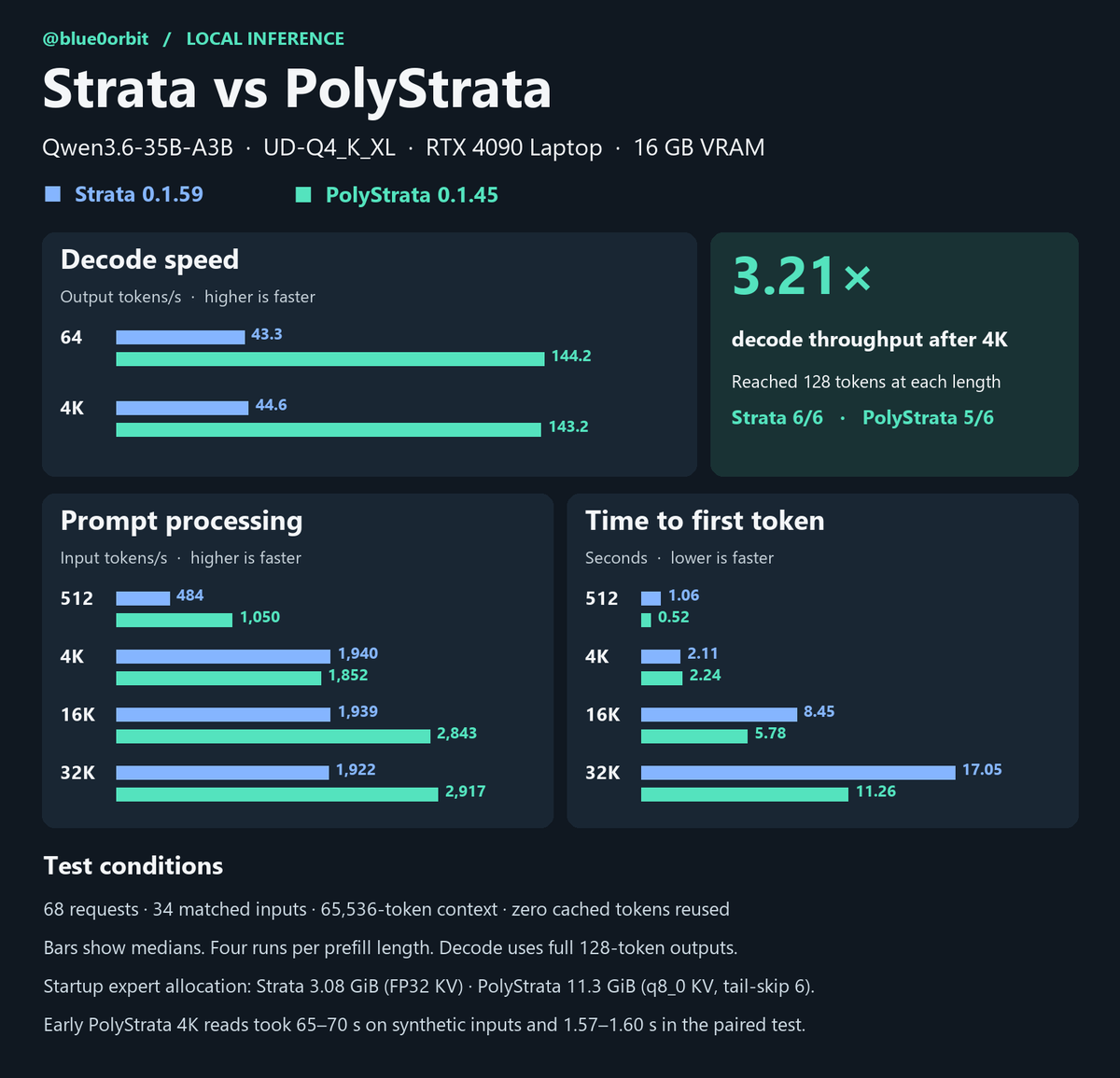
157 output tokens/s on my 16 GB RTX 4090 laptop. That was my fastest full 128-token run with Qwen3.6-35B-A3B on PolyStrata. I put the exact same GGUF through Strata to see how much of that speed held up across 68 requests.
With a 64-token prompt, median decode speed was 144.2 tok/s on PolyStrata vs 43.3 on Strata. After a 4K prompt, it was 143.2 vs 44.6 tok/s. That’s 3.21× the generation speed on the longer prompt. At each length, Strata reached all 128 output tokens on 6/6 attempts and PolyStrata on 5/6. Those medians use the full-length runs.
Reading the prompt gave a different result. At 4K, Strata had a small lead at 1,940 vs 1,852 input tok/s. At 32K, PolyStrata reached 2,917 vs 1,922 input tok/s. That cut my wait for the first token from 17.05 seconds to 11.26.
One result I still can’t explain: two early 4K reads on PolyStrata took 65–70 seconds with synthetic inputs. Its two early 4K reads in the matched text test took 1.57 and 1.60 seconds.
I used the same UD-Q4_K_XL file on an i9-13900HX with 80 GB RAM. Each engine got the same 34 inputs with a 65,536-token context window and zero cached tokens reused. I reversed engine order halfway through.
Strata 0.1.59 used FP32 KV and MTP depth 2, with 3.08 GiB of experts in VRAM at startup. PolyStrata 0.1.45 used q8_0 KV and tail-skip 6, with 11.3 GiB of experts in VRAM. Only 1 of 12 paired generation tests produced identical token sequences. I measured speed and didn’t score answer quality.
#LocalLLM #Qwen #Polystrata #strata