CodecFlow (@codecopenflow)

CodecFlow @codecopenflow 2026-10-27T18:02:13.000Z

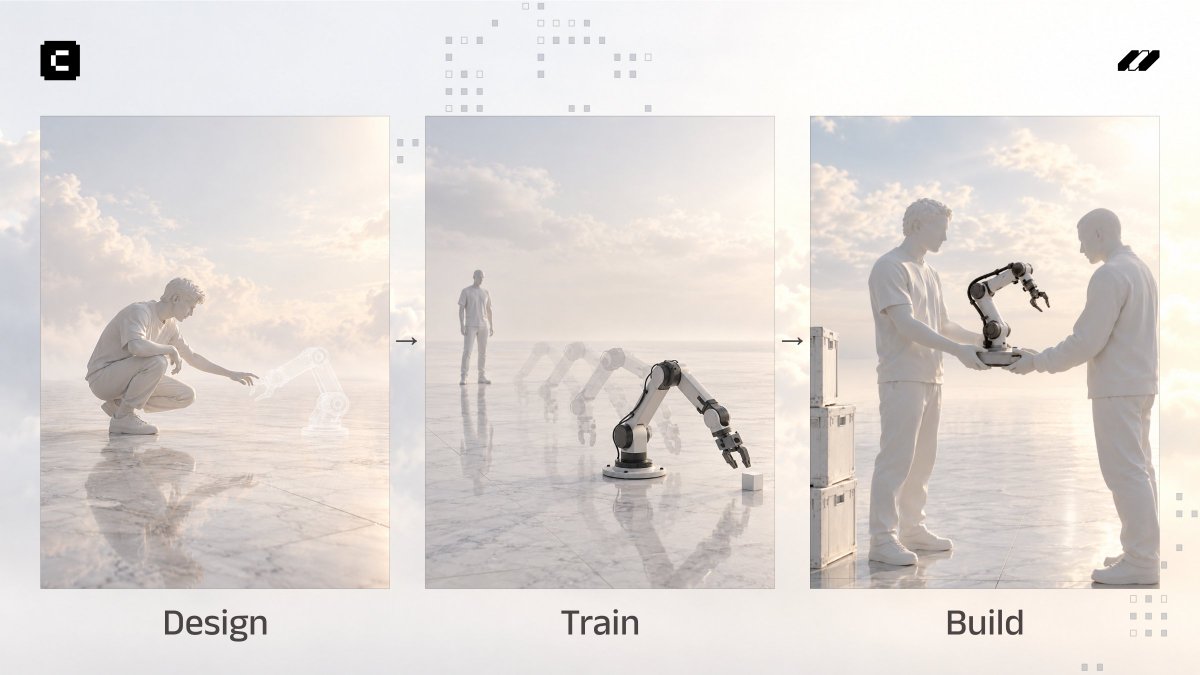
When CodecFlow started last year, robotics was barely on crypto’s radar. The goal was to change that by bringing the whole robot development cycle into the crypto-native world, from the first test to the finished machine. Talking to other builders and looking at the problem as a whole, the same conclusion kept coming up: building a robot is brutally hard, for three reasons. I. Nowhere to test it. Labs and hardware cost more than most ideas are worth, so the first thing we built was a way around them. SimArena lets anyone check whether a robot idea works in simulation before spending anything on equipment. This week, around 80 teams at the robo.innovate hackathon in Munich are using it for their challenges. II. Nothing to train it on. Robots learn from examples, and the examples they need either don’t exist yet or aren’t labelled in a way a robot can learn from. It’s one of the quietest bottlenecks in robotics and one of the hardest to fix, but there’s news on it coming soon. III. No money or network to build it. Once a robot works in simulation, getting it into production takes real capital, factory connections, a supply chain and customers waiting to buy it. This is where most robotics startups die. That’s why we teamed up with @machinedotfun and @peaq on a launchpad and accelerator built for exactly this stage. Through partnerships and integrations with @solana, @Raydium, @sunrise and @peaq, the goal is to give machines something they’ve never had: capital markets of their own, where a robot is tradable from day one, and anyone who believes in it can take a position before the rest of the market catches on. For the first time, the whole robotics lifecycle, in one place: design it → train it → build it. We’re excited to open that door to anyone, anywhere, and help them take a machine from prototype to business. @machinedotfun launches in the next 48H.
109 20 6627 14 3
CodecFlow @codecopenflow 2026-11-25T11:36:59.000Z

A growing share of production software is now written by a single founder directing an LLM. Hardware is following the same curve. Founders are taking machines from prototype to product with teams of one or two, and the bottleneck has moved from engineering to capital and distribution. What they need, and what doesn't exist yet, is a single venue for capital formation and go-to-market: http://machine.fun

40 7 1100 7 0
CodecFlow @codecopenflow 2026-11-24T14:11:19.000Z

Finishing the task is only part of robot evaluation. CoRL 2026 RoboEval scored Ilia Larchenko’s winning policy on outcome, safety and stability, efficiency, and coordination. The generic RL loop got most of the way quickly. The rest took scripted data for stages the demonstrations missed, recovery training, and per-task tuning. When a benchmark scores how a robot moves, the training data has to show it too. https://ilialarchenko.com/projects/roboeval2026/

34 6 1083 1 0
CodecFlow @codecopenflow 2026-11-19T13:00:19.000Z

Anthropic ($ANT) debuts on Nasdaq today after raising roughly $79 billion, the largest IPO pricing on record. All of that money backs intelligence that exists only in the digital world. Robotics is a few years behind on the same path. As capital at this scale moves into the physical world, the most valuable piece will be the layer that connects that intelligence to real machines.

53 5 1424 7 0
CodecFlow @codecopenflow 2026-11-17T12:20:35.000Z

SuperMimic is a humanoid whole-body motion tracker trained through one differentiable world model. It learns the shared dynamics across a large motion library, then uses imagined rollouts and analytic gradients to improve a single policy. The result is a major reduction in training compute. On one H100, SuperMimic surpassed the normalized return of SONIC’s released checkpoint within three hours. SONIC reported training for seven days on 128 L40 GPUs. The authors report more than 1,000× fewer GPU-hours. Across 129,514 training motions, SuperMimic reduced failures to 25 after three hours on one GPU and zero after 9.8 hours on two GPUs. These results measure training-motion coverage, not generalization to unseen motions. The policy also transferred to a physical Unitree G1. The work won the CoRL 2026 Best Conference Paper award, and its code is now available under Apache 2.0. For robotics teams, it points to large-scale humanoid-control research without cluster-scale infrastructure. CodecFlow is building the browser-native stack for simulation, data, training, and evaluation.

49 8 1662 9 2
CodecFlow @codecopenflow 2026-11-12T15:00:08.000Z

Proud to support @machinedotfun as it grows. It’s still early, with plenty of room from here. As volume grows, more revenue can go towards buybacks.

@machinedotfun

Our revenue dashboard is live. In the first two weeks, the platform recorded $5.96M in trading volume and generated $80.9K in trading fees, split as follows: Creators ($29.2K): claimable by each team at any time, giving founders operating capital without selling tokens. Rewards ($11.5K): a per-project reserve for traders and the community, which can fund future distributions, buybacks or liquidity, allocated with each team. Platform ($40.2K): funds project support, trader incentives, operations, marketing, treasury, and open-market buybacks of $CODEC and $PEAQ. Buyback details to follow. Live figures: http://machine.fun/revenue

44 4 1717 5 0
CodecFlow @codecopenflow 2026-11-11T09:30:18.000Z

NVIDIA’s GR00T 2 is a world-action model that predicts future video and robot actions together. This allows it to learn how physical interactions unfold and use that information to control different robot embodiments. Its results also show why simulation is becoming central to robot-model development. Adding simulated data raised GR00T 2 Turbo’s success on out-of-distribution real-world tasks from 6.7% to 63.3%. Across 14 policies and 25 tasks, digital-twin evaluations closely tracked physical evaluations, with a Pearson correlation of 0.92. For robotics teams, this changes how scarce hardware time can be allocated. Simulation can screen policies, expose failure modes and guide iteration before tests reach a physical robot. CodecFlow is building the browser-native workspace for that process.

54 4 3856 5 3
CodecFlow @codecopenflow 2026-11-10T11:55:29.000Z

Robotics is becoming one continuous loop. From simulation and data generation to training, evaluation, and deployment, CodecFlow keeps every stage connected in the browser. As the loop gets tighter, robots reach the real world faster.

57 5 1787 3 0
Grablab.fun @Grablabfun 2026-11-05T21:21:57.000Z

honestly the sim model was so ugly we almost didn't share it 😅 but that ugly box answered the only question that mattered: can the claw actually hold the ball? it could. so we started cutting steel. shoutout @codecopenflow for SimArena.

@Ronithedegn

build log #03 First time the claw moved, it wasn't in a workshop. It was in a simulator. We rebuilt the whole machine in @codecopenflow SimArena and dropped the claw into a pile of capsules. Ugly model, no textures, nothing pretty. Only one question mattered: can this claw actually lift this ball? If it can't do it in physics, it won't do it in steel either. And we are not shipping a claw machine that's rigged by design.

18 6 794 5 0