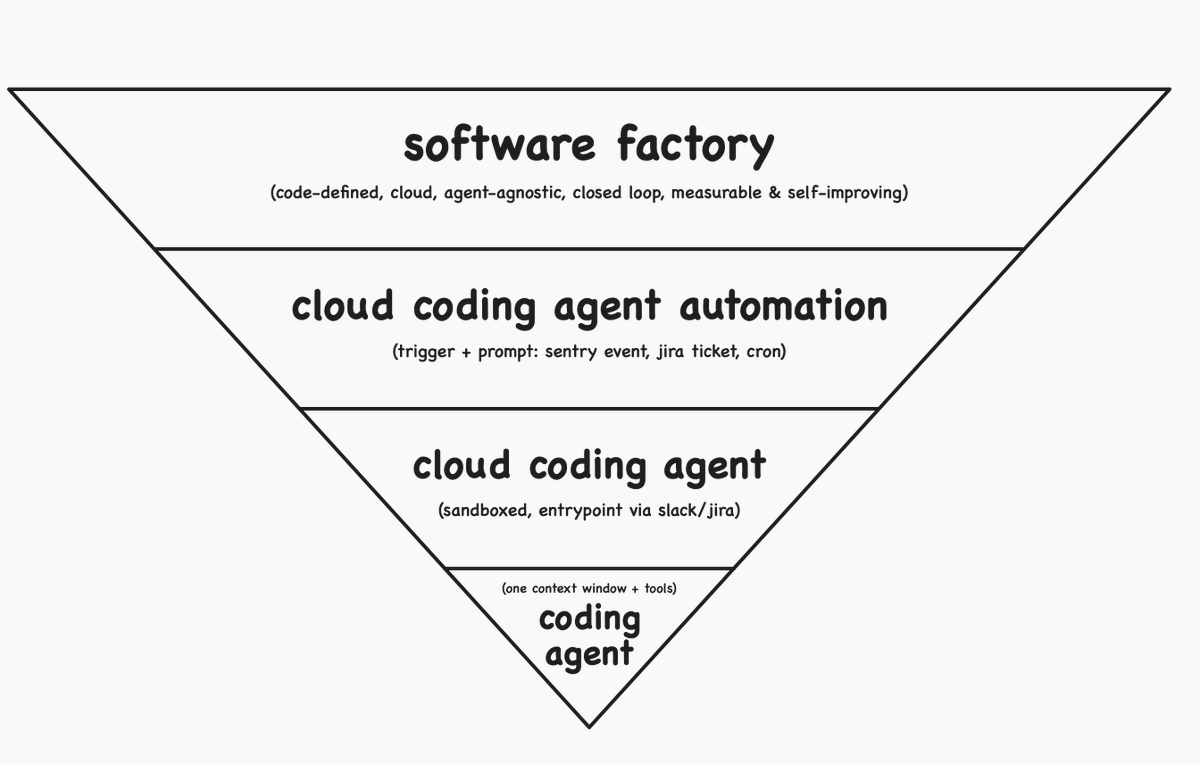
in diagram form https://t.co/Zh9OBRRVOS
@zachlloydtweetsHere’s my coding agent glossary. I’m trying to clarify what these terms mean so that we can meaningfully discuss them.
Coding agent: the thing you directly prompt that has a single context window, system prompt, tool definitions, etc. Examples are Claude Code, OpenCode, Pi, Cursor Agent, Warp Agent.
Cloud coding agent: a coding agent that runs in a cloud sandbox, probably with some entrypoint through Slack or Jira. Examples are Devin, Cursor Cloud Agents.
Cloud coding agent automation: a trigger that invokes a cloud coding agent with a prompt (e.g. “When this Sentry event fires, try to fix the underlying crash.” Examples are Devin automations, Cursor automations.
Software factory: A code-defined system for a fully closed loop encoding all of your organization’s cloud coding agent workflows, plus all of the infra for measuring, improving and securing those workflows at scale. This is Warp Factories. It’s also what companies like Uber and Stripe are building internally and what I hear platform teams ask for every day.
It’s only a “software factory” imo if it’s headless infrastructure:
1/ All your agent workflows are defined in code so they can be versioned, tested and self-improved
2/ It runs in the cloud - otherwise you can’t govern it, or automate around it
3/ It supports running different coding agents (it’s a higher abstraction layer than “coding agent” – your factory should be able to run any agent to test how it performs)
4/ It stores all of the agent data for use in self-improvement
5/ It is measurable, testable and self-improving
A lot of folks are marketing “software factories” that are really just strings of prompts typing together local or cloud coding agents, which influential devs like @poteto rightfully dismiss this as marketing bunk.
I agree this isn’t an interesting approach, but I also think it’s not really what platform teams who care about increasing productivity while minimizing cost are trying to build.