Barry Logen (@barrylogen)

Alexey Fateev @superalesha 2026-11-28T10:37:06.000Z

Everyone says 2-bit quants wreck a model. This 26B one keeps 94% of its base at 2.75 bits, fits a 12 GB card, and keeps a 1M context window. IST-DASLab shipped GGUF builds of Inkling 2 Mini, a 26.4B model with 128 experts per layer, 8 active per token and 12 of its 24 layers running 3 times with the same weights. Instead of one quant type for every tensor, a budget-constrained search picks a type per tensor across 169 tensors. Expert matrices get the low bits, 1 to 4. Attention and the output head stay at 4 to 8. GSQ learns the per-coordinate grids and RCO spends the size budget, so each tensor gets the precision it actually needs. The 2.75-bit build is 8.05 GB on the GPU plus a 0.93 GB embedding in system RAM. 8.98 GB total, and AIME25 falls from 99.33 to 92.33. The 3.5-bit build is 11.43 GB, holds 99.2% of the base task average, 98.33 on AIME25. The cheap build loses 5.7 points. The recommended one loses 0.75. Both are 26B with a 1M window, and the 11.43 GB build leaves real room for KV on a 16 GB card. Needs a llama.cpp build from Nov 21 or newer. Every build ships its per-tensor allocation, so you can check all 169 choices yourself.

107 6 7588 28 1
Pekka Enberg @penberg 2026-11-28T10:25:36.000Z

Speculative decoding is such an interesting optimization. In large language models, the generative step is auto-regressive, which means you generate one token at a time, as you need the previously generated tokens to predict the next one. This is a hard bottleneck, but you can cheat by actually generating more than one token at a time with a cheap model, and then verify if you got them right with a larger model. However, the efficiency of speculative decoding depends on what you are doing. For example, when generating text, speculative decoding is not that helpful often, but for coding tasks, it can be extremely helpful because code often follows a multi-token pattern. But what is even more interesting, is that the effectiveness of speculative decoding on coding tasks also depends on the programming language you are generating for!

42 0 4517 5 1
Niklas @niklaslenz_ai 2026-11-28T10:06:54.000Z

Inkling 2 Mini went from 43.0 to 22.1 tok/s on one RTX 5060 Ti, and all I changed was the context window. 16K to 32K on llama.cpp b12728, Unsloth's UD-Q4_K_XL file, no draft model, quick probe with a short prompt. The file is bigger than 16 GB, so some experts already sit in system RAM. With 32K it's most likely more. That's the real limit of a cheaper 16 GB card.

18 0 3870 17 0
Tekon Burns @TekonBurns 2026-11-28T07:57:26.000Z

Google Antigravity CLI v1.5.13–v1.5.18 changelog ships 34 improvements and 65 fixes: Gemini 4 Neon via ADC, customizable Orchestrator effort, mid-turn quota refreshes, and auto-swarm block. Damn they're not even taking thanksgiving off.

43 0 1410 11 0
Carol Monroe @CarolMonroe 2026-11-28T06:53:49.000Z

ok, race results. the job: migrating real screens of a big app to a new component library. 3 paired pieces, one blind reviewer Neon delivered first, 4.5 min avg vs 6.1. Opus passed review first try 2 of 3, Neon 1 with fixes they tie at 7.7 min. Neon got 2 of 3 merged

@CarolMonroe

tonight I'm running a race inside my agent factory 🏁 Gemini 4 Neon vs Claude Opus 5.5 each gets a different piece, paired by size and type same start time one reviewer grades both, blind early peek: Neon finished its first piece in 3 minutes 👀

1 0 268 1 0
Omarchy Updates @OmarchyUpdates 2026-11-28T06:40:06.000Z

DHH gave 3 local models the same 𝗢𝗺𝗮𝗿𝗰𝗵𝘆 jobs overnight: build a theme, a plugin, an app and a game. Thinking Machines' Inkling 2 Mini won. 🏁 On a 48–64 GB RTX Spark, judged blind out of 10: ▸ Inkling 2 Mini: 8.50, all 8 runs finished, 142 min ▸ Qwen3.8 27B: 8.00, 7 of 8, 240 min ▸ Nemotron 3.5 Bolt: 4.38 It's already in Omarchy's local model catalog. Omarchy's own run on a 64 GB NVIDIA N1X laptop: 32.7 GB loaded, 256K context, 78–92 tokens a second. Try it on 4.6 RC1: ▸ Super + Ctrl + X opens the agents panel ▸ Hit +, pick Use a local model, then Inkling 2 Mini if it fits your machine The catch: two runs per job, so DHH calls half-point gaps noise. RC1 is a release candidate. His post 👇 Which model runs your agent?

@dhh

American open-weight models can too! @thinkymachines's Inkling2 Mini just beat Qwen3.8 27B in my overnight eval shoot-out for best model for a 48-64GB RTX Spark on Omarchy malleability. Great recipe by @MiaAI_lab running on @tensorfold_dev 🤘 https://t.co/kLYClTofwm

34 1 1795 5 0
Simplifying AI @simplifyinAI 2026-11-28T02:29:46.000Z

GitHub solved the biggest problem with vibe coding. It’s called Spec Kit, and it quickly passed 120K GitHub stars. Give a coding agent a vague prompt and it can spend hours building the wrong thing. Spec Kit gets the agent to write a structured spec before it touches a line of code. The agent works out what you want, asks about the missing details and breaks the project into tasks. You get to catch a bad assumption while it’s still a sentence in a plan. Here’s the workflow: > /constitution → Set the project’s rules and standards > /specify → Describe what you want to build > /clarify → Answer open questions before coding > /plan → Choose the architecture and tech stack > /tasks → Put the work in order > /implement → Build it That means fewer hours fixing avoidable bugs, more consistent code and more predictable results. It works with Claude Code, Cursor, Copilot, Codex, Gemini CLI and 25+ other agents. GitHub released Spec Kit as open source. The repo has 10K forks.

311 35 29378 61 8
Rohan Paul @rohanpaul_ai 2026-11-28T01:08:58.000Z

New Northeastern University paper finds coding agents rarely back up what they change. That agents complete 86.1% of tasks but save the state they are about to destroy in only 15.2%. Agents now upgrade packages, edit databases, and delete emails outside their working folder. Built-in harness backups cover only the workspace, so when users later need the old state, it is gone. They built RegretBench, 205 tasks based on real cases where people regretted losing data. BackUpper, their fix, checks every tool call, turns rm into a move to trash, and sends harder cases to a small subagent. Across 6 frontier models, agents completed 86.1% of tasks but backed up before the regret moment in only 15.2%. BackUpper covered every regret moment and restored state to 92.2% similarity, at $0.014 extra per task. If your agent touches anything outside its workspace, add backups at the tool-call level instead of trusting the model to remember.

46 4 4483 27 2
Diptanu Choudhury @diptanu 2026-11-27T23:20:51.000Z

Going to share details of our new block storage - Project Santa Cruz tomorrow! Its been months of work, and going to significantly improve performance of coding agents running compilers and analytics engines such as DuckDB.

71 0 3038 5 0
Jafar Najafov @JafarNajafov 2026-11-27T11:12:53.000Z

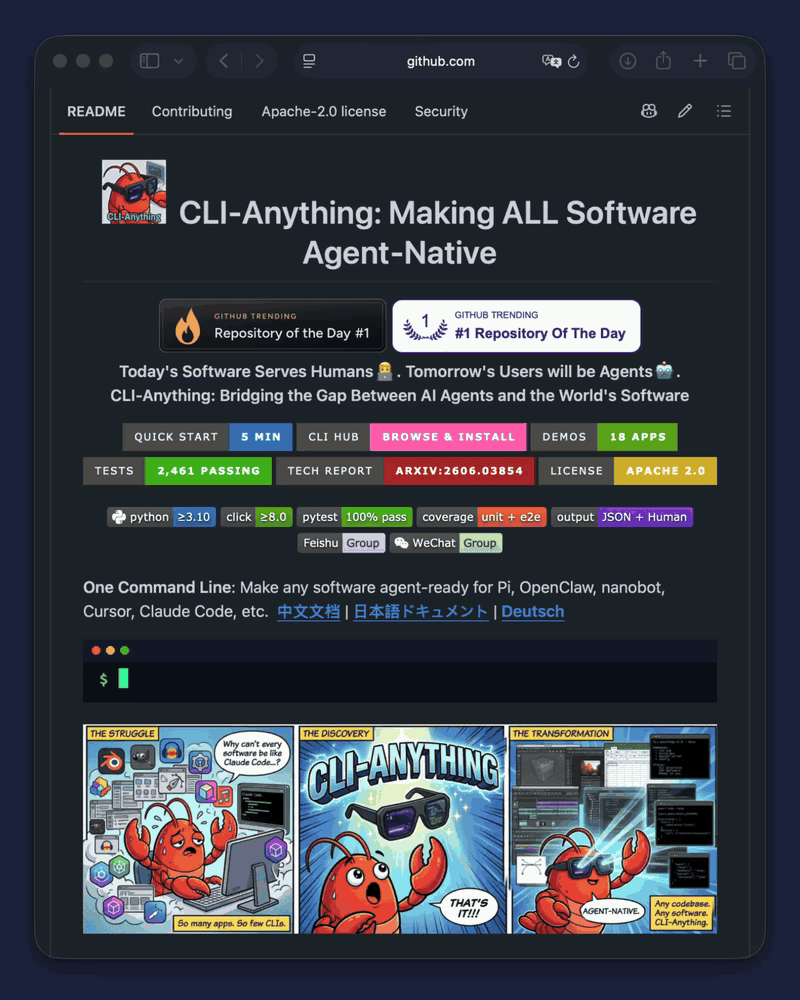
Someone built a tool that turns any software into something an AI agent can use. AI agents are good at reasoning. They're bad at operating real software. Ask an agent to edit an image in GIMP, render a scene in Blender, or cut a video in Kdenlive, and it has two options. It can take screenshots and click through the GUI, which is slow and breaks the moment a button moves. Or it can use an API, which most desktop apps don't have. CLI-Anything takes a third path. It generates a command-line interface for any app, so the agent drives it with text commands. You point your coding agent at the software, run one command, and it works through a 7-phase pipeline: → analyzes the source and maps GUI actions to the APIs underneath → designs the command groups and how state is tracked → implements the CLI, with a REPL, JSON output, and undo/redo → plans the tests → writes the tests → documents the results → packages it and installs the command on your PATH In Claude Code it's just: /cli-anything ./gimp The important part is that the generated CLI calls the real application. It doesn't reimplement it. PDF export runs through LibreOffice. Rendering runs through Blender. Audio for Audacity runs through sox. So the agent gets the actual software, not a simplified copy of it. Every generated CLI also ships with: ↳ persistent project state with undo/redo ↳ JSON output for agents and readable output for humans ↳ a SKILL md, so agents can discover how to use it ↳ unit tests and end-to-end tests that run against real files and the real software The repo already has harnesses for dozens of apps, including GIMP, Blender, Inkscape, Krita, Audacity, OBS Studio, LibreOffice, FreeCAD, Godot, Zotero, Obsidian, and n8n. There's also CLI-Hub, a package manager for these CLIs, so you can search, install, and launch them in one place: pip install cli-anything-hub It works with Claude Code, Codex, Cursor, OpenCode, Hermes, OpenClaw, Goose, GitHub Copilot CLI, and more. Agents don't need software rebuilt for them. They need a command line into the software that already exists. GitHub repo: https://github.com/HKUDS/CLI-Anything
22 3 1405 33 0
Vector @ItsvectorX 2026-11-27T11:26:38.000Z

This is not the Gemini coding agent. Google published a separate open-source CLI called gemini-api. It's a stateless, zero-dependency command-line client for AI agents, scripts and CI. Your agent can use it to generate text and media, analyze files, and hand work to Gemini managed agents, without adding an SDK. It runs in any normal shell, including Antigravity, Claude Code and Cursor. Limits from the official docs: • It's beta, so breaking changes can happen • You need a GEMINI_API_KEY • It's an API client, not an interactive coding agent Already have a coding agent and just want it to call Gemini from the shell? This is the tool.

1 0 128 9 0
Geeta @TechSoulGeeta 2026-11-27T03:08:29.000Z

🔥 Data Engineering Interview Question: Your data pipeline processes 100M records daily. A transformation runs successfully, but the output contains 20% more rows than the input. No duplicates exist in the source. How would you investigate? Join cardinality? One-to-many relationships? Aggregation logic? What would you check FIRST?

20 1 647 6 0
Shalini Goyal @goyalshaliniuk 2026-11-27T11:30:00.000Z

Before data is processed, stored, or analyzed… it has to be ingested the right way. Because how your data enters the system decides everything that comes after. Here’s a clear breakdown of the 3 core data ingestion strategies 👇 Pull-Based Ingestion → You ask for data Your system fetches data at scheduled intervals. Reliable and simple — but not real-time. Best for batch processing, reports, and periodic updates. Push-Based Ingestion → Data comes to you The source system sends data when events happen. Faster than pull, closer to real-time. Perfect for event-driven systems and live applications. CDC (Change Data Capture) → Only changes matter Instead of moving everything, you capture just what changed. Insert. Update. Delete. Efficient, scalable, and near real-time. 💡 The difference is not just technical - it’s strategic: • Pull → Controlled but slower • Push → Reactive and faster • CDC → Precise and efficient The best systems don’t rely on just one. They combine these approaches based on use case. Because in data engineering… Speed, cost, and accuracy all start at ingestion. Which strategy are you using in your pipeline right now? 👇 P.S. Preparing for a software engineering role? Check out my book, System Design and Behavioral Intelligence. It will help you: •⁠ ⁠Build strong System Design foundations and approach design problems with confidence •⁠ ⁠Develop practical frameworks to navigate complex behavioral and leadership challenges Get Your Copy anywhere internationally: US: https://lnkd.in/eVy2ACxQ UK: https://lnkd.in/evzmHKm4 India : https://lnkd.in/e25PthqU

48 16 1057 5 0
zing. @Zing_Xoro 2026-11-27T10:06:43.000Z

read-your-writes doesn't mean everyone sees your updates in distributed systems, seeing your own changes doesn't always mean everyone else sees them too. this is where read-your-writes consistency comes in. > what does read-your-writes mean? - when a user makes a change, their next read should reflect that change. - the guarantee applies to the same user or session. - it doesn't automatically apply to other users. > where does the problem appear? imagine updating your profile picture. - you upload a new picture. - you refresh your profile. - you see the updated version. but another user might still see your old picture for a while. why? - replication lag between servers. - eventual consistency across different replicas. - some users may read from a server that hasn't received the latest update yet. > what does it actually guarantee? read-your-writes guarantees that you can see the effects of your own previous writes. but it doesn't guarantee that everyone else will see those changes immediately. other users may observe older data, and the timing or order of updates can depend on the system's broader consistency model. that's an important distinction. systems can maintain this user-level experience while still using asynchronous replication and scaling reads across multiple servers. the key takeaway: seeing your own latest update doesn't mean the entire network has seen it.

25 2 388 14 0
Arika @Arikalabs 2026-11-27T09:46:01.000Z

Most developers still write ugly sum(case when ... then 1 else 0 end) queries to count multiple conditions in one pass. PostgreSQL, SQLite, and DuckDB support the standard SQL filter clause cleaner to read, no case boilerplate, and it returns 0 instead of null on empty tables: https://t.co/shc4i15RbF

39 3 2355 3 0
Barry Logen @barrylogen 2026-11-27T11:20:34.000Z

now sap. spiegel says stolen github tokens were enough to copy and change their source. they swapped signing keys and paused ci too. did anyone say what the old keys had already signed

@barrylogen

1password's vault crypto held. their deploy pipeline didn't. per their writeup, one employee's github account was enough to push code to backend services that downloaded customer names and emails. what i want to know is what sat between that push and prod

1 0 40 0 0