Humanoids are robotics’ biggest promise, but robots built to do ONE job are the ones already selling by the millions.
The appeal of humanoids is easy to understand. Our whole world is built for human bodies, so a robot shaped like us could, in theory, do any job we can. @Figure_robot's plan describes "one humanoid robot with a general interface, serving millions of tasks", and @elonmusk has said @Tesla_Optimus will be "the most valuable product ever made."
People who’ve built robots for decades are more careful when it comes to this topic. @rodneyabrooks, who co-founded the company behind the Roomba robot vacuum (arguably the most culturally significant product in the history of consumer robotics), says full-size walking humanoids "are not currently safe for humans to be around." He thinks profitable humanoids are "more than ten years away," while @MorganStanley expects adoption to stay "relatively slow until the mid-2030s."
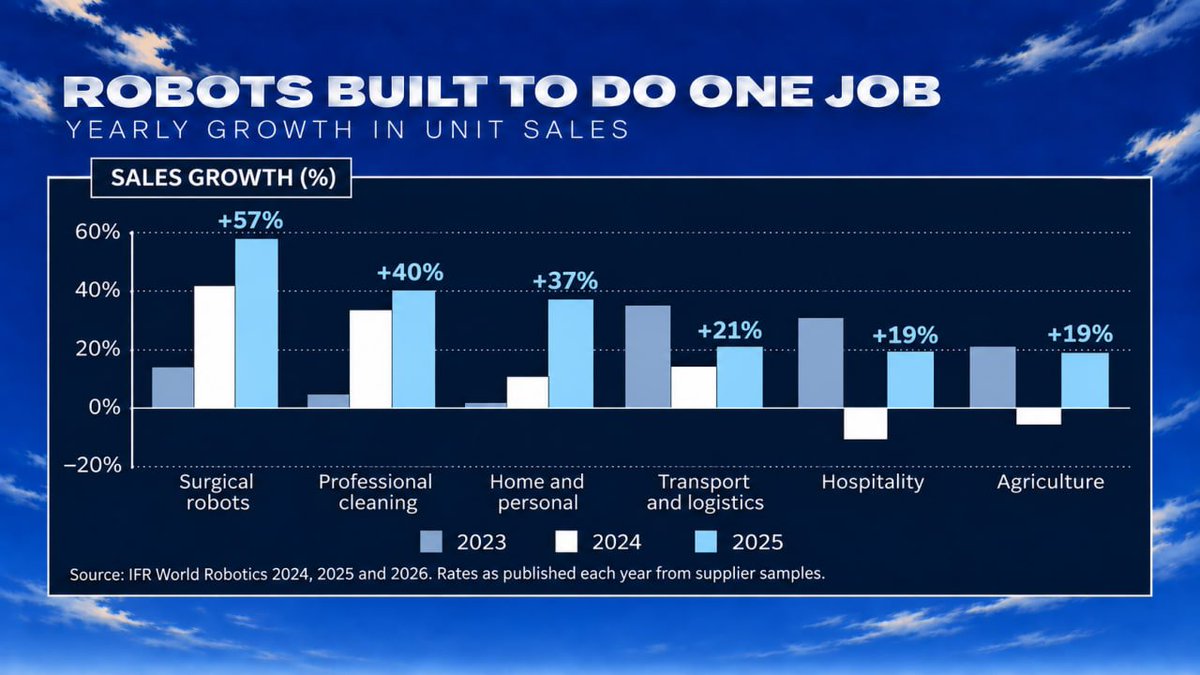
Single-job robots, on the other hand, are growing significantly:
- Home and personal robots: sales rose 1% in 2023, 11% in 2024 and 37% in 2025 to about 34 million units
- Professional robots: sales rose 30% in 2023, 9% in 2024 and 24% in 2025 to nearly 250,000 units, led by transport and logistics
- Surgical robots: sales rose 14% in 2023, 41% in 2024 and 57% in 2025 to 8,400 units
Most teams in these niches have a working robot and no funding to build more, because funds rarely invest this early.
Machinefun is built for this stage. Teams launch early, raise from people who believe in them, and build alongside founders who’ve already done it.
Somewhere, a 3-person team is building the robot that will own its niche, and backing it no longer takes an invite to a closed round.