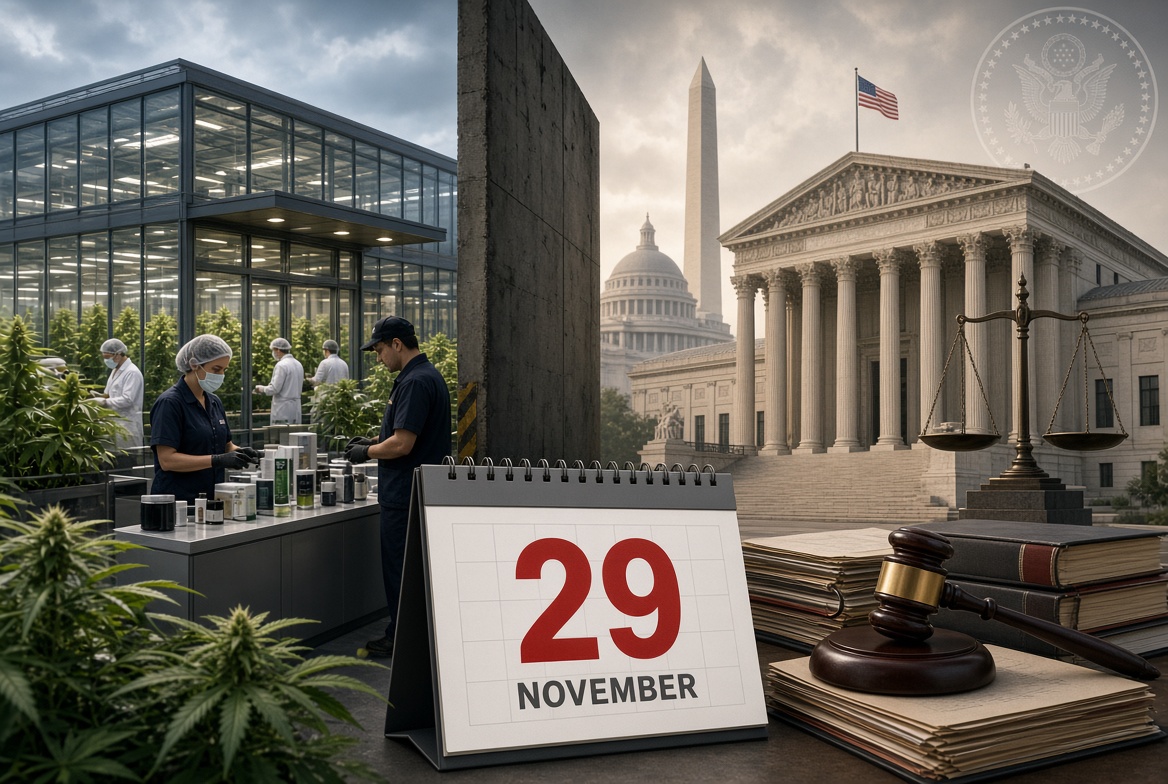
⚖️ Schedule III Just Became Schedule “See You in Court”
— Anthony Varrell @V_arrell
The Schedule III order that was supposed to be the industry's biggest win is now the subject of three consolidated lawsuits in the D.C. Circuit, an amicus brief from three Republican attorneys general, and a November 29 deadline that could cut licensed operators off from their own suppliers. Here is how it got here, what happens next, and what each path means for operators.
How we got here
Attorney General Todd Blanche's April order moved state-licensed medical cannabis to Schedule III and opened a 60-day window, April 28 to June 26, for businesses to apply for DEA registration with expedited processing. The catch was that DEA only had a dispensary form ready. The manufacturer and distributor portal, Form 225-M, didn't open until October 5, more than three months after the window closed. Vertically integrated operators that applied for dispensary registration in May couldn't apply for the cultivation and processing side of their business until fall.
Then DEA issued October guidance defining "Timely Applicants," those who filed complete applications in the original window, and set a November 29 deadline after which registered or timely-applying businesses may source product only from, and sell only to, other registered or timely-applying businesses. On October 30, DEA granted the first registrations: more than 900 dispensaries in seven states. It simultaneously sent orders to show cause to applicants in California, Delaware, D.C., Illinois, Minnesota, North Dakota and Oregon, citing state laws that allow non-medical sales or medical access without a physician's written recommendation.
The result is a market that, as the amicus states put it, is "hermetically sealed" into two groups that can't trade with each other. A dispensary with a DEA registration can't legally buy from a cultivator that filed in October. A cultivator that filed in October can't sell to anyone federally registered. Gillian Schauer of the Cannabis Regulators Association warned that in many states there may not be enough licensed cultivators, manufacturers and dispensaries in either group to form a functioning supply chain.
The lawsuits
Three petitions, now consolidated, make the same core argument. Standard Wellness Utah, Verde Americano and NW Confections OK filed first, followed a day later by four vertically integrated operators, G.P.M.II, MLH Explorations, Tri-Mountain Pure and Story of PA CR, arguing that DEA's staggered rollout created "industry confusion" and left them no realistic path to expedited cultivation registration before the deadline. On November 23, PennAlt Organics in Pennsylvania filed for a temporary restraining order, saying it filed Form 225-M on November 6, that two customers representing nearly $1 million in annual revenue have already demanded a DEA control number it doesn't have, and that it faces losing nearly all dispensary customers, the ability to supply its own 3,200 patients, and all 48 jobs.
The legal theories are APA: the guidance is arbitrary and capricious, DEA failed to consider reliance interests and consequences for patients and regulators, the November 29 date has no reasoned basis, and the penalty for missing a window that closed before the form existed is retroactive and incurable.
DEA's response
DEA filed Monday and gave no ground. The guidance, it argues, is not final agency action and creates no new legal consequences, so the D.C. Circuit lacks jurisdiction and petitioners lack standing. On the merits, the CSA is a closed system, the Attorney General's waiver covers timely applicants only, and nothing in the April order lets unregistered entities trade. Petitioners "have no reliance interests in violating federal law." The brief's analogies were chosen for effect: "A registered manufacturer cannot sell oxycodone to an unregistered gas station," and a pharmacy can't buy morphine from a backroom lab. A stay, DEA says, would interfere with CSA administration and U.S. obligations under the Single Convention.
The states step in
On Tuesday, Utah, North Dakota and West Virginia filed an amicus brief led by Utah AG Derek Brown. These are three Republican states with limited-license medical programs, and their argument is federalism with a hard edge: DEA "disrupts" state programs "by forcibly inserting new strictures on trade," the rollout is "a model of arbitrary and capricious agency action," and Utah's market will be thrown into "chaos" with "artificial scarcity" for patients. Utah wasn't among the seven states that received October 30 registrations. North Dakota is on both sides of the ledger: an amicus for the businesses and a recipient of show-cause orders.
That matters politically. The DEA is now defending its rollout against red-state attorneys general whose governors and legislatures built the exact kind of medical-only programs the Schedule III order was designed to reward.
Next steps
The court has consolidated the cases and petitioners want action "within a matter of days." The D.C. Circuit could rule on the TRO and stay motions before November 29, or let the deadline pass and decide on a normal schedule. No argument date has been set. In parallel, DEA continues processing the roughly 7,000 applications it received, including the manufacturer filings that began October 5, and show-cause proceedings move forward in the seven jurisdictions it has flagged. Judge Julius's recommendation on broader rescheduling, which would moot much of this by extending Schedule III to adult-use, remains pending with no deadline.
🇺🇸🌿🧺 $MSOS