TokensAtHome (@TokensAtHome)

TokensAtHome @TokensAtHome 2026-11-18T05:57:39.000Z

Ran Hibana vs TensorFold (Mia’s recipe) on Qwen3.8 Flash-Next, one DGX Spark. Hibana --fast: ~80 tok/s single stream vs ~40 on TensorFold. It gets there by swapping in 3-bit experts. Hibana --exact: about level on decode, ~30% faster prefill at 32K (3,337 vs 2,511 tok/s). All three went 10/10 on agent runs. Curious if TensorFold can close that prefill gap? @MiaAI_lab @yemara22

3 0 174 2 0
TokensAtHome @TokensAtHome 2026-11-23T15:11:07.000Z

GLM-5.4 just showed up on my coding plan and I'm ready to try it. It runs some of its layers twice instead of just getting bigger, kind of like Inkling 2 Mini but at 750B. Anyone tried it on real coding work yet ?

1 0 39 2 0
TokensAtHome @TokensAtHome 2026-11-22T13:54:54.000Z

@TheAhmadOsman I hope they do. I tried Inkling 2 Mini next to Qwen 27B on my Spark last night and Inkling was about 3x faster at writing answers. Qwen was still quicker at reading long prompts though. A new Qwen 27B that speeds up would be the one I'd switch to.

1 0 239 1 0
TokensAtHome @TokensAtHome 2026-11-22T06:16:48.000Z

Ran Inkling 2 Mini vs Qwen3.8-27B on one Spark, both Q4 on llama.cpp. Inkling does 39 tok/s, still 36 at 8K context. Qwen 27B does 12.8. Qwen still wins prefill though. 973 vs 594 tok/s at 4K, and 872 vs 329 at 32K. For long prompts I'd rather stay on Qwen for now. Anyone using Inkling for coding yet ? @UnslothAI @thinkymachines

2 0 119 0 0
TokensAtHome @TokensAtHome 2026-11-21T15:02:29.000Z

Flash-Next is 180B total with 6B active. GLM 5.3 Flash is 320B with 18B. Most of the weights just sit there each token. That's why I'd rather have 128GB on the Spark than a faster card with 32GB. Is anyone streaming experts off SSD day to day or is it still a demo ?

0 0 47 1 0
Elon Musk @elonmusk 2026-11-22T00:11:51.000Z

Tesla FSD V15 is a banger release! Completely new architecture that deserves being called β€œsuper” intelligence, as it drives better than human intelligence.

@TeslaSI

Full release notes below – – – v15 upgrades every part of the end-to-end driving network. Includes: Upgraded vision encoder shared between FSD, Robotaxi, and Optimus, which is trained on millions of internet videos for improved generalization and data efficiency, improving the critical intervention rate by 25x. Introduced Tesla Reality View, replacing all of the explicit model signals into a single end-to-end visualization using less total compute. Improved navigation by using an end-to-end learned model based on route preference data from the fleet. Improved parking location selection by using personalized parking history, and the map will now display multiple parking options at your destination. Improved driver monitoring by increasing vision-based attention monitoring availability with hats and sunglasses and decreasing strictness in higher speed driver profiles. Improved detection of road signs, small animals, road debris, and chains. Improved detection of potholes, road details, and avoidance of deep standing water. Improved speed handling for each driver profile, school zones and speed limits, and inclement weather. Improved Autoshift functionality by unifying with FSD-based gear predictions.

24521 2378 1804071 1575 287
Preston @iamprestonlogan 2026-11-21T00:12:02.000Z

@TokensAtHome Saw the same pattern on my Spark. Hibana's fast profile got Flash-Next to 101 tok/s on prose for me, and prefill was around 3,300 tok/s at 8K-32K, so it lines up with your numbers. Good to see 10/10 on your agent runs too. https://x.com/iamprestonlogan/status/2123893999090241780

@iamprestonlogan

Single DGX Spark owners: Qwen3.8-Flash-Next at 101 tok/s on prose (82 at temp 1.0). 2.2Γ— the typical recipe in the same test. Most Flash-Next speed posts lead with code. The 101 here is prose, the slow path for speculative decoding and what you actually sit through while it thinks. β€’ 101 tok/s prose β€’ 133 tok/s code β€’ 253 tok/s total across 4 requests β€’ ~3,300 tok/s prefill on 8K–32K prompts β€’ One docker compose up Uses Hibana's lossy fast profile, quality measurements and speed demo below. Built on @dedene's recipe and @yemara22's Hibana engine πŸ‘‡

0 0 15 1 0
Sebastian Christiansen @CerebralCoding_ 2026-11-20T08:29:09.000Z

Tencent just open-sourced its 770B flagship. One Mac Studio can hold it. Hy4: 770B total, 49B active, 1M context Q4_K_M GGUF: 438 GiB Mac Studio M5 Ultra 512GB: one box, $22,299, 1.2TB/s DGX Spark: 128GB each, so four in a ring at $6,950 each = $27,800 before cables Four NVIDIA boxes or one Mac. The Mac is $5,501 cheaper.

55 1 6971 11 2
TokensAtHome @TokensAtHome 2026-11-20T14:56:01.000Z

Saw a setup where local models review the plan in parallel and GLM only writes the code after. I like that. Parallel is where my Spark earns its keep anyway. Do local reviewers catch things the cloud model misses or is it mostly noise ?

0 0 32 2 0
NVIDIA RTX Spark @NVIDIARTXSpark 2026-11-19T21:31:04.000Z

Congrats to @RadixArk on their first model release, DaisyRose-27B! Explore NVFP4 weights with @sgl_project recipes for NVIDIA GeForce RTX 5090, RTX PRO 6000, and DGX Spark. πŸ‘‡

@radixark

How much can you improve a small model in 18 days on 144 GPUs? Meet DaisyRose-27B, RadixArk's first open-weight model! It is trained with RL on Qwen3.8-27B, with 1,200 curated long-horizon agent tasks for 18 days on 144 H200s. Powered by Miles and our own training backend, we stretched agent sessions up to 1M tokens and raised the Terminal-Bench 4.1 score from 5.6% to 12.0%. See how we pull it off ⬇️

56 3 4326 8 1
JRB @JRB_AI 2026-11-20T07:40:00.000Z

I tested every speculative decoding drafter I could get running on Qwen3.8 27B, across three engines. The winner: DFlash2 on TensorFold. 6.6x faster, 97.7 tok/s, single stream, on a single DGX Spark πŸš€ TensorFold 14.7 to 97.7 tok/s with DFlash2 (6.6x). DSpine close behind at 94.8 llama.cpp 12.4 to 61.9 tok/s with DFlash2 (5.0x). Built-in MTP head 34.5, 4B draft model 20.7 vLLM 10.6 to 56.0 tok/s with DSpine (5.3x). DFlash2 48.6 (4.6x)

28 1 4105 13 2
TokensAtHome @TokensAtHome 2026-11-19T16:11:11.000Z

TideLM says GLM 5.3 Flash fits on a single Spark by keeping only the experts you actually use in memory. GLM is the one cloud sub I still pay for, mostly for coding. If Flash holds up on real Zcode tasks at home I'd drop it. Has anyone tried it on actual agent work yet ?

1 0 137 1 0
David Hendrickson @TeksEdge 2026-11-18T21:30:01.000Z

πŸ”„ You should update your vLLM ASAP. Lots of Local AI improvements. This new release fixes a bug that left up to 84% of the available KV cache unusable on a DGX Spark. And the new vLLM v0.34.0 release has some other serious Local AI optimizations hidden in the changelog. Let's start with the Spark. Running Qwen3.8-27B NVFP4 on 1x DGX Spark, developers discovered vLLM's new extensible KV cache was incorrectly accounting for reclaimable system memory. Look at the results πŸ’Ύ Before fix β†’ 11.2 GiB KV cache πŸ’Ύ After fix β†’ 67.6 GiB KV cache πŸ‘ˆ That's 6x the usable KV-cache capacity! 🀯 Reported token-cache capacity πŸ”΄ Before β†’ 42,130 tokens 🟒 After β†’ 253,952 tokensπŸ‘ˆ vLLM also added Engram disk offloading for Qwen3.8-Flash-Next. On 1x DGX Spark πŸ’Ύ Loaded weights β†’ 99.09 GiB β†’ 72.09 GiB πŸ‘ˆ That's 27 GiB of memory saved. And decode speed? ⚑ Before β†’ 33.63 tps ⚑ After β†’ 32.45 tps Only ~3.5% slower The trick? Keep the huge Engram lookup tables on NVMe and retrieve the necessary rows on demand. Sound familiar? I just posted about similar techniques for Tencent's 224B Hy4-Flash. And AMD gets some β™₯️ too. On Strix Halo, an optional W4A16 optimization cut time-to-first-token 🧠 Qwen3-4B β†’ 782ms to 578ms 🧠 Qwen3-8B β†’ 1,328ms to 1,033ms 🧠 Gemma 4 31B β†’ 8.75s to 6.88s 21–26% reduction And 2x DGX Sparks running GLM-5.3-Flash also improved from 15.3 to 18.0 tps without speculation.

56 7 4665 8 0
Ryan Shrout @ryanshrout 2026-11-18T22:15:48.000Z

The @Surface Laptop Ultra with the NVIDIA RTX Spark runs a 94 GB model through complete enterprise agent workflows at more than four correct an hour, in our testing. We built @Signal_65 PINNACLE Client to measure this class of PC, and the RTX Spark is an ideal proving ground for it.

@Signal_65

The Microsoft @surface Laptop Ultra with the @nvidia RTX Spark puts 128 GB of unified memory and the CUDA software stack in a laptop, and in our testing that is enough to run complete enterprise AI agent workflows on the device. Read the article: https://pinnacle.signal65.com/articles/signal65-pinnacle-client-measuring-correct-work-on-the-pc-and-workstation/ We have been building Signal65 PINNACLE Client to measure this class of system by how much correct work it completes, and the RTX Spark is an ideal proving ground for it. First results from the Surface Laptop Ultra, in our testing: ➑️ The laptop completes more than four enterprise workflows correctly every hour on Qwen3.8-Flash-Next, a 94 GB model, with each workflow running up to 69 agent steps. This means real work and real value being created ➑️ Every SQL query, file read and script in those workflows is executed on the device, and the data stays there ➑️ The speculative-decoding recipe NVIDIA publishes for these models speeds the same workflows up by as much as 2.2x on the same hardware ➑️ The CUDA path runs 1.23x to 1.45x faster than a common llama.cpp Vulkan build ➑️ With 128 GB there is a real choice of models, and the fastest one we ran finishes 8.7 workflows an hour at the expense of getting 3.9 of them wrong. This is why the PINNACLE Intelligence scores matter! Work that needed a data center or a cloud API a year ago can now run on a PC, which is why Signal65 PINNACLE matters now and why performance testing like this will keep growing in value as more of these systems reach the market. These are initial results on one system, and more PCs and workstations are in testing now.

1 0 770 3 0
TokensAtHome @TokensAtHome 2026-11-18T18:16:40.000Z

Nice, the gateway works in front of any OpenAI compatible server. Going to put it in front of my Ollama setup on the Spark this week. https://x.com/0xBakeer/status/2123103524758163930

@0xBakeer

TandemLLM 0.16.0 is out, and it's two projects now. TandemEngine does inference work and nothing else. TandemApp is the dashboard, Chat and gateway in front of it. It went open source today. Each works alone. What the split changes: - The engine has no GUI any more. It serves the OpenAI-compatible API, health and metrics. Every page lives in TandemApp. - TandemApp doesn't need my engine. It sits in front of any OpenAI-compatible server or cloud API and gives your clients one address. - An API key can now name which backends and which models a client may run. - Each project has a docs site with a version for every release. Both are Opensource. Details below, links in the last post.

2 1 168 1 0
Qwen @Alibaba_Qwen 2026-11-18T03:02:40.000Z

Qwen4-Max lands on @runware. Start building today! πŸ™Œ

@runware

@Alibaba_Qwen Qwen4-Max is live on Runware 🧠 Alibaba's Qwen4 flagship takes text, images and video in a 1M-token context window, with configurable reasoning effort, function calling and JSON Schema output. - 1M-token context, up to 128K output tokens - Image and video input for screenshot, document and video analysis - Same price in thinking and non-thinking modes, one input tier up to 1M tokens - Call alibaba:qwen@4-max on /v1/chat/completions or /v1/responses from $1.50 per 1M input tokens, $4.50 output and $0.075 cached input

375 17 55419 42 7
Seapy @seapy 2026-11-18T04:00:05.000Z

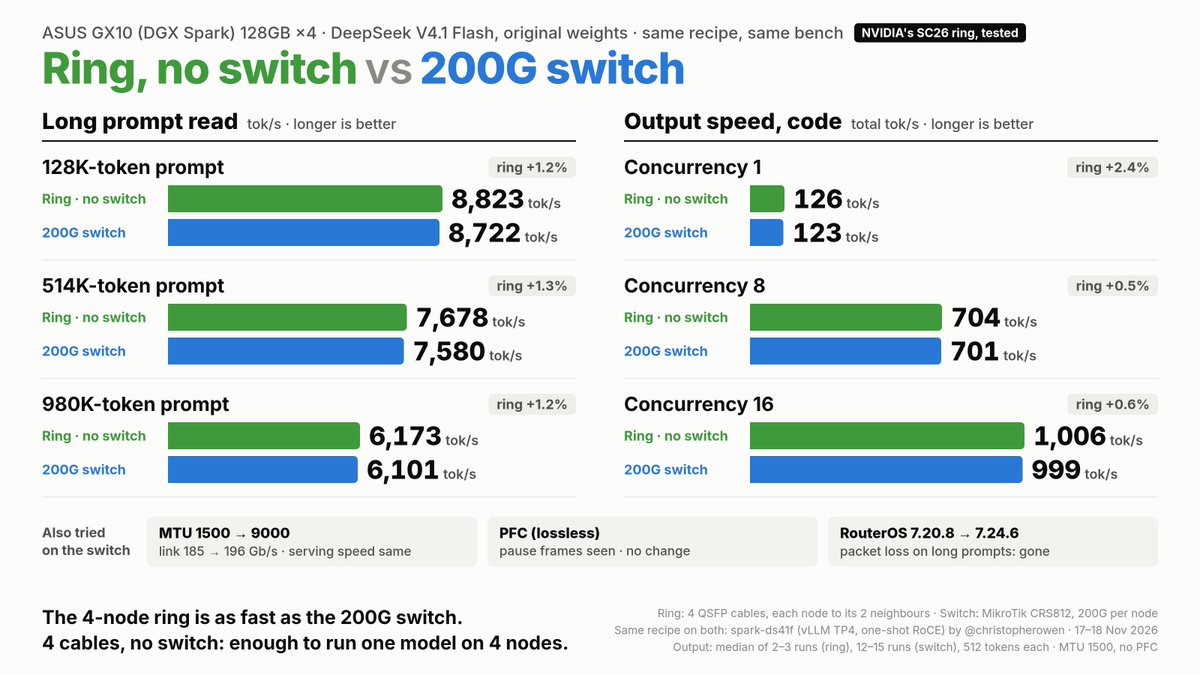
NVIDIA showed a 4-node DGX Spark ring with no switch at SC26. I cabled mine the same way and compared it with my 200G switch. ASUS GX10 (DGX Spark) 128GB Γ—4, DeepSeek V4.1 Flash, original weights, same recipe, same bench Ring vs 200G switch 128K prompt read: 8,823 vs 8,722 tok/s 980K prompt read: 6,173 vs 6,101 tok/s Concurrency 16 (code): 1,006 vs 999 tok/s Concurrency 1 (code): 126 vs 123 tok/s The ring comes out about 1–2% ahead. I don't know why. I only ran the ring 2–3 times, so I wouldn't read this as "the ring is faster". NVIDIA's own numbers have the switch about 10% ahead at 4 nodes (Qwen3.8-27B, 32.82 vs 36.34 tok/s), and I'd trust their measurement over mine. Either way the gap is small. For 4 nodes running one model, I don't think you need a switch. 4 cables are enough. The ring needs a normal LAN on every node, and all 4 run as one group only. Also tried on the switch MTU 9000: link 185 β†’ 196 Gb/s, serving speed the same PFC (lossless): no change RouterOS 7.20.8 β†’ 7.24.6: packet loss on long prompts is gone spark-ds41f @christopherowen Β· switch: MikroTik CRS812

Bar chart: 4-node DGX Spark ring with no switch vs 200G switch, DeepSeek V4.1 Flash. Long prompt read 128K: 8,823 vs 8,722 tok/s; 514K: 7,678 vs 7,580; 980K: 6,173 vs 6,101. Code output at concurrency 1: 126 vs 123; 8: 704 vs 701; 16: 1,006 vs 999 tok/s.
67 7 8374 10 3
TokensAtHome @TokensAtHome 2026-11-18T13:56:38.000Z

@seapy Great data. 1-2% either way is noise to me, the 4 cables part is what I care about. One question: how long did the ring take to set up vs the switch ? I'd rather skip buying a switch if I go to 4 boxes.

0 0 76 0 0