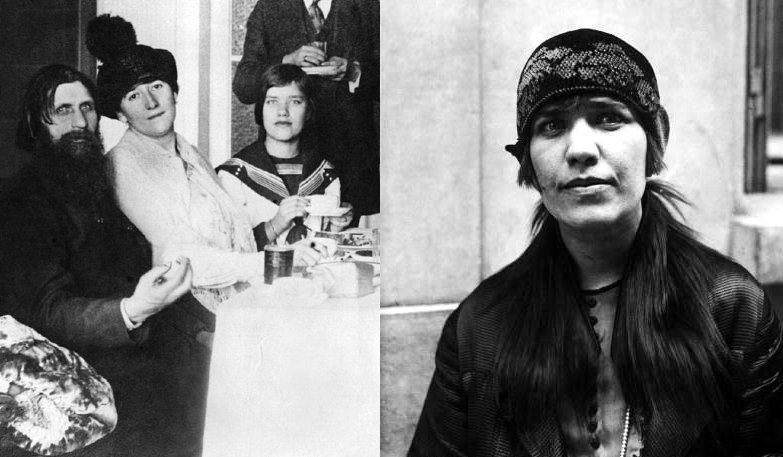
Maria Rasputin (1898–1977) was the daughter of Russian mystic Grigori Rasputin, whose life shifted from imperial court circles to exile, circus performing, and writing memoirs in the United States....
Born in Siberia, Maria moved with her family to St. Petersburg as her father gained influence with Tsar Nicholas II and Tsarina Alexandra, who trusted his ability to treat their son Alexei's hemophilia. Through her father's ties to the court, she spent time around the Romanov children, though her father also kept strict discipline at home. In December 1916, conspirators led by Prince Felix Yusupov murdered her father in St. Petersburg. Maria helped identify his belongings and body as political turmoil mounted.
. . . .
Maria Rasputin grew up watching doors open at the mention of her father’s name—and slam shut just as quickly behind it. Her father, Grigori Rasputin, was both feared and sought after, a man accused of corrupting power while simultaneously being trusted with the life of a royal heir. For Maria, that contradiction wasn’t political—it was personal. To her, he was simply “Papa.”
Then came the fall.
The empire collapsed. Her father was murdered. And everything that had once protected her became the very thing that endangered her. The name Rasputin no longer granted access—it provoked suspicion, hostility, even danger. Maria fled, not as a socialite, but as a refugee. And like so many women of her time, survival meant reinvention.
In 1917, Maria married Boris Soloviev, and they eventually left Russia amid civil war and the fall of the monarchy, settling in Europe with their two daughters. After Boris died of tuberculosis in 1926, Maria supported her family by working as a cabaret dancer and later as a circus animal trainer and lion tamer in Europe and the United States.
In Europe and later America, she turned herself into spectacle—branding her identity before the world could weaponize it against her. Audiences came to see “the daughter of the Mad Monk”… and stayed to watch her face down lions. It was part performance, part defiance. If the world saw her as dangerous, she would become something even more untouchable.
But survival came at a cost. A brutal animal attack ended her time in the ring, forcing her to pivot yet again—this time into ordinary labor, the kind history rarely records. During World War II, she worked in a Los Angeles shipyard, riveting metal alongside other women who were quietly reshaping the war effort from the inside out. No titles. No mystique. Just endurance.
Promoters leaned heavily on her Rasputin surname to draw crowds. She left the circus after being mauled by a bear in 1935 and later worked wartime industrial jobs, taught Russian and lived in California.
While the world painted her father as a manipulator who helped bring down a dynasty, Maria spent decades insisting on a different truth. She wrote. She spoke. She even took legal action against Felix Yusupov, the man tied to her father’s death—an almost impossible fight, but one she pursued anyway. Because for her, this wasn’t about history. It was about memory. About refusing to let others define the man she loved.
Even in Los Angeles, far from the palaces and chaos of imperial Russia, she held onto that identity. Teaching Russian. Claiming she inherited her father’s strange, hypnotic presence. Naming her dogs after his killer—not out of affection, but as a quiet, lingering act of control over a story that had once controlled her.
Maria wrote three memoirs defending her father's character and challenging hostile accounts of his life, culminating in Rasputin: The Man Behind the Myth (1977). Historians often treat her recollections with caution because she strongly idealized him, though her writing remains a notable first-person perspective on his final years. She died in Los Angeles in September 1977 at age 77.