When protein design meets differentiable programming
Most protein design tools assume a stable 3D fold. But many biologically critical proteins are intrinsically disordered: they never adopt a single structure, instead flickering across vast ensembles. Standard ML approaches that predict a folded structure don’t apply.
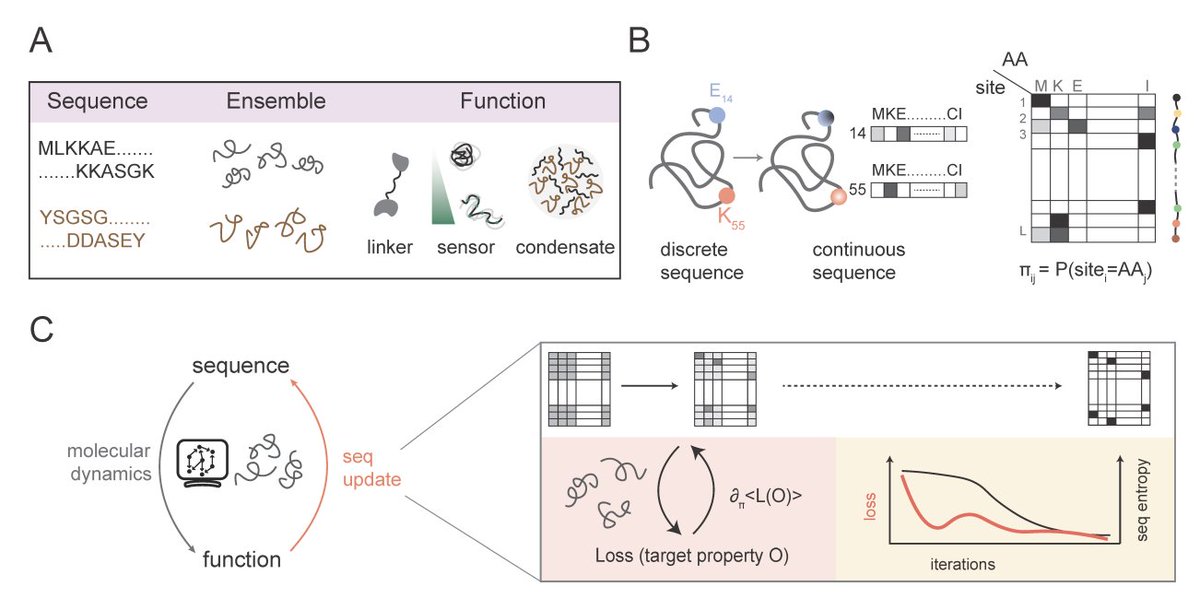
Ryan K. Krueger, Michael P. Brenner, and Krishna Shrinivas present a differentiable framework that inverts molecular simulations. The key idea: represent a sequence as a continuous probability distribution over amino acids, run coarse-grained simulations to model its ensemble properties, and then backpropagate gradients directly through the physics. This turns sequence design into an end-to-end optimization problem, where objectives can be tuned for size, flexibility, responsiveness, or binding.
With this method, the authors design disordered proteins that act as loops or linkers, remain compact yet disordered, or function as sensors that expand or contract in response to salt, temperature, or phosphorylation. They even extend it to create candidate binders for other disordered targets—long viewed as one of the hardest problems in protein engineering.
The result is a general recipe for physics-grounded differentiable design: keep the molecular simulator, make it differentiable, define the right loss, and let optimization explore sequence space efficiently. For applied ML, it’s a blueprint showing how simulation and differentiable programming can merge to tackle problems beyond text or images—pushing generative design into the messy, high-dimensional space of biology.
Paper: https://www.nature.com/articles/s43588-025-00881-y