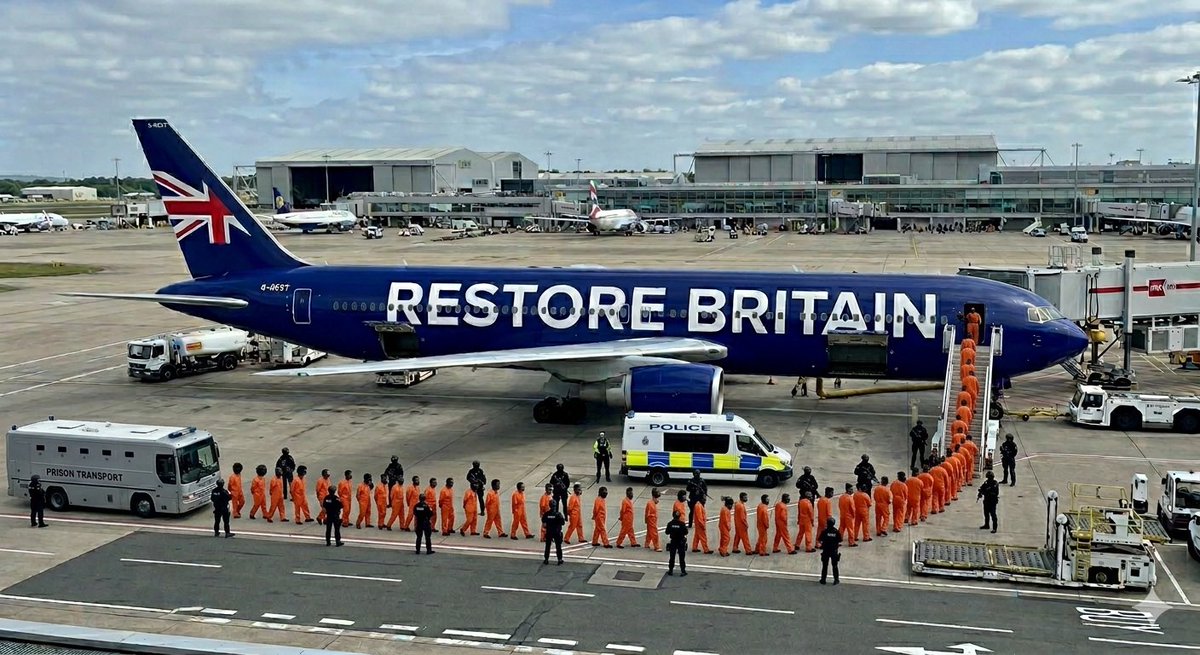
I want to put this idea to bed that it’s impossible to deport 10 million people. Not only is it possible, but I’m going to prove to you right now that it is entirely feasible and fiscally sensible. In fact, I’ll do even better than that… I’ll prove it can be done in a SINGLE PARLIAMENTARY TERM, for less than the cost of supporting those immigrants in the UK for a SINGLE YEAR!!!
Gather round as I present to you, a plan that I’m literally going to make up off the top of my head right now… @RestoreBritain, @RupertLowe10, @cfdownes_, @Harry_pitt you might want to take notes because this is bound to be an absolute belter. Here we go…
Doncaster Sheffield Airport is currently closed. It has a runway nearly 10,000ft long. They are planning on reopening it commercially next year or the year after… Scrap that. We requisition it and turn it into a dedicated deportation hub.
The cost to refurbish the airport has been estimated to be in the region of £200m. Add another £75m, because you want to increase the amount of hard standing. You’ll need that later. Add another £50m for extending taxiways, £25m for hangar upgrades, £150 for a new deportation processing building. Add another £100m for inspections, regulatory approval and contingency. That’s £600m.
Now we’re buying aircraft. 100x old 737s. There are over 150 for sale globally, they go for between £6m - £10m. Call it £10m each. That’s £1bn. Now you will want to spend another £200m to refurbish them and make sure they’re flight-worthy. Again add another £100m for inspections, regulatory approval and contingency. That’s £1.3bn in total.
Now you’re going to run 50 outbound and 50 inbound flights a day with an average of 150 people per flight (capacity is about 180). That’s 7,500 deportations per day. In 1,334 days… Roughly 3 years and 8 months… That’s 10,000,000
Can the airport and aircraft do it? Doncaster can easily handle double that number of flights per day. Presuming that 40% of flights go to India / Pakistan, 30% to sub-Saharan Africa, 20% to North Africa and 10% to the near Middle East (rough guess, but weighted towards the more distant places for contingency) the required pace for the aircraft is roughly 0.61 round trips per jet per day. Fleet readiness rates for the 737 average about 82%… 82 jests can comfortably fly around 105 OUTBOUND flights per day. Giving us massive redundancy.
So what are the flights themselves going to cost? Well in total, all of the flights across all of the jets with the destination split work out to around 864,000 block hours. Operating costs for that (fuel, maintenance, crew, insurance, etc…) shakes out to around £5bn in total. Operating the airport, the operational staff and what not for 3 years and 8 months will be another £600m. Throw in an extra £100m for any unforeseen problems.
All in, you’re looking at a £7bn operation that takes less than 4 years… The UK spends nearly £5bn a year just on migrant hotels… The true total cost of supporting immigrants in this country is conservatively tens of billions.
All of those figures are estimated at the higher end. I could probably do it cheaper. Check mate.
@Gasseous_ClayYour ridiculous post treats mass removal as a pure air-transport capacity problem. That framing collapses once the binding constraints are examined. By the way you didn’t mention other countries telling you to FO.
Civilian charter assumptions
The £75,000-per-day figure for an A320 or 737 is roughly in the range of short-haul European group-charter quotes for a single flight, but it understates sustained operations. Positioning flights, overnight crew costs, airport handling, security screening for non-compliant passengers, and escorts are routinely additional. Continuous daily utilisation of 20 aircraft also assumes an unlimited pool of airframes and crews that commercial operators will simply hand over for years. In practice, many operators decline or heavily surcharge such work because of insurance, reputation, and operational risk. The resulting £500-per-passenger figure therefore covers only the flying element, not the full system.
Military airlift claims
RAF C-17s are configured for roughly 102 passengers in standard troop seating (higher with temporary palletised seating). A400Ms are rated around 116. Your 100 passenger working figure is therefore plausible as a ceiling. What is not plausible is treating the entire fleet (8 C-17s + 22 A400Ms) as available for one dedicated passenger flight every day for years. Aircraft availability is limited by maintenance cycles, training, and existing operational commitments. Diverting the UK’s strategic and tactical airlift force at that intensity would degrade readiness for other defence tasks. The quoted daily operating costs also omit the additional security detachments, medical support, and temporary passenger configuration work required for high volume removal flights.
The “finances exist / political will” comparison
Aircraft operating costs are only one line item. Current Immigration Removal Centre capacity is approximately 2,200–2,400 beds across seven facilities; even modest expansion programmes have been slow and politically contested. Scaling detention, casework, escorts, legal representation, and reception arrangements to support thousands of daily removals would require capital and recurring expenditure far beyond the plane hire numbers. The comparison to annual asylum support spending therefore equates a partial transport cost with a full system figure.
Legal, documentation and diplomatic barriers
Removal is not an administrative bulk process. Individuals can raise challenges under the ECHR (especially Articles 3 and 8) and the principle of non-refoulement, these are assessed case by case and generate appeals, judicial reviews, and interim measures that interrupt flight plans. Large numbers of people lack travel documents; obtaining emergency documents from embassies is a known chronic delay, and many origin countries are reluctant or refuse to accept returns. Unilateral airlifts do not create acceptance on the receiving side. Historical UK removal volumes have remained limited precisely because of these constraints rather than a shortage of aircraft.
Ancillary claims (France returns, self deportation, decade scale “restoration”)
Returns to France under bilateral arrangements have been small relative to arrivals and remain reciprocal. Evidence that large scale “hostile environment” measures produce rapid mass self deportation is limited, such policies also generate legal and political resistance. Once detention capacity, case-by-case legal processing, documentation, and international cooperation are factored in, realistic annual throughput is far below the 1 million figure derived from unconstrained aircraft utilisation. The decade scale outcome therefore rests on assumptions that successive governments and courts have not been able to deliver at anything approaching that scale. 10 million deportations my arse. Xxxxxx