Peter Clack (@PeterDClack)

Peter Clack @PeterDClack 2026-11-25T09:25:37.000Z

China holds commanding dominance over the world's rare earth elements, critical metals and refining capacity. Building wind turbines, solar panels, batteries and electric vehicles at ever-faster rates — trying to keep pace with established hydrocarbon primary energy — is creating a global explosion in pressure on mining and refining. Rare elements like neodymium, dysprosium, lithium, cobalt and graphite were once mined in modest amounts for consumer electronics like mobile phones. Now they are expected to carry the workload for heavy industrial-scale grid infrastructure. A typical mobile phone contains about 1 to 6 grams of lithium, while a single EV battery typically requires 3 to 10 kilograms — more than a thousand times as much. Traditional workhorses like copper face the same surge in demand for vast new networks of transmission lines, energy assets and vehicles. This relentless acceleration has put immense pressure on a mining industry already showing signs of strain and collapse. High-grade deposits are harder to find, forcing miners to dig, crush and process far more rock for the same yield while emptying out existing mines. Finding, permitting and developing new mines takes years, often a decade or more. Geopolitical friction, export restrictions and hurdles like safety and regulatory costs for large-scale battery storage only compound the crush. The sheer scale of wind and solar production is creating bottlenecks and driving price volatility, leaving overstretched supply lines and mines running out of juice. The world simply can't outrun geology or accelerate mining timelines developed over centuries.

99 49 2039 5 3
Peter Clack @PeterDClack 2026-11-24T23:04:59.000Z

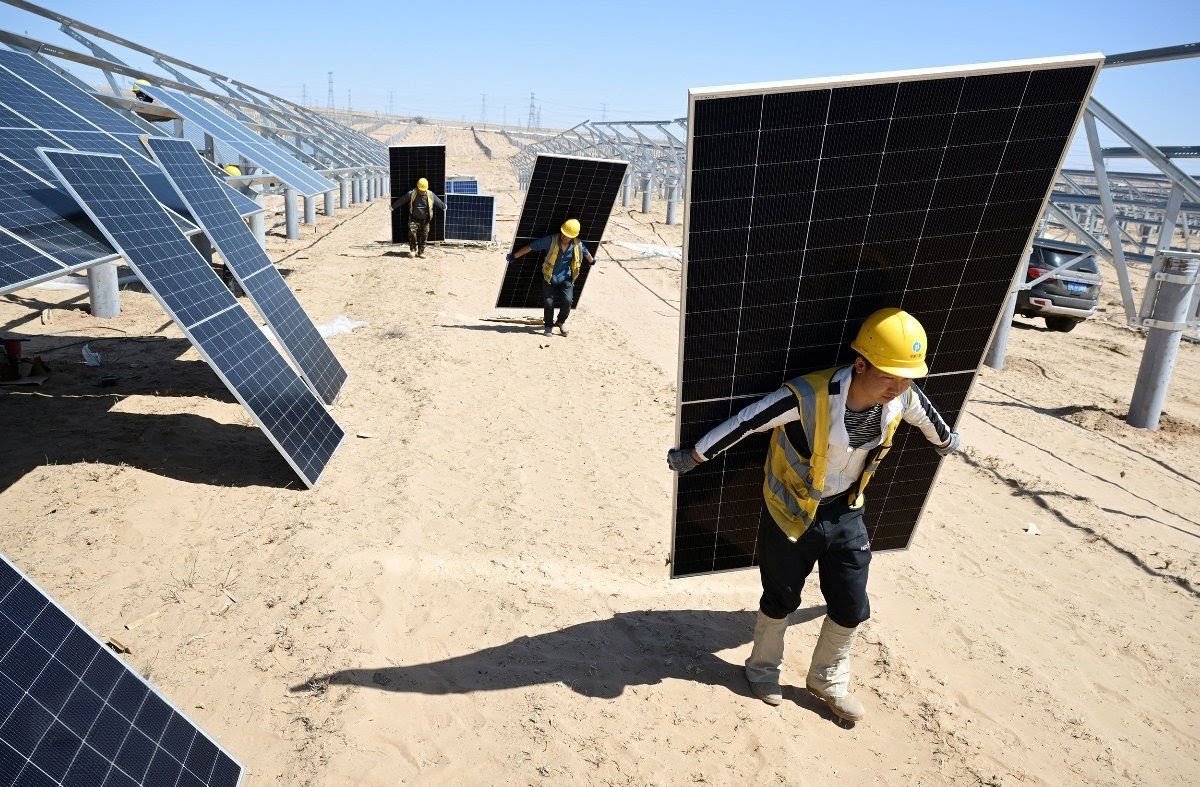
China has achieved a near-monopoly on refining critical minerals like lithium, cobalt and rare earth elements — while flooding global markets with solar panels, wind turbines and EV batteries. This represents a profound strategic miscalculation by the West. Decades of heavy subsidies, state planning and aggressive climate mandates have created a stark paradox: pursuing decarbonisation now requires an endless transfer of Western wealth to its major geopolitical rival. The West is blindly replacing historic dependence on Middle Eastern oil flows — with absolute reliance on Chinese industrial hardware and it's refined mineral supply chains. By degrading abundant, reliable hydrocarbon energy in favor of weather-dependent renewables, Western nations have wrecked their own energy security. Rising electricity costs and grid instability have driven out high-paying jobs, throttling the once working-class backbone of Western economies. Essential core sectors are now unable to produce basic components without China, which produces more than half the world's steel and roughly 90% of its solar photovoltaic components, refined critical minerals and battery cells. We have handed the keys to the modern energy system to Beijing — cementing China as the world's manufacturing superpower.

397 176 10511 47 22
Shenzhen 老孙 @sun_jun69301 2026-11-25T08:07:08.000Z

The West moved its manufacturing to China decades ago, and now it has discovered that even its energy transition depends on China. Suddenly, Chinese industrial dominance is a national security threat. 😂 They don't want to invest, build factories or do the hard work of developing supply chains, yet they expect China to manufacture affordable products without becoming better at it. It's like outsourcing your entire kitchen to a Chinese chef, enjoying the food every day, and then banging the table: "How dare you become the world's best chef in MY kitchen?"

8 0 161 1 0
Peter Clack @PeterDClack 2026-11-25T01:17:40.000Z

Today’s global climate framework rests on a glaring contradiction: the greatest manufacturing superpower in world history is still officially classified as a 'developing' nation. China builds nearly all the wind turbines and solar panels on Earth (around 90%), operates the largest fleet of coal-fired power stations in history (roughly 1,200), and produces nearly a third of global carbon emissions — more than the United States, the European Union and India combined. How did this happen? Through the blundering architecture of the United Nations — that's how: the world's largest unelected bureaucracy, commanding over 120,000 personnel and nearly $70 billion funding from member states. While Western economies dismantle their coal and gas infrastructure to chase strict net-zero targets — triggering soaring energy costs, deindustrialisation, and economic strain — China operates under exemptions designed for impoverished nations like Bangladesh. Backed by abundant and cheap coal power, Beijing continues to approve and build new coal capacity at a rapid pace, sometimes up to two new plants a week, to guarantee reliable electricity for its factories. Handed heavy industry on a plate by wayward UN leadership, China now produces over half the world's steel. It virtually controls rare earths processing. It dominates the supply chains for the very wind turbines and solar panels Western nations are spreading across their countrysides. The paradox? The West hollowed out its industrial base to cut emissions, while the world’s largest carbon emitter expanded its fossil-fuel-driven dominance to superpower status — under UN protection. This collision of policy and reality is no freak accident. It stems from a structural flaw built into the UN Framework Convention on Climate Change ahead of the 1992 Rio Earth Summit — long before 'net zero' became global dogma. To secure signatures for a single global treaty, negotiators divided the world into two rigid camps based on the economic realities of 1990. Annex I covered wealthy, industrialised nations deemed responsible for historical emissions and tasked with bearing the immediate burden of cutting them. Non-Annex I grouped every other country — including China and India, which were portrayed as rural at the time — granting them exemptions so their economic growth would not be capped. Thirty-four years later, that map from the past is etched in time. Unlike World Bank mechanisms, this treaty has no graduation clause — no off switch. The excuse is simple: because the UN operates by consensus, a country cannot be moved out of the 'developing' tier without its own permission. Nor does the UN even try. Beijing and New Delhi flatly refuse to yield that status, arguing their per-capita wealth still trails the West and large rural populations remain poor. That single technicality shields their industrial sectors from binding emission caps regardless of aggregate economic or manufacturing might. Look at the result: the West is shedding its industrial core while yesterday's 'developing' nations have become global superpowers. What began as a diplomatic cushion for struggling economies has hardened into an entrenched, one-sided geopolitical advantage. It is just one more legacy from a UN that has long outlived its use-by date.
533 240 7331 33 25
Peter Clack @PeterDClack 2026-11-24T07:56:15.000Z

China now dominates the entire manufacturing world; it produces more than half of all steel, almost all the renewables and component parts, and has industrial power second to none. This represents the largest, quietest transfer of industrial might in history. It is nothing short of a modern-day miracle. Yet the Western world — paralysed by the imminent crisis of dismantling its own baseload power — slumbers at the wheel. But brilliant China is not asleep. This inspired, red-hot industrial powerhouse manufactures 80% of all solar panels, 75–80% of all batteries, 60–65% of wind turbine parts and 55% of the world's crude steel. In manufacturing dominance, it is greater than the next 15 countries combined — larger than the US, EU and Japan together. To power this industrial onslaught, China has been commissioning around six state-of-the-art coal units a month (50–80 GW a year). Beijing operates roughly 1,200 coal plants totaling over 1,200 GW — more than half the world’s total coal energy capacity. Its coal mining output is more than four times larger than second-place India. As a result, China’s share of global manufacturing has soared from 6% to 30% since 2000. Meanwhile, America’s has plunged from 25% to around 12%, and Europe’s has collapsed from 25% to around 14%. China uses abundant, reliable coal power and refuses to bind itself to Western net-zero timelines. Its leadership treats factories and steel mills as critical assets — unlike leaders in the West. In geopolitical terms, this should be a lightning rod for decaying Western preeminence. Instead, the job is just about done: the Western green transition is almost completely dependent on hardware manufactured by its chief global competitor. This rise to world supremacy was only possible by using the very same dense hydrocarbon energy whose demonisation has already sent the Western world broke. China's glittering rise against the odds should be the biggest, loudest and most outrageous news story in history — but it hardly rates a mention.

2362 989 48751 220 140
A Patriot @PlebeianHero 2026-11-24T10:14:13.000Z

@PeterDClack The UK sold its heavy industry to Japan starting in 1970. Today we are just a banking cartel with 80% of or "services" being in banking, no more dirty working class people making ships and cars its all been sold to Asia.

23 2 1350 3 0
Peter Clack @PeterDClack 2026-11-23T22:14:17.000Z

Almost all the reinforced concrete foundations of wind turbines ever built — many of them now weighing a thousand tonnes each — are being left in the ground for good. It's another legacy of our world in transition. Hundreds of thousands of turbines and billions of solar panels now occupy huge areas of once-open landscapes everywhere. The basic flaw lies in the scale of a vast structural overbuild in an effort to capture intermittent energy from wind and sunlight. But no matter how many turbines and panels are built and spread across the world, they can never match or replace the dense baseload power of traditional hydrocarbon fuels. Over the decades, these massive blocks can disrupt deep-soil hydrology and remain as permanent industrial junk just below the surface of rural landscapes. The concrete base of a typical early 2–3 MW turbine weighs 400 to 800 tonnes. Foundations for modern 5 MW+ turbines exceed 1,000 tonnes. The number reaching the end of their working lives will soon surpass tens of thousands, installed at a staggering cost across the globe. While fluids like gearbox oil and hydraulic lubricants are drained when towers are dismantled, the subterranean concrete itself is rarely touched. In most jurisdictions, decommissioning rules only require clearing the foundation to a depth of 1 to 1.5 metres below the surface. The financial reality is murky. Bank guarantees or bonds (often around $100,000 per turbine) fall well short of the removal and restoration costs of $200,000 to $400,000 per unit. Even as states like NSW move to tighten rules for future disposals, thousands of existing turbines sit under older permits. Operators can simply walk away, leaving landowners holding the bag. We're seeing this play out at Victoria's Codrington wind farm, which is due to close in 2027. Operators plan to remove only the top 1.5-metre pedestal, leaving roughly 7,000 tonnes of subterranean steel and concrete permanently buried — a precedent triggering fierce backlash from local communities and MPs who argue it violates the original promise to restore the land. No one wants to pay to excavate these concrete monoliths once the turbines stop spinning. But what is even worse, no one appears to care.

2560 1240 39929 208 114
Peter Clack @PeterDClack 2026-11-24T05:07:23.000Z

Key claims in Al Gore's 2006 documentary - An Inconvenient Truth - were overstated, false or misleading. Climate scientists and the 2007 UK High Court ruling (Dimmock v Secretary of State for Education and Skills) found that while the film was broadly grounded in climate science, it contained nine significant errors — largely involving exaggeration, omitted timeframes, or overextended attribution — and required balanced guidance notes for schools. Key overstated or disputed claims often highlighted from the film include: Snows of Kilimanjaro disappearing within a decade: While glaciers and snow cover have declined somewhat, snow has not disappeared. Researchers note that seasonal snow changes and dry air/solar radiation also play roles in local variability. Sea levels rising by 6–7 metres: Gore's simulations showed severe coastal flooding in Florida, San Francisco and Lower Manhattan. Climate scientists and the UK court ruling noted this scenario was false; extreme ice-sheet collapse would occur over a much longer timeframe (centuries or more) rather than causing imminent flooding. Pacific island nations being evacuated: The film suggested low-lying Pacific atolls would have to be evacuated due to rising seas, which the UK court ruling cited as overstated or unsubstantiated. Hurricane Katrina: The film linked 2005's Hurricane Katrina directly to climate change and said storms would become more frequent and intense. Scientists and the UK ruling noted that attributing a single storm directly to climate change went beyond the evidence. Lake Chad shrinking: The documentary attributed Lake Chad's shrinking to global warming, whereas the UK ruling and subsequent analyses noted that water diversion, irrigation and regional weather patterns were major drivers. Shutdown of the Atlantic 'ocean conveyor' (AMOC): The film said warming would disrupt global ocean circulation and trigger abrupt cooling in Europe, which the UK court listed as overstated. Polar bears drowning in large numbers: The film depicted polar bears struggling in open water as a direct result of sea-ice loss. The UK court ruling noted that while sea-ice loss could threaten habitat, bears were not drowning in large numbers — an extrapolation from the evidence. The year after the film's release, Gore shared the 2007 Nobel Peace Prize with the Intergovernmental Panel on Climate Change, receiving approximately $750,000 (half of the 10 million Swedish krona prize, worth about $1.5 million total at the time). For a detailed walkthrough of the Dimmock ruling and these points, see Simon Clark's video, The Many Errors of An Inconvenient Truth: https://youtu.be/uxiHzjH-uIo?si=l7uZ5JdkNbaJQOHB

1299 566 24589 96 55
Peter Clack @PeterDClack 2026-11-23T09:30:53.000Z

When world flashpoints ignite - like the Strait of Hormuz blockade - the United Nations is now almost always absent and silent. This is not an operational oversight; its a structural defect built directly into the Security Council veto. The UN is unable — or unwilling — to fulfill its primary objective. Instead it has turned inward to survive: a classic case of institutional mission creep. Today, it has morphed into the largest unelected bureaucracy in world history, absorbing $68 to $74 billion annually. This includes several billions for rare peacekeeping operations and $3.5 to $3.7 billion just to maintain a vast workforce of up to 190,000 personnel. This huge bureaucracy is adrift in the world; and it operates in isolation from ordinary economic reality. Under the 1946 Convention on the Privileges and Immunities of the United Nations, UN staff also enjoy broad privileges, like exemptions from national income taxes on their salaries. Meanwhile, the world's taxpayers funding this monolith face escalating tax burdens driven increasingly by the UN's costly climate and economic ideology. Established after World War II with a mandate to resolve international conflicts and prevent wars, the UN’s core peacekeeping mission is eternally gridlocked when and where it matters most, because any permanent member can block resolutions at will. The UN has redirected its authority toward climate change and interfering in illegal migration flows. Treaties like the UN Framework Convention on Climate Change operate unhindered by Security Council vetoes, allowing unelected officials to oversee vast financial movements — including billions earmarked as carbon credits and the Green Climate Fund — with little to no democratic accountability. In practice, these strict emissions appear to target Western industries, while China and India freely expand vast coal-powered production under developing-nation exemptions. It is global wealth redistribution disguised as environmental stewardship. A similar pattern of bias against Western interests governs it's considerable involvement in fostering cross-border illegal migration. Through cash-card programs, transit shelter networks, and legal frameworks like the Global Compact for Migration, UN agencies actively institutionalise and facilitate mass population flows. This erodes national borders and sovereignty in the process. Unable to stop wars, and rarely offering more than hollow statements, the UN’s survival now depends on fabricating fresh climate mandates. It has traded its original peacekeeping purpose for climate control, wealth transfer, and migration management. The UN continues to fabricate fresh climate mandates — even as summits like COP31 collapse in public disarray. IMAGE: COP31 fails to deliver climate unity in Türkiye.

452 200 6464 48 25
Peter Clack @PeterDClack 2026-11-22T08:47:09.000Z

Earth’s average global temperature sits at roughly 15°C — nearly 10°C colder than the 24°C average across the entire span of life on land. We are not living through an unprecedented heat anomaly. We are within a geologically rare icehouse era — the Late Cenozoic Ice Age — that began around 34 million years ago. For the past 2.58 million years, the planet has been locked into one of the most severe glaciation cycles in half a billion years. Yet the modern climate agenda treats the 15°C baseline as a razor's edge, relying on alarmist language like 'global boiling' while ignoring deep-time reality and lessons from the past. Decades ago, high-profile forecasts predicted the polar ice caps would vanish within ten years. Both ice caps remain intact today. Runaway global warming is no longer even mentioned. The same distortion applies to atmospheric carbon dioxide. At 420 parts per million — just 0.04% of the atmosphere — CO₂ is sitting near a historic floor, down from the peaks of 4,000 to 7,000 ppm during the Cambrian Explosion, when all multicellular life emerged. To turn a trace gas into an existential crisis within a few decades requires a statistical accounting system that divides global atmospheric totals into ledger entries per country. This mad race to net zero treats a complex and ancient planetary system as profit and loss columns on a bureaucratic spreadsheet.

2394 1020 33862 101 70
EIKE @EIKE_KLIMA 2026-11-22T16:55:55.000Z

@PeterDClack Die Weltgemeinschaft hat sich gegen die Klimareligion und für Wohlstand entschieden. Nur Minister Schneider wird dafür sorgen, dass wir diesen Schlamassel bis zum Ende ausbaden.

14 0 120 1 0
Peter Clack @PeterDClack 2026-11-23T04:14:29.000Z

The unity of the Paris era is crumbling as pure rhetoric collides with hard reality. Nations cannot keep bankrupting their own economies when even the atmosphere ignores every pledge ever signed. Everyday people are paying the price for this ideology in higher energy costs. Antalya may be remembered as the final straw — not over a missing line in an unsigned UN text, but because the theatre behind the curtain is harder to hide. After forty-four hours of overtime, COP31 broke down without a deal as nearly two hundred nations deadlocked over leaving 'fossil fuels' out of the final text. Presided over by Australia’s Climate Change Minister Chris Bowen — an awkward fit for a country built on coal and gas exports — the impasse is already being mourned in Western capitals as a blow to global solidarity. In truth, economic and physical limits have finally punctured thirty-one years of diplomatic routine. Western nations pushing toward 'net zero' have hit a wall, hollowing out industries and driving up power prices. Developing nations and energy producers have drawn a straightforward conclusion: they will not sign deals that deny their citizens cheap, reliable baseload power. Bowen even had the gall to offer vastly more generous climate reparations for poorer countries, always ready to sign a blank cheque on Australia's behalf. Except we pay, not him. Meanwhile, the physical data lacks the urgency needed to sustain the 'Code Red' dramatics. CO₂ sits around a steady 427 parts per million at Mauna Loa, and global temperatures have been flat for two years. https://www.facebook.com/share/v/14vmTtikrAu/

1176 387 22026 95 32
EIKE @EIKE_KLIMA 2026-11-23T09:08:21.000Z

@PeterDClack Was aktuell in Antalya passiert ist, ist der Anfang vom Ende der Klimareligion. Aber das Ganze wird dauern. Zum Schluss wird sich entscheiden, ob die EU und mit ihr Deutschland erst am Ende ist, vor dem Ende der Klimareligion, oder umgekehrt. Ich hoffe auf letzteres.

12 1 249 2 1