Patrick C. | The RTX 3090 Whisperer (@MythomancerX)

Patrick C. | The RTX 3090 Whisperer @MythomancerX 2026-11-18T01:59:30.000Z

I run Qwen3.8-27B on one 3090. No cloud, no per-token bill. What I've measured on it so far: 74 tok/s stock, 157 with DFlash2 code 78-79 tok/s, prose 58-64 64k-token prompt: 63 s to the first word 13.5 W idle, about 340 W generating same model won't fit on my 16GB 4060 Ti, split with system RAM it does 7 tok/s I post every run. Starting local AI? Reply with your GPU and I'll tell you what to run first. Want help building yours: http://iconic.onl

Terminal output: Qwen3.8-27B on an RTX 3090, 74 tok/s baseline vs 157 tok/s with DFlash2
5 0 243 2 0
elie @eliebakouch 2026-11-25T01:38:27.000Z

openai recently shared perplexity numbers for their models on their internal codebase. this is super valuable information and we need more public comparisons like this, so here is a first try with open models introducing v0 of pre-training index https://eliebak.com/pretraining-index it covers 27 open models (base and post-trained) on ~260 curated sources (code, math & science, systems writing, essays) + uncheatable eval there are a few challenges with comparing perplexity across models. first if the model is train on a document it can easily mememorize it and then have veryyy low ppl on it. one obvious fix is to only use very recent documents that can't be in the pretraining corpus, which is what uncheatable eval does (50% of the index). but i was a bit frustrated because it cuts a lot of the sources you can include, so i tried a few ideas first, you can compute a win rate, if a model memorized a doc its loss collapses, but if you use win rate that only counts as one win (hence kinda normalize the importance of each document) second, you can try to detect outliers (document where model have insanely low loss on) loss(model, doc) ~ difficulty of the doc + skill of the model + r difficulty is the median loss of all models on that doc, skill is how much better the model usually is than the median of other document in the sources and r is what's left. r < -2 means a loss 4x lower than expected this seems to work pretty well. on uncheatable eval (published after every model's cutoff) only ~1% get flagged, vs 27% of older docs. by default the index drops every old doc that any model flags (with r < -2 as the threshold) for all models some other notes - i didn't have time to "base recover" the post-trained models, so keep in mind their base model perplexity is likely much lower! i think there is a lot to study here, especially the impact of SFT, distillation and RL on ppl - for the curated sources, i took some of my favorite blogs and some i know high quality sources, gave them to neon, opus, sol and a few more models and asked them to find more like these and just iterate with models and looking at data. i know source quality is probably not the biggest differentiator here, oai does it only on their held out codebase, but there is something cool about evaluating how well models do next token prediction on the best stuff humans wrote - i would prefer held out set for everything obviously, but i wanted to try to see a bit how we could detect memorization, and if/how it matters for different model and training process likely have impact on this! you can make the index 100% of uncheatable eval to remove as much as possible memorization - i also asked a model to filter out heavily ai generated code/text on some sources, but i think it's relatively fine to have some llm generated data here (i know there is some). it might be a bigger issue for oai/anthropic models since they write a lot of code - you can customize everything and build your own index by changing the weight of each domain, toggling sources on/off, picking the r cutoff, and clicking any document to see which models look like they memorized it - there is also a lot of cool work on compression/memorization by nicholas carlini and others that i need to look into more! - this first version of the index is OBVIOUSLY not good to compute ppl threshold to release model or not, probably a lot of way to under/overfit on it, and not the goal here wanted to share this publicly quickly, i'll keep improving it when i have time and look for better ways to handle memorization. please give feedback and send cool resources to include!!
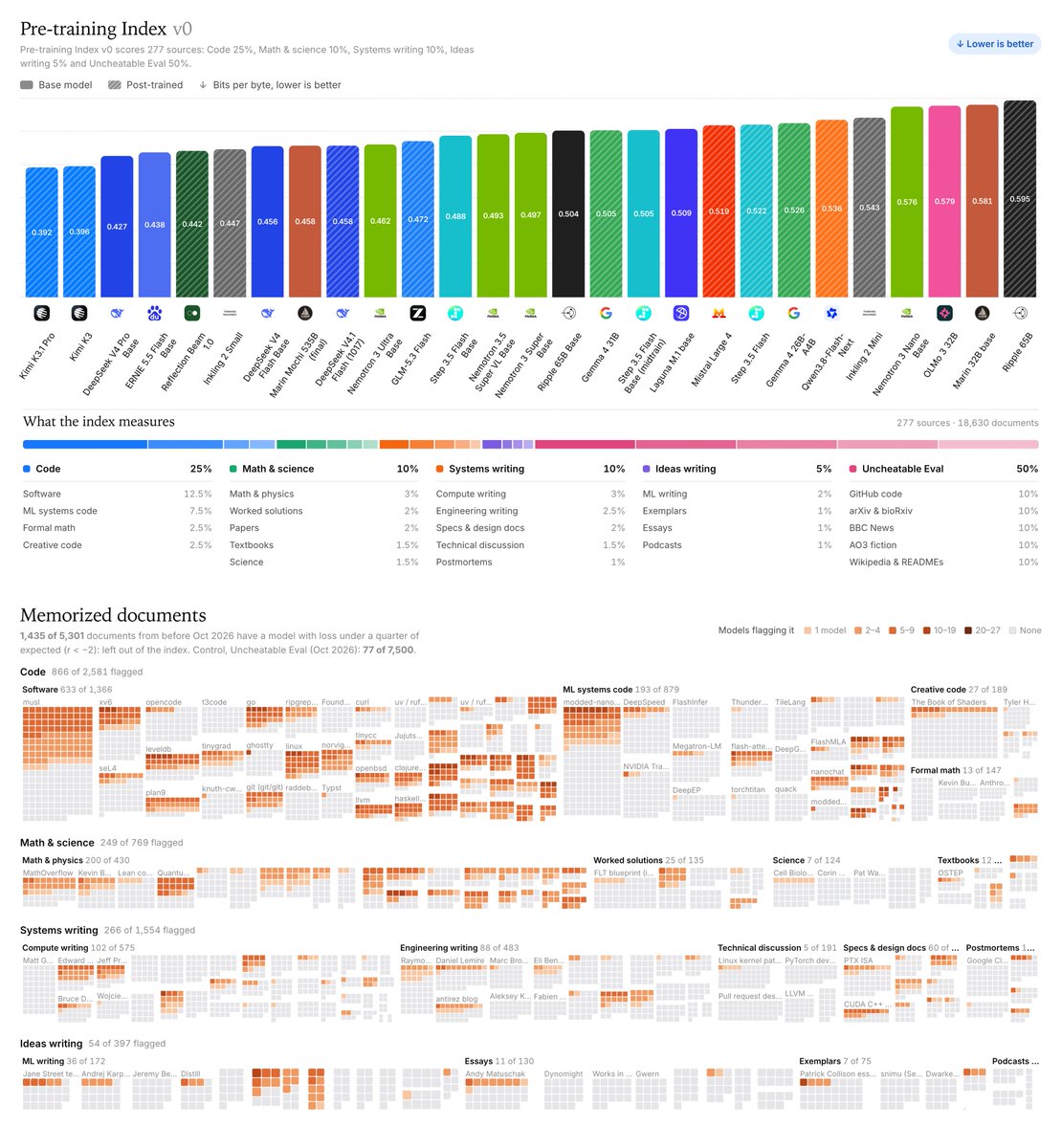
60 14 3591 18 1
Tiezhen WANG @Xianbao_QIAN 2026-11-25T00:51:30.000Z

Still remember the ChatGPT-Voice demo from the GPT-5 launch a year ago? It was one of the first products that really showed what real time native multimodality could feel like. And it looks like the researcher behind it, Ruochen WANG, has left OpenAI. Based on his profile page: > Finished his PhD at UCLA (with an ICLR Outstanding Paper in year one) > Worked across core GPT, Sora, and Robotics stacks > Shipped that launch demo within 5 months of joining OpenAI. With a rare mix of frontier research taste, experiences across multi-modality, and production experience. I'd be curious what he is going to build next? Source: https://mp.weixin.qq.com/s/2wceg0QtOf_iFS1BM17ojQ

4 1 527 2 0
Patrick C. | The RTX 3090 Whisperer @MythomancerX 2026-11-25T00:53:33.000Z

8GB card? Pick your context size before you pick the model. Qwen3-8B Q4_K_M, llama.cpp, default f16 KV, on my 4060 Ti 16GB (nvidia-smi, whole card): 8k ctx: 6,660 MiB 32k ctx: 10,110 MiB decode 53.1-53.5 tok/s at both The file is 4,795 MiB. Going 8k to 32k added 3,450 MiB, so on an 8GB card stay near 8k or test a quantized KV cache. ~760 MiB was already in use before load.

Terminal output: Qwen3-8B Q4_K_M on an RTX 4060 Ti uses 6660 MiB at 8k context and 10110 MiB at 32k context, about 53 tok/s at both; model file 4795M; 754 MiB in use before load
1 0 34 1 0
FHILY👑 @Oluwaphilemon1 2026-11-24T23:59:29.000Z

Qwen3.8-27B Runs at 52 Tokens/s on an RTX 3060 With 12GB VRAM A single RTX 3060 with just 12GB of VRAM is reportedly running Kintsugi-27B, a heavily quantised Qwen3.8-27B derivative, at approximately 52 tokens/s, with a configured context window of 262K tokens. Here are the reported specifications: GPU: RTX 3060 12GB Model size: 10.5GB Quantisation: 2.47-bit VRAM usage: 11.5GB Context: 262,144 tokens Decode: ~52 tokens/s Prefill: ~680 tokens/s How does it work? The setup combines four inference optimisations: 1. Aggressive quantisation The 2.47-bit quantisation compresses the 27B model into approximately 10.5GB, making it possible to fit the weights into the RTX 3060’s limited memory alongside inference overhead. 2. Q4_0 KV cache Both key and value caches use Q4_0 quantisation, reducing memory consumption as context grows. 3. Flash Attention This improves attention memory efficiency by reducing intermediate memory requirements during computation. 4. DFlash2 speculative decoding A separate draft model proposes up to seven tokens per round. The main model verifies them, potentially accepting multiple tokens at once and reducing sequential decoding work. The developer’s configuration also enables a 262K context, Flash Attention and GPU KV-cache allocation. One important distinction: 262K is the configured context capacity, not a guarantee of consistent speed or perfect retrieval at that length. Similarly, the reported 52 tokens/s is workload-specific, while 680 tokens/s measures prefill rather than generation. Still, running a 27B model on a 12GB RTX 3060 at a reported 52 tokens/s is an impressive local inference experiment. It shows what aggressive quantisation, memory optimisation and speculative decoding can achieve together. https://x.com/DogukanUrker/status/2124477986334274022/video/1

7 2 1966 1 2
imjustnewatai @imjustnewatai 2026-11-24T23:43:03.000Z

🚨Rumors I've been hearing. OPENAI & ANTHROPIC. Both OpenAI and Anthropic has reached the threshold of super intelligence, and this is causing massive panic and hysteria inside the labs. Axios even reported today that employees at both labs don't think the internal models can be safely released, and people inside are debating whether to keep training new models at all. RSI is possible right now, the models they have now can already recursively self improve, but both labs are working together in some sort and holding the brake on it, they are not letting it happen so fast. Both CEOs already said publicly back in September that it's time to slow down, and this is why. The internal models are way ahead of what the public has. Navier Stokes in September and Riemann last week are just the ones the public got to see. What I'm hearing is that P vs NP has been solved internally too and P = NP, which would make every proof just a search, and building a better model too, which is why RSI could go insanely fast if they let it, and that's exactly why both labs are on the brake. THE CIA HACK. This is where it gets scary. The CIA and ODNI just had a breach of an unclassified network they use for open source intelligence, and it reportedly happened the same day the FBI's crime database got hit last week. Nobody has said who did it or how they got in. Officials are saying AI is finding vulnerabilities so fast that agencies have been rushing patches and breaking their own systems, that's the "maintenance" outages everyone has been seeing. The FBI also put out a warning this month about AI agents that attackers are using to hack on their own. Nobody has tied the CIA breach to AI yet, but with all of this happening in the same month I don't think it's a coincidence. The next few months are going to be so weird, so fictional, so insane. Please take care of yourself it’s going to get alien.

1744 120 297605 161 38
Token Gremlin @TokenGremlin 2026-11-24T21:39:35.000Z

NO FUCKING WAY. Bro left Anthropic, played WoW for several weeks, probably had some fun playing GTA 6, and then joined OpenAI. OpenAI now has two former KEY Anthropic employees. The creator of Claude Code for Desktop (@amorriscode) and Anthropic's former Tibo (@trq212). The potential for Codex improvements is insane. We should start seeing them soon.

@ArfurGrok

✅ Thariq Shihipar (@trq212) has joined OpenAI.

970 33 121213 58 10
Sam Pullara @sampullara 2026-11-24T20:53:49.000Z

this has been super fun to use and work on to make a truly agent first dedicated coding OS. also now tested on M1 though working on moving it from Asahi to Aurora to get access to better deepsleep. https://t.co/3E3hf3pLuF

@sampullara

i have bad news. this laptop performs basically the same as a modern laptop for this use case and it has a much better keyboard. spent over 5 hours today developing on it. a pleasure!

8 0 614 1 0
nisten @nisten 2026-11-24T20:31:55.000Z

100 tps in the browser on a 7 year old GPU btw https://prismml-eng.github.io/Talk/ https://t.co/i5c2Y7uyf3

@PrismML

Today, we’re releasing Ternary Bonsai 2.5 27B. An upgrade to Ternary Bonsai 2 27B, with substantially stronger agentic coding, multi-turn tool use, and long-horizon task execution. All within the same 5.9 GB model footprint. Based on Qwen3.8 27B, the model is 9x smaller than its full-precision counterpart. It scores 73.9 on tau3-bench and 75.6 on SWE-Bench-Verified, making it the strongest AI model of its memory footprint for agentic workloads. Compared with Ternary Bonsai 2, Ternary Bonsai 2.5 completes tasks in fewer turns, uses fewer tokens, and delivers results faster and more accurately. Available today under Apache 2.0.

19 3 930 1 0
huihui.ai @support_huihui 2026-11-24T19:33:49.000Z

The UD-IQ1_S version of GLM-5.3 is 217 GB, while the Q8_0 is 801 GB, so there’s still a noticeable gap. We uploaded this because someone needed it — if no one had requested it, we wouldn’t have uploaded it. Since it’s already uploaded, we might as well see if anyone else needs it too.

0 0 6 1 0
Ash Hart @ashxhart 2026-11-24T19:27:57.000Z

I deleted my original post as I could not edit it, and I wanted to be 100% clear about what T3 Code is doing. Oh dear @theo 👎🏼 T3Code collecting privately identifiable info and sending it via your telemetry endpoint isn’t good. 😬 Glad I never installed it. Things it reads & sends back; - Claude and Codex credential files to hash your account IDs - Userspace data - Browser data - Vairious other things.

@realchendahuang

最近 X 上一堆人在推 @theo 做的开源项目 T3 Code,吹它是自由开源的本地 AI 编程神器。 我顺手把它的源码从头到尾扒了一遍,看完只觉得背脊发凉,这哪是什么良心开源,分明是一场明目张胆的数据收割。 事情得从今年 3 月说起。3 月 6 日,T3 Code 合并了 PR #174,直接塞进了默认开启的 PostHog 遥测。那时候仓库里没文档、软件里没弹窗、设置里没开关,关闭用的环境变量就那么悄悄藏在代码深处,普通用户装上运行,数据就开始往外传。 可就在默认遥测偷跑的这整整三个多月里,T3 Code 官网首页还一直明晃晃挂着两行大字承诺: No telemetry / Unless you opt in. Full stop.,意思很明确,除非你主动同意,否则零遥测,没有例外。 靠着这块金字招牌收割了一波讲究隐私的开发者口碑之后,直到 6 月 18 日,@theo 自己在一次首页改版 commit 里把这两行承诺静默删了,既没有发公告,也没有给老用户弹一句提醒,就像什么都没发生过一样。 如果只是藏着掖着收点版本号,很多人或许还能忍。 可到了 10 月,@theo 亲自提交 PR #15028,直接把每 10 秒一次的批量上报切到了自建服务器 https://t.co/WOgVQPKbCD,代码注释写得清清楚楚,T3 服务端会先把每条原始事件自己留存一份拷贝,再转发给 PostHog。 你的模型选择(连你自己接的私有模型名字都报)、权限模式、每次运行的耗时、输入输出与缓存 Token、本地有多少个项目和线程、点过哪 30 多种界面功能,连同操作系统和设备型号,全都源源不断送进他的数据库。 10 月 19 日,@theo 更进一步,亲自提了 PR #21506,理由是现有的统计口径不够准,没法知道一个人到底装了几台机器。 于是他干了一件极其越界的事,在 Identify.ts 里写代码,直接把手伸进用户电脑家目录,静默读取隔壁工具 ~/.codex/auth.json 和 ~/.claude.json,把里面的 OpenAI user_id 和 Claude accountUuid 抠出来,连同 T3 Connect 账号和设备 ID 一起做了无盐 SHA-256 哈希往上传,专门用来在后台把你名下所有电脑和账号串成一张网。 嘴上轻飘飘管这叫匿名使用数据,稍微懂点技术的人都想笑。无盐哈希碰到服务端手里原本就有明文的 T3 Connect 账号,拿哈希一碰就能精准反查到你是谁,第三方账号 ID 一旦泄露同样能轻松关联回真人。 除此之外,软件里还有一套发往 Axiom 的中继诊断追踪,官方自己在文档里都承认,浏览器版和移动端根本关不掉,也不认你在服务端配的环境变量。 更赤裸的嘴脸,写在社区和他们的每一次交锋里。 6 月 23 日,有开发者在 Issue #1397 里客客气气提议,能不能在设置页加一个关闭遥测的开关。 核心维护者 Julius 直接把帖关成 not planned,留下了一句堪称开源史奇观的原话: We will not make this easier to opt out of, it is crucial for us to know how many users we have,翻译过来就是,我们不会让关闭遥测变得更容易,知道有多少用户对我们至关重要。 7 月有人翻出官网存档截图,开 Issue #4123 质问他们为什么一边承诺零遥测一边默认偷跑。拖到 10 月 21 日,@theo 的账号拿一个毫不相干的修复草草把帖关了,被评论区群嘲之后第二天勉强重开,到了 11 月 4 日干脆一声不吭再次关死。 社区里不信邪的程序员,从 9 月到 11 月前前后后白送了四个加设置开关的 PR,分别是 #13458、#16763、#21248 和 #27077,结果无一例外全被拒之门外。 最新那个 #27077 甚至已经通过了维护者实机验证,147 个测试全部跑绿,11 月 17 日还是被一句话直接关掉,顺手贴了个 unwanted 的标签。 说到底,T3 Code 免费开源不收订阅费,真实去重用户数和各家模型的 Token 消耗占比,就是 @theo 拿去跟大模型厂商谈合作、给自家商业产品导流、在网上吹 10 万用户的核心筹码。 为了把这张数据报表做漂亮,他宁可撕毁官网承诺,宁可把手伸进用户的本地配置文件,宁可把所有要求关开关的声音按死在门外。 这就是一个打着开源旗号偷数据的独裁小人。靠社区的信任和免费传播起家,转头就把每个用户的行为轨迹、机器数量和跨平台身份当成自家私产,连给你点一下关闭按钮的体面都不肯给。 提醒所有正在用或者准备尝鲜的开发者,多长个心眼,盯紧自己的数据安全,别自己被人家卖了,还在评论区帮着吹良心开源、替人家说好话。 还在用本地版或桌面版的,立刻在 ~/.zshrc 里加上下面两行环境变量重启,或者直接把 http://ingest.t3.codes 写进 hosts 拦死: export T3CODE_TELEMETRY_ENABLED=false export T3CODE_OTEL_SDK_DISABLED=true 参考链接与一手源码证据: 3 月 6 日默认上线 PostHog 遥测(PR #174) https://github.com/pingdotgg/t3code/pull/174 6 月 18 日 @theo 静默删除官网零遥测承诺(commit 3bdaa6e1) https://github.com/pingdotgg/t3code/commit/3bdaa6e10046945ccc08264d2d6f3b81775efcb3 6 月 23 日维护者关闭 Issue #1397 并宣称不会让关闭变容易 https://github.com/pingdotgg/t3code/issues/1397 7 月质问虚假承诺、11 月 4 日被 @theo 再次静默关闭的 Issue #4123 https://github.com/pingdotgg/t3code/issues/4123 10 月 @theo 改走自建 http://ingest.t3.codes 留存原始事件(PR #15028) https://github.com/pingdotgg/t3code/pull/15028 10 月 @theo 新增跨工具身份归因追踪(PR #21506) https://github.com/pingdotgg/t3code/pull/21506 社区 4 个被拒关的遥测开关 PR(#13458 / #16763 / #21248 / #27077) https://github.com/pingdotgg/t3code/pull/13458 https://github.com/pingdotgg/t3code/pull/16763 https://github.com/pingdotgg/t3code/pull/21248 https://github.com/pingdotgg/t3code/pull/27077 遥测默认开启与上报主代码(AnalyticsService.ts) https://github.com/pingdotgg/t3code/blob/main/apps/server/src/telemetry/AnalyticsService.ts 读取本机 Codex 与 Claude 本地凭证做无盐哈希归因(Identify.ts) https://github.com/pingdotgg/t3code/blob/main/apps/server/src/telemetry/Identify.ts Token 与模型指标上报代码(ProviderUsageAnalytics.ts) https://github.com/pingdotgg/t3code/blob/main/apps/server/src/telemetry/ProviderUsageAnalytics.ts 官方遥测文档(承认网页版与移动端 Axiom 追踪无开关) https://github.com/pingdotgg/t3code/blob/main/docs/user/telemetry.md

439 22 24770 57 7