MichaelKitces (@MichaelKitces)

MichaelKitces @MichaelKitces 2026-11-28T22:01:03.000Z

For those who are fortunate enough to have parents and/or grandparents with the desire and means to pay some or all of the cost of a higher education, however, 529 plans offer a tax-efficient means of saving and paying for college expenses. Notably, distributions from 529 plans are tax- and penalty-free to the extent that they are used for the beneficiary’s qualifying education costs. https://kitc.es/4j8N8VW #529 #collegeplanning

33 2 3722 1 0
MichaelKitces @MichaelKitces 2026-11-27T19:30:08.000Z

"Family Risk" Presents (Sometimes Unexpected) Retirement Burden: A recent study examines "family risks" to retirement security, finding that parents often underestimate the chances that they will end up providing financial support to their adult children. https://kitc.es/4j4nQJL (Anqi Chen, Siyan Liu, and Gal Wettstein | @RetirementRsrch) #WeekendReading

34 0 2736 2 1
MichaelKitces @MichaelKitces 2026-11-27T13:46:08.000Z

Why having two household incomes is not necessarily better than one, particularly given the ways in which real-world households tend to structure their expenses, and the potential to leverage the "non-linearity premium" to boost lifetime earnings for households with one earner instead of two. https://kitc.es/4ei5SzE

182 9 70919 9 1
MichaelKitces @MichaelKitces 2026-11-26T22:01:03.000Z

How does the financial advisor choose the best strategy when it comes to avoiding too much tax deferral and harvesting income instead, especially when there are opportunities to harvest both ordinary income (e.g., Roth conversions) and also capital gains (at their own preferential rates and tax bracket thresholds)? https://kitc.es/3XvFMo9 Advisors choosing between these methods – and whether to harvest ordinary or capital gains income – should consider the tax rate brackets associated with each income type to assess how to most effectively minimize overall tax liability (both now and in the future), as well as the “Capital Gains Bump Zone”

46 2 5452 7 1
MichaelKitces @MichaelKitces 2026-11-26T13:59:16.000Z

As advisors and clients can get quite close over the years, it make it all the more devastating when a client declines and eventually passes away. How advisors can navigate loss to both support clients… and get the support they need themselves > https://kitc.es/4zFLpyr In this 204th episode of Kitces & Carl @behaviorgap, we discuss how to best show up for clients, feeling the gap between their technical training and the emotional need of the client, and resources such as @Amy_Florian's work can help them close that gap.  #podcast #advisorpodcast

31 0 2704 1 0
MichaelKitces @MichaelKitces 2026-11-25T22:00:04.000Z

Avoiding Common Pitfalls: Implementing two kinds of client service calendars with effective efficiency-focused and value-enhancement calendars https://kitc.es/3Wzb7pH In this guest post, Mike Lecours explores how advisors have adapted a concept long used by client-facing businesses outside of financial planning – the Customer Journey Map – into what's become known within the profession as a Client Service Calendar (CSC): a proactive, often client-facing, outline of the touchpoints that a client can expect to experience with their advisor over the course of a year.

60 1 9854 2 0
MichaelKitces @MichaelKitces 2026-11-25T14:01:05.000Z

Three Paths To Incorporating Tax Preparation Into Your Tax Offering: https://kitc.es/4CjDNmL 1.Partner with an independent tax professional; 2.Prepare and file your clients' tax returns in-house; or 3.Acquire the business of a tax professional. In this guest post, @rkroeger13 and @back40lawyer explore three ways that advisory firms can bring tax preparation closer to their planning process, from partnering with an independent tax professional to preparing returns in-house to acquiring a tax firm. They also explore the compliance, legal, and operational issues to consider with each option.

39 0 3346 2 0
MichaelKitces @MichaelKitces 2026-11-24T22:00:13.000Z

Research in psychology and anthropology suggests that there may be another limit (besides time) to the maximum number of clients - the physiological limit of our brain's neocortex that constrains the number of social relationships that can be actively maintained. This threshold - called "Dunbar's number" - is estimated to be about 150 people on average, and corresponds not just to the average size of many ancient tribes and villages, but also the military unit size of the Roman army, and even the average number of Facebook friends or engaged Twitter followers!  https://kitc.es/4uVjSWz

56 2 12303 0 2
MichaelKitces @MichaelKitces 2026-11-24T19:00:06.000Z

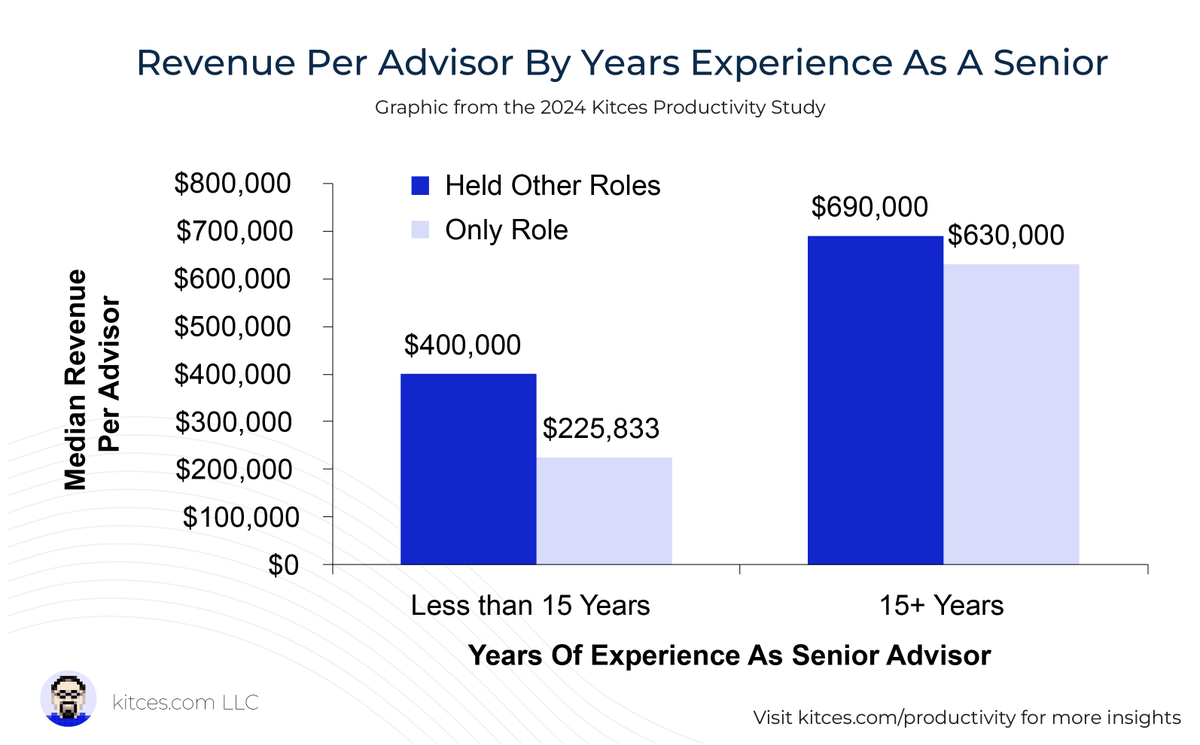
Historically, most Senior Advisors began by simply `hanging out a shingle' and prospecting without any prior industry experience. However, it's becoming more common for advisors to progress through other industry roles, such as starting as a Client Service Administrator (CSA), getting licensed, transitioning into an Associate Advisor role with trading and planning responsibilities to support a Senior Advisor, and eventually becoming a Senior Advisor. Which raises the question of whether advisors who follow the profession's emerging career tracks tend to be more successful when they reach the Senior Advisor position. The answer seems to be yes - especially early on. Among Senior Advisors with fewer than 15 years in the role, those who held other industry roles first generate nearly double the revenue per advisor of those who started out from scratch ($400,000 versus $225,833). Among those with 15+ years of experience, this gap narrows - though it is not fully eliminated. We dive deeper into career progression among advisors in our Advisor Productivity Study, available entirely for free here: https://kitc.es/4gpB6Ef
61 1 12849 0 1
MichaelKitces @MichaelKitces 2026-11-24T14:01:10.000Z

Driving Tax Alpha With More Integrated Tax Services To Reach $950M AUM Serving Emerging HNW Clientele: https://kitc.es/4sDISC2 In #FASuccess Ep 517 With Meghan Railey, managing partner of OPTAS Capital, we talk about how her firm integrates tax planning services throughout the business, including by adding in-house tax preparation services, to better serve its high-net-worth client base.

23 0 2948 0 0
MichaelKitces @MichaelKitces 2026-11-23T22:00:05.000Z

The first question isn't, "How do I advise this client?" – It's, "Should I continue advising this client?" A client's international move can change the regulatory landscape (even if nothing else about the relationship changes). In fact, the U.S. regulatory framework doesn't go away; the new country's is ADDED.   https://kitc.es/4BPaLLR In this guest post, Ashley Murphy shares a 5-question framework for questions for compliance, and discusses how a client's international move can affect everything about the advisory relationship, including the regulatory landscape that an advisor is subject to (even if nothing else has changed), as well as custodial options and capabilities.

32 0 3080 2 0
MichaelKitces @MichaelKitces 2026-11-23T14:02:04.000Z

How many clients can financial advisors really serve? According to the latest Kitces Research on Advisor Wellbeing, the answer depends significantly on whether you are a "minder" or a "finder": https://kitc.es/3Xwu9NI For minders (and the overall sample, which consists primarily of them), wellbeing rises with client count up to a 'sweet spot' of 50–100 clients per advisor, after which it progressively falls as more clients are added. For finders, advisor wellbeing continues marching north as the number of clients they have increases. In this article, Kitces Director of Research Mark Tenenbaum shares findings on advisor welllbeing, the ideal number of clients by wellbeing, and how to scale as a minder versus a finder. #KitcesResearch #advisorwellbeing

73 2 15075 6 0
MichaelKitces @MichaelKitces 2026-11-22T22:00:08.000Z

It is very difficult for next-generation advisors to figure out where to focus and what to do in order to succeed. The fact is that the path to leadership and partnership eventually entails growing beyond “just” being a great and expert advisor serving clients, but also learning how to manage and develop a team of subordinates. https://kitc.es/3R14A4y

95 0 30749 8 2
MichaelKitces @MichaelKitces 2026-11-21T22:01:03.000Z

Helping clients articulate meaningful goals is often more difficult than it first appears. Many clients feel uncomfortable discussing their finances openly, especially with someone they have only recently met. How the CLEAR Framework can provide advisors with a structured approach to bring more depth to discovery conversations. https://kitc.es/4ipjSew

31 0 2908 1 0
MichaelKitces @MichaelKitces 2026-11-20T19:30:09.000Z

This #WeekendReading kicks off with the news that the @USDOL this week issued a final rule reversing Biden-era regulations originally intended to broaden the types of workers who would be shifting from independent contractors to instead be categorized as employees. https://kitc.es/4ALnZI4 The ruling comes as a win for both corporate RIAs and broker-dealers (who won't have to potentially count their independent-contractor registered representatives as employees) and the reps themselves (who might prefer to maintain the freedom that comes with independent contractor status), though it's possible that the tug-of-war over this policy could continue into the future (as future administrations might reconsider the status of 'gig workers' who might prefer the benefits and protections offered by employee status). #DoL #DoLnews

31 0 1993 1 0
MichaelKitces @MichaelKitces 2026-11-19T22:01:03.000Z

Downside protection ETFs can serve a niche purpose, such as holding short-term funds earmarked for near-term goals where principal protection is critical and the investor is comfortable sacrificing upside. But they are not a true substitute for equity exposure, and their complexity can mask the relatively modest benefits they offer compared to more traditional fixed income strategies. https://kitc.es/3WW69mS

56 1 7287 2 1