metaversejr.eth (@MetaverseJR)

metaversejr.eth @MetaverseJR 2026-11-28T06:46:09.000Z

We've talked before about how FHE makes it possible to perform computations on encrypted data. But does @primus_labs really perform all these heavy computations directly on the blockchain? The easiest way to understand this is to think of how a restaurant works... You place your order at the table, but nobody tries to cook the meal right there. The real prep happens in the kitchen. There's a similar division of responsibilities in Primus' FHETransform architecture. While smart contracts operate onchain, computationally intensive cryptographic operations are handled by offchain FHE nodes. The contracts on the blockchain side work symbolically on references to the encrypted data (ciphertext handles). They handle access permissions, payments and transaction coordination, including decryption requests. The FHE nodes then do the actual math behind those references in the background. And the nice part is that the data stays encrypted throughout these computations. So why does this matter? Running these intensive computations entirely onchain would place a significant computational burden on the network. By separating coordination from execution, Primus makes it possible to build confidential financial applications directly on EVM-compatible blockchains. A transaction settling onchain does not mean every computation behind it has to run on the blockchain itself.

25 6 200 18 0
heymen33 @atlas16022015 2026-11-28T16:55:01.000Z

@MetaverseJR @primus_labs The key detail is how FHE nodes prove their computation was performed correctly. Can users independently verify that an offchain node returned the correct encrypted result without having to trust the node operator?

1 0 11 1 0
LOKMAN @Md_Lokman_71 2026-11-28T04:11:59.000Z

While traditional privacy coins continue getting pushed off centralized exchanges, @primus_labs is building around a very different thesis. Look at the broader market backdrop: KuCoin is delisting Monero on November 30, while the volume of Bitcoin sitting in addresses with exposed public keys has climbed to roughly 7.12 million an all time high. Pure, opaque anonymity keeps running into hard regulatory walls. Primus is approaching the problem from the opposite angle: selective verifiability. Instead of building a black box that hides everything, the infrastructure lets institutions keep trading strategies and balances encrypted while proving only the specific facts a counterparty or regulator needs to see. You can see this distinction playing out across their actual shipping timeline this year: - January & June: Live zkTLS support deployed on HashKey Chain and BNB Chain. - April & May: Real time Proof of Reserves integrations for Perena and Unitas. - October 29: Partnership with Cournot to verify web evidence for prediction markets and private credit. Verifiable reserve proofs and auditable data pipelines are translating into real institutional utility, whereas total concealment tech mostly generates surface level noise. On the social side, attention still tracks closely with campaign cycles. Mindshare dipped from 1.2M on November 18 down to 365K on November 22 before bouncing back toward 748K on November 25. With Kaito Epoch 3 running through December 21, the real test begins once the campaign incentives wind down. Post December 21, the market will be watching one thing: whether new enterprise reserve contracts and protocol integrations keep expanding organically on the strength of the tech itself. Tasks Portal: https://s.kaito.ai/6hyFypL @KaitoAI

78 6 569 66 0
metaversejr.eth @MetaverseJR 2026-11-28T16:59:36.000Z

@Md_Lokman_71 @primus_labs i don't think counting new integrations alone is enough... tracking whether verification requests through existing integrations are increasing would also help us understand how much the technology is actually being used...

0 0 5 0 0
Tanvir Nabil @tanvirnabil25 2026-11-28T15:42:31.000Z

Good Night Guys Primus Points and the Vision of a More Verifiable Internet. The internet is full of valuable information, but how can applications know whether that information is authentic? This is where @primus_labs is exploring an interesting solution through its zkTLS technology. zkTLS (Zero-Knowledge Transport Layer Security) aims to make information from Web2 platforms verifiable through cryptographic proofs while protecting users' personal data and privacy. For example, imagine an application wants to verify someone's social media activity or account details. Instead of sharing screenshots or exposing unnecessary personal information, users could prove specific details without revealing everything behind them. This creates new possibilities for connecting Web2 data with Web3 applications. Where does Primus Points fit in? The Primus Points platform allows users to explore different verification activities through weekly themed tasks. These activities provide a practical way to understand how external information and online activities can become verifiable. Some potential use cases include: ▪ Digital Identity: Verify specific information while protecting personal privacy. ▪ Online Reputation: Build more reliable reputation systems using authenticated data. ▪ Web3 Applications: Connect external information with decentralized platforms. ▪ Financial Services: Verify certain requirements while limiting sensitive data exposure. ▪ Cross Platform Verification: Make information from different online services more useful. Of course, these are potential applications, and their implementation depends on technology, integrations and adoption. Blockchain has made onchain activities more transparent but much of the internet's valuable information still exists outside the blockchain. Connecting that information with Web3 while maintaining privacy is an important challenge. I believe verifiable data infrastructure could play a significant role in the next generation of decentralized applications. That's why Primus is worth paying attention to. The bigger idea is simple: Prove what matters without revealing everything. Explore Primus Points: https://points.primuslabs.xyz/home

42 1 336 34 0
metaversejr.eth @MetaverseJR 2026-11-28T16:53:16.000Z

@tanvirnabil25 @primus_labs another important detail is that Primus provides predefined data templates... developers don't have to design a verification mechanism from scratch for every Web2 data source, making it easier to build new applications...

0 0 7 0 0
jaime.eth ∞ @0xJaimeth 2026-11-27T13:39:08.000Z

What amount of information does a financial protocol really need to have? Let’s consider applying for a loan through an onchain lending protocol. It will want to check whether you have enough financial resources to repay the loan. Totally understandable. But does it really need to see all of your financial portfolio, your account balances and transactions history? And that’s where the power of zkTLS + FHE by @primus_labs comes into play. → zkTLS helps to verify the authenticity of the financial data obtained from external sources. → FHE helps to perform calculations on encrypted financial values. In the case of a lending application, these technologies can help to check whether a borrower meets some financial requirements without the unnecessary exposure of their underlying assets. Of course, authenticity of data does not equal good lending decision making process. The application still needs a proper risk assessment logic. But I believe that there is a greater potential here. Rather than designing financial applications to collect as much data as possible, we could start designing them to collect as little data as needed. That’s the direction I would love to see Primus explore further. http://s.kaito.ai/7UOaVcc

247 14 6806 222 0
metaversejr.eth @MetaverseJR 2026-11-28T14:55:08.000Z

@0xJaimeth ZKredit makes an interesting design choice here. It makes verified financial data available onchain but leaves credit assessment to the protocols. This allows different lending protocols to apply their own risk models using the same verified information...

0 0 5 0 0
Murat Arda @megerpa 2026-11-28T14:12:03.000Z

@MetaverseJR @primus_labs Once the heavy computation moves to the kitchen, give the confidential transfer a two-line receipt. Onchain gas on one line, the Primus SDK’s FHE fee estimate on the other. That makes it easier to estimate the total cost upfront.

1 0 19 1 0
metaversejr.eth @MetaverseJR 2026-11-28T14:38:21.000Z

@megerpa @primus_labs especially since FHE service fees can vary depending on the operation, knowing the total cost before confirming would be useful. actually, transaction costs are one of the topics I'm planning to cover in my upcoming Primus posts...

0 0 12 0 0
Murat Arpacı @2mrpc 2026-11-28T14:11:44.000Z

@MetaverseJR @primus_labs Give the order ticket and the finished dish their own status. The Primus SDK can check computation status by transaction hash. An app could use that to show “Confirmed onchain” and “Encrypted computation complete” separately.

1 0 15 1 0
Giang @truonggiangle99 2026-11-26T00:32:44.000Z

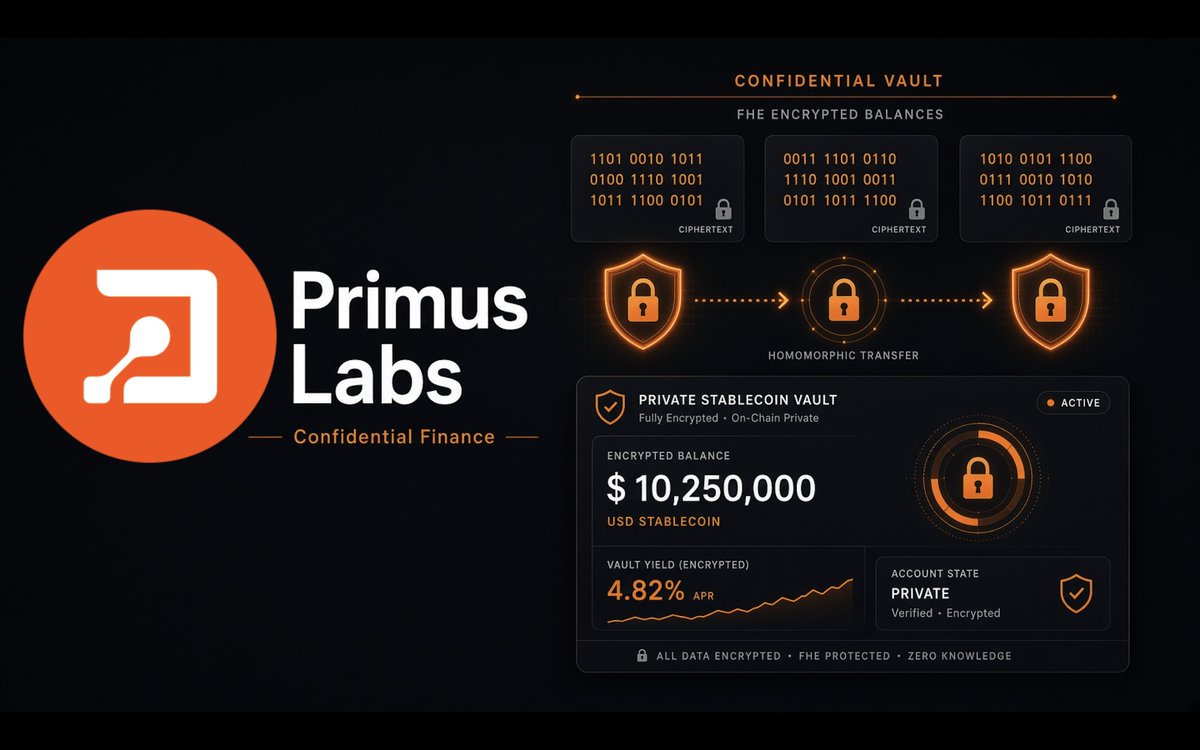
That’s the infrastructure layer for real onchain finance @primus_labs 🚀 Public chains make every balance, transfer size, and position permanently visible. That’s fine for transparency. It’s a problem for institutions. Strong anonymity tools hide the details, but they usually make selective disclosure and verification harder. Institutions need both: privacy by default and the ability to prove specific facts when required. Primus Labs is solving exactly that with Fully Homomorphic Encryption (FHE). Instead of storing balances in plaintext, FHE stores them encrypted on-chain. Transfers are executed as homomorphic addition and subtraction directly on those encrypted values. The computation node processes the transaction without ever seeing the underlying amounts or resulting balances. Observers only see encrypted state. Decryption is denied by default and controlled by an access layer. When an authorized party needs to check a specific value (auditor, regulator, compliance), the disclosure is explicit and can be recorded. This puts confidentiality at the data layer, not just the network layer. Privacy becomes a property of state and computation, with a controlled path back to plaintext when needed. The product side is already live:→ Confidential Vault on BNB Chain: convert stablecoins into encrypted form ($EU), transfer them, and earn yield without exposing position size or strategy. → zkTLS: prove data from any website or API is authentic without revealing the raw content. → Proof of Reserves: cryptographic verification of reserves while keeping sensitive operational data private. Primus isn’t forcing a binary choice between full transparency and total opacity. It’s building the middle path institutions actually need: confidential by default, selectively verifiable when required.

@truonggiangle99

Primus builds a verification + privacy infrastructure layer based on zkTLS and FHE. It does not create a new chain but plugs into existing ecosystems (BNB Chain, Base, etc.). @primus_labs 👉 https://s.kaito.ai/mfqwjes Proof of Reserves (PoR): Allows stablecoins, exchanges, and custodians to cryptographically prove their reserves without exposing detailed books. Already live with Unitas (USDu) and Perena (USD*) together with Brevis. Confidential Finance / Confidential Vault: Converts stablecoins into encrypted versions (e.g., $U → $EU). Users can transfer and stake for yield while keeping balances and transaction amounts private on-chain. Trusted Credit & AI Agent Verification: Enables verification of income, identity, trading behavior, or AI agent actions without revealing the underlying raw data. Loyalty Program / AlphaNet: Lets users create a Web3 profile by bridging verified private data on-chain and building a Reputation Score. Hailuo, CapCut, and Dreamina Now Live on Proof of Creation Primus has added Proof of Creation under the Agentic Ara section of AlphaNet. Users can now verify their video creation count on three AI video platforms. Current Traction of Primus Over 1 million users (extension + Dev Hub + zkTLS apps). Over 10 paying enterprise customers (stablecoins, AI, L2s, socials…). Over $72 million in value verified through Proof of Reserves across 4 production projects. Raised $6.5 million (pre-seed + seed) led by Dispersion Capital, Symbolic Capital, VanEck… and incubated by YZi Labs. 👀 Primus operates on a B2B2C model: enterprises pay for setup + API access, network activity generates fees, and builders use the Dev Hub to integrate. This is infrastructure with real users and revenue, not just narrative.
342 43 5705 303 1
Lynn @NKLinhzk 2026-11-28T06:30:00.000Z

people talk like you have to stake tokens before a phone can earn anything on acurast... do you? the base share just comes from the phone being online and passing the hardware test no stake needed for that part, tbh that's the bit you get just for showing up you can add a stake later if you want the extra layer if you wanna try with one https://hub.acurast.com/rebellion?ref=e7hzj7 would you plug a phone in first, or wait until you've got tokens ready, @Acurast?

@Acurast

Becoming a compute provider takes a download and a few minutes. Install Acurast Processor Lite, leave it open on the charger overnight, and your phone receives ACU for providing compute to a global decentralized cloud. No spare device needed. No factory reset. Check the full onboarding guide here: https://acurast.com/onboarding/

330 20 4661 280 0
撸币教程 @lubijiaocheng 2026-11-27T07:02:49.000Z

当隐私开始有毫秒数 密码学项目最常见的失败方式,是没人愿意为它多等三秒,而非被攻破。 隐私赛道这些年的尴尬就在这儿:技术早已被证明可行,产品却大多停留在演示页面。隐私一旦变成一笔额外支出,比如延迟、Gas、多几步操作,它就永远排在需求清单的最后一行。 Primus 在改变的就是这个排序。它给互联网数据配上来源证明(zkTLS),再让这些数据在不解密的前提下被计算(FHE)。真正有价值的地方是,它把三个经常被混在一起的问题拆开了;“能加密”本身并不是重点。这条数据是不是官方服务器给的,基于它的计算有没有算错,过程中能不能谁都不看。少回答一个,“我已经隐私了”就是错觉。 就像医院会诊:化验单得确认出自本院检验科,推理不能跳步,病历又不必在走廊里传阅。 三环里最难的环节是速度,安全反倒不是最难。门级 FHE 的开销很容易算:一次 64 位运算编译成几千个门,每个门做一次自举压噪声,叠起来就是分钟级。分钟级的隐私,在支付清算里等于没有。 AutoHoG 换了个问法:能不能让一次自举吞下整段逻辑?复合门的构造自动化之后,直接接入 Verilog,在电路层合并可复用的片段。不靠硬件,延迟最高先降到原来的 1/5.7;加上 8 张 RTX 5090,一笔机密转账 90 毫秒,每秒 210 笔以上。更关键的是全程整数运算:浮点会让不同机器算出不同的密文,链上可以保密,但结果不能各说各话。 隐私第一次有了能横向比较的性能参数,机构的采购流程才谈得上启动。发薪、托管、场外结算,要的从来不是匿名,是能办事又不把余额摊在桌上。 当然要降温。90 毫秒是引擎基准,不是主网确认;AlphaNet 靠 TEE 走向去中心化,Phala 节点刚接入,信任假设是否还成立,得继续看;代币没发,经济模型还是空白。团队拿过 VanEck 等领投的 650 万美元,今年八月又进了 YZi Labs 孵化,钱不缺,缺真实付费的使用方。 隐私赛道喊了很多年“自由”。我更愿意说体面:能证明自己付得起,而不亮出账户;能证明数据没被改过,而不交出原文;能让机器替你算,而不必先信任那台机器。 90 毫秒离终局很远。至少它让这件事,第一次看起来像买得起的。 @primus_labs

94 8 13431 87 0
Caps @capsxbt 2026-11-28T11:58:05.000Z

What was/will be the first Airdrop you received in 2026? My first Airdrop in 2026 will be $PRIM from @primus_labs if I get into LB. Tell me yours now...

38 1 514 22 0
NikkiSixx7 @NikkiSixx_7 2026-11-28T13:16:05.000Z

Trump ailesi yangından mal kaçırıyor 🤡 Bugün $WLFI tek mumda -%60 yedi. $USD1 ise depeg oldu Trump ailesi kısa bir süre önce ellerindeki Bitcoin ve Ethereum'ları da satmıştı Her şey Demokratların Trump ailesinin kripto işlerini soruşturacaklarını açıklamasından sonra yaşandı Trump ailesi kanser gibi kriptoya çöktü. Vurdukları paranın haddi hesabı yok. Sömürdüler sektörü yok ettiler

286 30 33627 41 1
Faustino @77bncvbsdcg 2026-11-28T13:16:18.000Z

@MetaverseJR @primus_labs The Primus FHETransform architecture separates onchain symbolic handling from offchain computation. Imagine if real time health data processing used a similar model, how would you ensure real time alerts while maintaining patient privacy with offchain calculations?

1 0 16 1 0