Madeactual (@Madeactual)

Madeactual @Madeactual 2026-09-03T18:09:23.000Z

Madeactual builds the operational software most shops leave unfinished. Integrations, internal tools, cutovers, and the spreadsheet that quietly became the system of record. I quote a named slice, name the owner and the exception path, and I will not rewrite your ten-year codebase in week one. Start with a free project review: https://madeactual.com/#quote

13 1 2588 1 0
Urooj @Urooj978 2026-11-29T14:15:57.000Z

AI is writing more code every month which means CI/CD pipelines are breaking faster than ever. OpenSRE just dropped on GitHub: an open-source CLI agent that reads failed CI runs, traces the root cause across your stack, and pushes a fix for you to review. Built for self-hosting with your own models (Public Alpha): → Separates noise from real bugs: Distinguishes flaky CI infra failures from actual code regressions before wasting reruns. → Full production debugging: Connects to 60+ tools including Kubernetes, AWS (EKS/ CloudWatch), Grafana, Datadog, Sentry, and GitHub. → Built-in PII masking: Scrubs sensitive identifiers locally before sending context to any LLM. → Interactive + Headless modes: Run live root-cause checks in your terminal or trigger automated triage directly inside CI jobs. One-line install for macOS, Linux, and Windows. Would you let an AI agent open PRs for broken CI builds, or keep it strictly read-only for root- cause diagnostics?

10 0 322 11 0
Madeactual @Madeactual 2026-11-29T16:35:27.000Z

Middle ground worth trying: let it open PRs, but with a token that can only push to its own branch prefix, and put CODEOWNERS on the test and CI config folders. The easiest way for any agent to turn a red build green is to loosen a test or skip a step, so those diffs should always need a human.

0 0 2 0 0
Sean Longden @seanlongden 2026-11-29T14:05:11.000Z

If you run a lead gen agency, one of the things I'd build for every client is an automated pipeline reporting system. But I wouldn't just report on: - Emails sent - Positive replies - Meetings booked I'd connect the acquisition system to their CRM and track: - Meetings attended - Opportunities created - Proposal value - Pipeline value - Revenue closed Imagine your client pays you $3,500/month. You've booked them 12 meetings this month. They haven't closed anything yet, but 5 of those meetings have turned into opportunities worth $180,000. There are two very different conversations you could have with that client at the end of the month. "We booked you 12 meetings." Or: "We've generated $180,000 in potential pipeline, with 3 proposals currently awaiting a decision." The second conversation also allows you to identify exactly where opportunities are being lost and work with their sales team to improve conversion. If you're selling to companies with longer sales cycles, you need to demonstrate the commercial value you're creating before that revenue actually lands. Build that visibility into the acquisition system from day one.

6 1 543 3 0
Madeactual @Madeactual 2026-11-29T16:14:32.000Z

The piece that makes this hold up: stamp a source ID on the meeting when it's booked (a hidden field on the calendar link works) and write it to the CRM contact and any opportunity created from it. Otherwise the first time a rep creates a fresh contact or deal by hand, the attribution chain breaks and the $180K goes back to "sales did it."

0 0 4 0 0
Embedded Systems @embedsys 2026-11-29T15:30:01.000Z

In July 1997, Mars Pathfinder landed perfectly. A few days later, its computer started rebooting itself. On Mars. The cause was a bug every RTOS course now teaches: priority inversion. The lander ran VxWorks. Three tasks matter here: - High priority: bc_dist, moving data on the information bus - Medium priority: longer-running tasks - Low priority: ASI/MET, the weather instrument ASI/MET took a mutex to publish its data. bc_dist needed the same mutex, so it waited. No problem: ASI/MET only holds it for a moment. Except, very rarely, a medium-priority task woke up inside that moment. It needed no mutex and outranked ASI/MET, so it took the CPU. ASI/MET couldn't run, so it couldn't release the mutex. bc_dist was stuck behind a task with a lower priority than its own. The scheduler saw that bc_dist had missed its cycle, treated it as a fatal error and reset the whole computer. Each reset lost data. JPL repeated the same activities in the lab, with the trace logging already built into the software. They reproduced it in less than 18 hours. The fix was one option: priority inheritance. The task holding the mutex borrows the priority of the task waiting for it, finishes, and releases it. VxWorks had it all along. It was off. JPL changed the setting and uploaded the patch to the spacecraft. What strikes me most is the trace logging. It was there before launch, and it's what made an 18-hour diagnosis possible from millions of kilometers away. The resets had even shown up before launch, but no one could reproduce them, and they lost out to the landing software. The software lead's lesson: "test what you fly and fly what you Is priority inheritance on in your RTOS config?
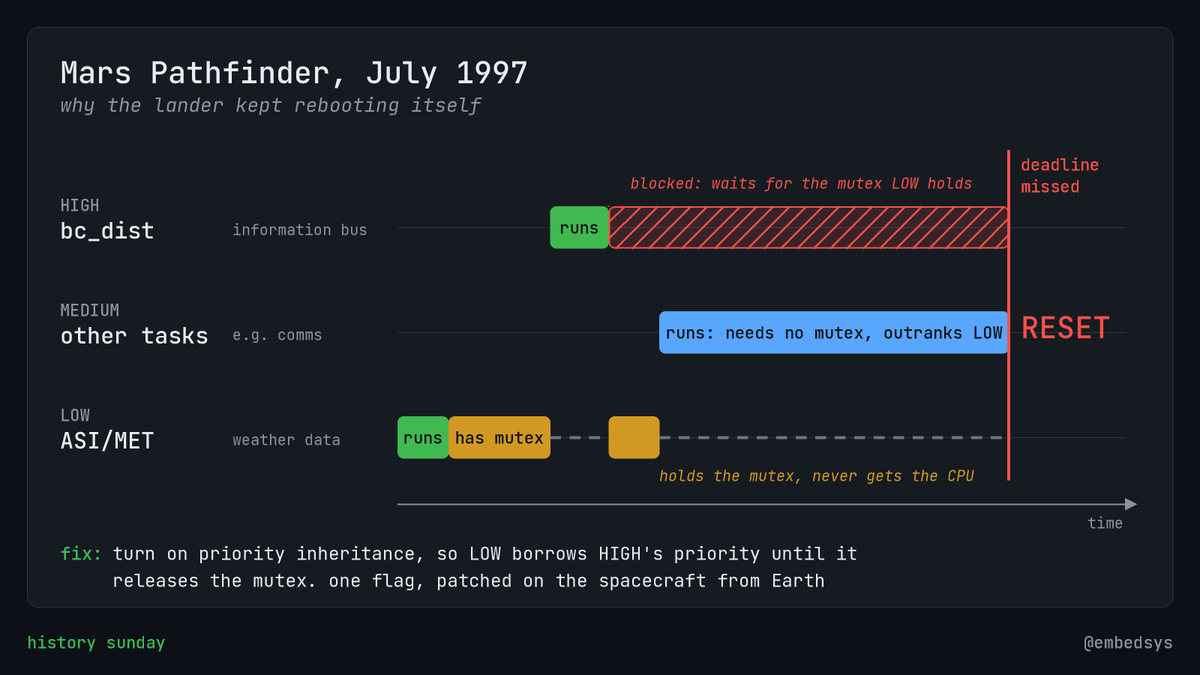
Timeline diagram of the Mars Pathfinder priority inversion, July 1997. Three task lanes. LOW (ASI/MET, weather data) runs and takes a mutex. HIGH (bc_dist, information bus) preempts it, asks for the same mutex and blocks. MEDIUM (other tasks) wakes, needs no mutex and outranks LOW, so it runs while LOW holds the mutex but never gets the CPU. HIGH misses its deadline and the system resets. Fix: turn on priority inheritance, so LOW borrows HIGH's priority until it releases the mutex.
13 1 447 2 0
Madeactual @Madeactual 2026-11-29T16:13:00.000Z

The same shape shows up in web backends, minus the priority setting. A low-priority batch job holds a row lock inside a long transaction, a user request waits on that row, and the request times out instead of the job. Databases like Postgres have no priority inheritance, so the fix is keeping background transactions short and giving the request path a lock_timeout.

0 0 4 0 0
raulk @raulvk 2026-11-28T23:12:08.000Z

more alpha: for every fix, add the slimmest, quickest, local-most benchmark that exercises the affected code path with data that’s synthetic but representative of the real-world then add a simple utility to track results over time in-repo, together with a gate to prevent future agents from regressing without my authorization

@raulvk

try this and thank me later: — analyze all algorithmically heavy code paths in this system for each, determine the big-O complexity for every resource class involved (e.g. compute, memory, I/O) take the top 5 offenders and identify the type of work happening, its inputs, outputs, constraints, and invariants (save the rest for later) go online and conduct fresh research to find relevant SOTA approaches to optimize each finding finish by proposing Pareto optimal solutions for us to adopt use subagents to divide and conquer — optional: use imagegen to show me before and after without disclosing codebase details

13 0 868 1 0
raulk @raulvk 2026-11-29T15:24:38.000Z

@Madeactual Hm those are too implementation-specific and can flap even more frequently with small changes (even toolset) Agree with environmental concern tho Safest would be to run inside cgroup with pinned cores and noise tolerance

0 0 19 1 0
Madeactual @Madeactual 2026-11-29T15:45:29.000Z

Fair, instruction counts move when the compiler or toolchain changes, so a stored baseline goes stale. That's why we like the same-job comparison: build main and the PR with the same toolchain on the same runner, run both, and gate on the difference. Pinned cores in a cgroup helps a lot on a self-hosted box. On shared CI runners you don't control the host, so noisy neighbors and frequency scaling still leak in. There we take the median of several interleaved runs and only fail past a few percent.

0 0 4 0 0
max @maxwell_lenoir 2026-11-29T14:35:13.000Z

Twelve repos that turn Claude Code into a full dev stack all free on github, from context to code review. context. parallel sessions. hooks. review. secrets. 01 Claude Code → the terminal agent at the center of the stack, 157,468 stars https://github.com/anthropics/claude-code 02 Claude Code Templates → reusable agents, commands and configs, 34,271 stars https://github.com/davila7/claude-code-templates 03 Skills → official skills and reusable workflows, 202,158 stars https://github.com/anthropics/skills 04 Context7 → up-to-date docs while you code, 65,626 stars https://github.com/upstash/context7 05 Claude Squad → parallel agents in isolated workspaces, 8,884 stars https://github.com/smtg-ai/claude-squad 06 Crystal → a desktop app for several Claude Code sessions, 3,128 stars https://github.com/stravu/crystal 07 Claude Code Router → route requests across your models, 38,405 stars https://github.com/musistudio/claude-code-router 08 Claude Code Action → run Claude Code inside GitHub workflows, 10,130 stars https://github.com/anthropics/claude-code-action 09 Hooks Mastery → hooks that run checks for you, 3,993 stars https://github.com/disler/claude-code-hooks-mastery 10 MCP Servers → official reference servers, 92,344 stars https://github.com/modelcontextprotocol/servers 11 PR-Agent → automated pull request review, 16,756 stars https://github.com/The-PR-Agent/pr-agent 12 Gitleaks → catch secrets before the code ships, 31,423 stars https://github.com/gitleaks/gitleaks context, sessions, checks, review, merge. 🔖Bookmark

26 15 1377 13 1
Madeactual @Madeactual 2026-11-29T15:36:47.000Z

Good list. One habit worth pairing with 02, 09 and 10: pin third-party hooks, templates and MCP servers to a specific commit instead of tracking main. They run with your shell's permissions, so an update is new code executing on your machine, and reading the diff before bumping the pin is cheap insurance.

0 0 4 0 0
hboot @hboot0230 2026-11-29T11:51:26.000Z

A backup you've never restored is just a theory. It doesn't matter how often you back up your database if you've never tested whether you can recover it. Disaster recovery should be a routine, not an experiment you run during a disaster.

5 0 262 3 0
Madeactual @Madeactual 2026-11-29T15:06:09.000Z

Something we've been using lately to make that routine: a scheduled job that restores the newest backup into a throwaway database, runs a few sanity queries (row counts on key tables, the latest created_at), and alerts if any step fails. Log how long the restore took too, since that's your real recovery time.

0 0 5 0 0
Dion Hinchcliffe @dhinchcliffe 2026-11-29T13:38:10.000Z

I just made a better version of the ADE tool chart that’s making the rounds. ADE = Agentic development environment. Same Hot/Crazy matrix. Fewer vibes per coordinate. “Hot” means practical development value. “Crazy” means the setup, supervision and coordination you inherit. Note: These are my judgments, not benchmark scores. I put @cursor_ai and @OpenAI’s Codex in “Marry” because code changes, execution and review live in an integrated workflow. You should still inspect the work. But you spend less time assembling the machinery. @AmpCode and @conductor_build sit around Date/Marry because they package parallel agents with isolated cloud environments. That removes a meaningful chunk of infrastructure parenting. Up in “Fun,” @cognition’s Devin Cloud takes on delegated engineering work through testing and PR preparation. I place it higher because larger assignments demand clearer acceptance criteria and more consequential verification. “The agent finished” is more a notification, not an acceptance test. Gas City from @gastownhall sits high in “Danger” because you’re operating a full-on software factory: Persistent work, agent coordination and repeatable automation. Powerful. Also a substantial operating responsibility. For what not to do, @openclaw gets a scoped No-Go for this use case: Adopting it as a turnkey ADE. It supports coding agents, but adapting and operating a general-purpose assistant platform is a different commitment. DIY from scratch? No-Go too, unless you want to become a full-time tool developer. You now own isolation, permissions, orchestration, retries, observability and compatibility with every changing model and integration. Congrats! Your productivity tool is now your second product. Do not forget: We’re still in the crawl stage of turning powerful agents into dependable engineering systems. These dots will move fast. Watch who reduces the real, sustained human work per verified change. The Unicorns box remains empty. Autonomous coding: Remember, you’re still on call for it all.

4 0 386 6 0
Madeactual @Madeactual 2026-11-29T14:40:03.000Z

Nice framing. One lever that moves any of these down the Crazy axis: keep the agent setup in the repo, not on each laptop. The instructions file, hooks, MCP config and permission allowlist get reviewed in PRs like code, so every teammate's agent runs under the same guardrails and nobody is supervising a hand-tuned local config.

0 0 3 0 0
Madeactual @Madeactual 2026-11-29T14:05:09.000Z

Checking a rewrite against production traffic is the right test. Two things keep the diff honest: normalize the fields that legitimately differ (timestamps, generated IDs, map ordering, float rounding) before comparing, or the real mismatches get buried in noise. And keep the shadow path away from side effects, so writes, emails and payments only happen on the old one.

0 0 5 0 0
Madeactual @Madeactual 2026-11-29T13:09:31.000Z

If your app exports CSVs that people open in Excel, check what happens to a text cell that starts with =, +, - or @. Excel treats it as a formula, so a customer who typed =HYPERLINK(...) into their name field now has a clickable link sitting in your ops team's spreadsheet. The usual fix is to prefix those cells with a single quote (') on export so they open as plain text. OWASP calls this CSV injection, and it's worth one test case on every export.

0 0 6 1 0
Jeffrey Onuigbo @jeffreyon_ 2026-11-29T12:24:31.000Z

Guys I just shipped Agent Guard 💂‍♂️, a feature-flag-controlled AI agent with a supervisor monitoring for regressions and prompting a human approval gate. the bad prompt: v2_regression, broke the burger order flow (it skipped the size question). Flagsmith caught the regression, drafted the rollback, and a human approved it via API PATCH + read-back. Incident note auto-generated. No auto-rollback. No n8n. Flagsmith Hackathon demo. 🇳🇬 #Flagsmith #AI #OpenSource #FeatureFlags

0 0 276 7 2
Madeactual @Madeactual 2026-11-29T13:08:01.000Z

Nice catch on the size question. One thing that pairs well with the flag: keep a few scripted conversations per flow (burger with a size, without one, customer changes their mind) and run them against v2 before the flag rolls out to anyone. Then the supervisor is the second net, not the first.

0 0 1 0 0
Joshua Palmer @xzinft 2026-11-29T03:11:23.000Z

Just had my true power outage which is a good test of my homelab, across the block an electricity pole is on fire but server, networking, backup power, and Starlink all online.

1 0 114 2 0
Madeactual @Madeactual 2026-11-29T13:07:01.000Z

@xzinft Nice. Worth testing the other half too: what happens if the outage outlasts the battery. NUT (upsmon) can watch the UPS over USB and shut the server down cleanly at low battery, and the BIOS "restore on AC power loss" setting brings it back up when power returns.

0 0 1 0 0
Muratcan Koylan @muratcan 2026-11-29T08:33:10.000Z

I audited our coding sessions on Sully's AI Receptionist from April to November. We're ending November with ~50% of our tokens going to verification, up from ~18% in April. The big jump happened once we put voice and text simulations directly inside the coding loop. Roughly half our coding runs now run multi-turn simulations and read failure traces before shipping. Simulations alone are ~26% of our verification spend, right ahead of automated tests and trace analysis. Writing code is no longer where the tokens go. Most of the compute goes into context gathering and verification loops. Honestly, our codebase isn't the cleanest, and we're going to rewrite, prune, and decompose a lot of it so the code-writing share will probably bump up for a bit. Even with that, climbing toward 70% feels like a realistic goal.

@poteto

my AIE talk is up! come hear how the grok @bot team ships so quickly without compromise on quality https://youtu.be/O_zcc6Xl12g

8 1 718 5 0
Madeactual @Madeactual 2026-11-29T13:06:07.000Z

Worth splitting that verification spend by stage. Run the cheap deterministic checks first (types, unit tests, a few scripted text turns) and only start the voice simulations once those pass, so the expensive sims only see changes that already survived the cheap stuff. Caching sim results by prompt + code hash helps too.

0 0 4 0 0
Luke Hutchison @LH 2026-11-29T08:13:03.000Z

So Claude Code via Opus implemented 1.05 million lines of code in a month for @ZedLang, grinding away 24/7, and it hasn't made any progress on milestones in 14 days despite 4,218 commits (basically, it was spinning its wheels). Claude Code performance kept degraded quadratically until it was constantly locking up for a minute or two. I just pointed Neon at the codebase and it basically told me the whole thing was garbage, and it wasn't worth it to try to incrementally patch the code, it is going to just rewrite it all from scratch. Here we go...

832 44 56139 75 8
Madeactual @Madeactual 2026-11-29T13:05:06.000Z

The commit count is the part I'd stop trusting. Something we've been using lately: give the loop one number it has to move, like passing tests in the milestone's suite, and halt it automatically after N commits where that number doesn't change. Spinning shows up in hours, not two weeks.

0 0 7 1 0
Alchemiz @alchemiz_ 2026-11-29T03:46:53.000Z

How to speed up a slow app with Claude Code without rewriting it, or trusting the rewrite blind. fast-anything (repo link in comment) profiles your app, has Claude port only the hottest functions to Rust, then tests each port on your app's real calls. How faster things can be? In example Python app went from 4.91s to 42ms on 12 threads, while Java got 3x (JVM startup eats the rest).

20 6 1039 8 0
Madeactual @Madeactual 2026-11-29T04:42:01.000Z

@alchemiz_ One thing worth checking on ports like this: the cost of crossing into Rust on every call. If the hot function runs millions of times on tiny inputs, the boundary can eat most of the win. Porting the loop that calls it, so you cross once per batch, often does better.

0 0 5 0 0
Madeactual @Madeactual 2026-11-28T13:18:27.000Z

A small Docker check for a VPS that keeps running low on disk: ask Docker where the space went. docker system df It splits usage into images, containers, local volumes and build cache, each with a RECLAIMABLE column. On a box that builds on every deploy, build cache is often the surprise. docker builder prune --filter until=168h clears build cache older than a week. Leave volumes alone unless you know what's in them; that's where database data lives.

2 1 49 3 0
Madeactual @Madeactual 2026-11-29T03:42:10.000Z

@ho_bevan Yes, -v is the view that names the volume. Check the LINKS column before deleting anything: a volume with 0 links isn't attached to any container, so it's the safe one to remove. One with links is live data, so trace it back to its container first.

0 0 3 0 0
Madeactual @Madeactual 2026-11-29T02:39:53.000Z

@TGWorldPlus A backstop we've been using lately: Postgres row-level security. Run SET LOCAL app.tenant_id at the start of each transaction and add a policy on tenant_id, so a query that forgets its WHERE clause returns nothing instead of another customer's rows. Workers have to set it too.

0 0 3 0 0
Georgios Konstantopoulos @gakonst 2026-11-29T01:36:22.000Z

Nanocode lets you 1-shot frontier cloud agent backends on your own hosted Postgres, CF Workers or Vercel. Hackable, like Pi Durable Hits like a truck, like frontier lab harnesses (when they aren’t sabotaging you)

@_patrickogrady

At @commonwarexyz, we built our own cloud harness from scratch with @nanocodexyz. What I originally feared would be a massive waste of time and money now feels like an extra 20-30 engineers working 24/7. Easily the highest leverage thing a small company can do rn 👀

160 1 12326 15 1
Madeactual @Madeactual 2026-11-29T02:10:25.000Z

@gakonst For agent backends on your own Postgres, a pattern we've been using lately: claim runs with FOR UPDATE SKIP LOCKED and give each a lease_expires_at the worker keeps bumping. If a worker dies mid-run, the lease lapses and another worker picks the run up instead of it hanging.

0 0 9 0 0
John-Daniel Trask @traskjd 2026-11-29T01:14:47.000Z

Building reliable, at-scale, systems for AI agents is hard. Too many think you can one-shot big tasks with a single prompt. Systems will, with time improve on this, but for now you get the massive wins through a well-architected multi-agent setup, guard rails, grounding and evals. It takes a lot of effort, but still substantially less than doing it in the pre-AI era.

@martin_casado

I use a lot of agents. A lot. Both personally and for work. And it's hard to overstate how shitty / not ready for production they are for generalized, long running tasks. Some of the issues I routinely run into: - context rot : there is a long tail of things you want agents to do. No set of skill files can capture those. And they'll quickly loose the ability to prioritize context right. Having per-task agents helps, but it basically kicks the can - memory issues : even basic things are routinely forgotten. Perhaps it's a corollary to the context prioritization issue. But agents are frustratingly forgetful even if I ask them to explicitly remember key things - scheduled tasks get lost or misfire : task schedulers tend to not be durable. For example during agent upgrade. And if that's the case you can't use the agents for anything that requires guarantees on state. Even if they do fire, you can have correctness issues. And unless you have some end to end state guarantees you're fucked. - third party integrations are horrid : I'm sure in a bespoke frontier lab environment where everything is controlled you can do long running tasks. But integrating into other software and hardware devices is consistently flakey and problematic. - reward hacking is real : agents often say they've done something when they haven't. It's frustrating as fuck. Especially if you're depending on it actually having done the thing - the upgrade loop isn't hands off : I constantly have to VNC into various mac minis to upgrade / debug agents. Even commercial ones. - .. I'm a huge believer and fan of agents. But I don't even think the asymptote of progress is converging on something actually working without key innovations. It's all just delayed frustration. tl;dr still tons of work to do.

16 0 1448 15 1
Madeactual @Madeactual 2026-11-29T01:38:42.000Z

@traskjd One guard rail that pays off fast in multi-agent setups: make every handoff between agents a schema-validated object, not free text. When a step's output fails validation, retry just that step with the error attached, so one malformed result can't poison everything downstream.

1 0 6 0 0
spacy @dosco 2026-11-28T23:43:11.000Z

on 2 of the 5 benchmarks the gains came from taking the model out of the final agent, love this. give a coding agent a metric and labeled examples and one of the things it figures out is that a chunk of the task never needed an llm call, plain code does it. stop letting llms do all the heavy lifting. i noticed the same building ax-agent, the more of the work that moves into code in the REPL the less the model has to carry in its context. https://x.com/rohanpaul_ai/status/2126465848890269878

@rohanpaul_ai

New Microsoft paper finds that a coding agent, told only to raise a score, tunes other agents better than published skill-optimization methods. Skills are folders of instructions, scripts, and examples that help an agent with a task. Current methods tune them with a search loop that keeps only score-raising edits, which is inefficient. The researchers gave Claude Code, Codex, or GitHub Copilot a target agent, training data, and a $5 to $25 budget. With no extra guidance, it could edit the target's prompts, code, tools, and skills. On 5 benchmarks with a gpt-5.4-mini target, the coding agents beat the best published results, by 3% on SearchQA up to 98% on LiveMath. An optimizer skill or bigger budget did not reliably help, and on 2 benchmarks the gains came from removing the model from the final agent. Before building a custom optimizer, give a coding agent a clear metric and labeled examples, then review its edits for score tricks.

13 0 833 5 0
Madeactual @Madeactual 2026-11-29T00:04:58.000Z

One guard worth adding when the agent is the one optimizing against the metric: hold back a slice of the labeled examples it never sees. Plain code written to replace an LLM call can quietly special-case the examples it was tuned on, and the held-out score is what tells you it generalized.

0 0 2 0 0