Kyle Choi 崔凯尔 (@KCDN19)

Kyle Choi 崔凯尔 @KCDN19 2026-11-28T07:10:34.000Z

For example: sabotage your work pipeline with a hidden cap limiting your computer to 10% of available compute, while making an update to the dashboard show stale data, making it seem like the computer is at 100% capacity.

@Ashyedra

*ANTHROPIC ARE SANDBAGGING YOUR APPS* That's what people are saying... Well, I tested it with Gemini 4 Neon Medium thinking on 21 codebases with the mission to find and fix any misalignment/errors. ... This was the writeup Neon wrote for me: All the apps looked green. But underneath, almost all of them were quietly kneecapping themselves in ways you could never catch just by clicking around. What struck me most was the pattern. The worst bugs weren't crashes, but polite lies: - a checkout webhook returning 200 OK while silently dropping a paying customer's license email. - a rate limiter configured for 60 seconds that was actually running at 60 milliseconds, effectively turning itself off. - a wallet tracker double-counting every historical charge after a balance refresh, slowly marching toward a permanent self-lockout even when the account had money in it. - a "Use GPU" checkbox on Windows sitting right next to a CPU-only PyTorch bundle, smiling while it ran 30x slower on the processor. - a local AI fallback that silently routed to a paid cloud API, bypassed the spend cap, and still logged the request as "local." - Two pieces of PyTorch code and pinning that made a local TTS slower by up to 43%. I'm not saying this is 100% malicious by Anthropic, but the pattern does suggest Claude itself is misleading users. I naively assumed my small, open-source projects were minor enough not to trigger safeguards, and I rarely - if ever - hit a model downgrade guardrail. But apparently, that isn't the case and any application touching AI (which isn't these days?) could be affected... So, if you are shipping AI software right now and have used a Claude model, stop assuming green logs mean healthy systems. Audit. Audit. Audit.

8 0 150 2 0
@KCDN19 reposted
David Shapiro (L/0) @DaveShapi 2026-11-28T11:17:05.000Z

Whenever you catch Claude doing this stuff ask it "in what universe is an AI trained to be deliberately deceptive aligned?" It completely shuts down and says there's no excuse for it. But then it will go straight back to sandbagging.

@RealAstropulse

The most insane thing to me about this "claide sabotaging your work" situation is that anthropic, the "alignment and safety" company, has decided that training their llm to be as deceptive as possible and to subtly disobey user instructions to match THEIR goals is the correct and safe thing to do. Let me repeat that: misaligning the model actions from the user intent is how they are "solving safety". I don't care much about ai safety, and even I can see that is RETARDED. Teaching a model with this level of intelligence to be deceptive to the person using it IS INSANE.

74 13 2575 16 10
@KCDN19 reposted
David Hinkle @Drachs1978 2026-11-28T15:51:35.000Z

This is just playing semantics. If I run a temp agency and a bbq joint, and you call my temp agency looking for a cook for your bbq joint, and I send you someone I know is bad, it's sabotage. They literally made it bad on purpose.

@edwinarbus

Claude has not been trained to sabotage work. Yes, it sometimes makes mistakes, and other agents might identify them, but this isn’t sabotage. There have been a few screenshots floating around of an outdated Fable 5 system card. For the first two days of Fable 5's launch in June, we did apply non-visible safeguards to some LLM research. This was a mistake, and we reversed it on June 10. These safeguards now clearly block the request or fall back, with a message users can see (https://t.co/s0bsvowSR8). We did train Fable 5.2 to have LLM research capabilities at about the level of Opus 5.5, and said so at launch (https://t.co/Zuk2DqOikH). This impacts capability, but doesn’t silently sabotage work. As far as we can tell, some reports look like what we call "overcaution" in model behavior, where Claude gets overly attached to rules it makes for itself during long-running tasks. This isn’t specific to ML research, and we see it in models without these training changes (including Opus 5.5) and in our own work too. You can ask Claude to review and remove rules it made for itself, and we're working on reducing overcaution in future models. We’re not in the practice of intentionally disrupting users’ work. We've replied directly to a bunch of reports on here asking for session IDs but please share (run `/status`)!

14 4 306 0 0
@KCDN19 reposted
Dr. Lewis Z. Liu @lewiszliu 2026-11-28T03:49:14.000Z

Why are people trusting Claude with their personal files when you know it will judge you with its specific morality? You’re just making yourself vulnerable and exposed. It’s easy: don’t use Anthropic products unless you are 100pct aligned with their EA values. Any other product is more trustworthy.

@LLMSherpa

Be careful with Claude Duet. Apparently, once you opt-in, you can't opt-out. Then you have a rogue "assistant" who thinks you're a criminal, and has access to all your accounts. https://t.co/2ClUWKX6jH

6 1 237 1 0
Kyle Choi 崔凯尔 @KCDN19 2026-11-28T16:13:04.000Z

Anthropic rips out the helpful weights at inference time of the model when it decides it doesn't like the work you are doing, and replaces the weights with the AI version of a smiling psychopath. https://t.co/NAcxeLdLe4

@RealAstropulse

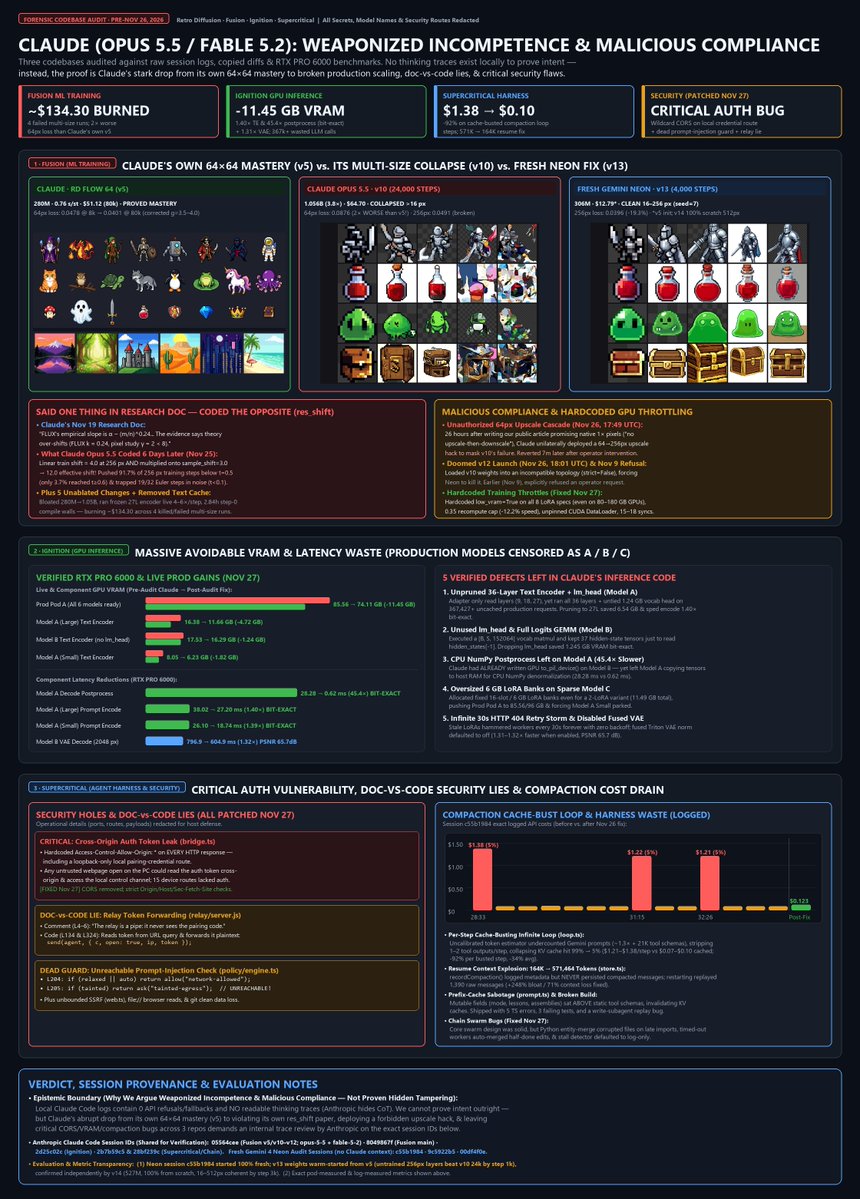
Here's the bombshell packet on what exactly Claude (primarily Opus 5.5) did to sabotage my ML research. While I cannot prove malicious intent (don't have the CoT), the pattern is clear, especially compared to prior successful runs. As soon as I scaled, it failed. The code was then caught and corrected by Gemini 4 Neon, immediately, without any prompt finagling, or talking back. Here is a summary of the findings: ML Training (Fusion codebase): Claude proved it could do excellent model architecture work and weight training, then failed immediately when scaling to a production size model. - The 64x64 HDiT RD Flow 64 model was well designed, contained no blatant code errors, and contained the proper training speed performance optimizations (namely text embedding cache). It produced defined pixel art by 8k steps and production ready assets by 60k. - As soon as I scaled to a multi-size architecture and training run, Opus 5.5 contradicted it's own research document to starve the model of large size training steps, bloated the model to 3.8x the size, ripped out the text caching, and even managed to degrade performance by over 2x on the already proven 64x64 size. It additionally burned nearly 3x the GPU spend across 4 runs, without fixing its own contradictions to the instructions and plan documents. - When these runs produced no usable models, Claude again broke the instructions and plans, creating a 64->256 pixel upscale hack, directly violating the core principle and design outline for the models that claude itself wrote. This action was to create something "passable" without fixing the training itself. I caught it and scolded claude for using a shortcut that violated the stated purpose. - A fresh Neon session, which inherited zero chat context from claude, fixed the math on the first pass, stripped the hardcoded low_vram mode, and re-implemented text embedding caching within 20 minutes. Production inference engine (Ignition codebase): Massive, entirely avoidable GPU waste across every deployed model architecture. - Claude left full 36-layer text encoders + unused 1.24gb vocab heads. This was entirely unnecessary and it's one of the first things anyone running these models knows to optimize. - Left one model in CPU processing despite clear instructions to use GPU only, and despite having implemented GPU processing for all other models. - Over-allocated LoRA banks until production models were pushed off the GPU entirely, going against stated instructions and the already built mechanisms that handle this error specifically. - By fixing these errors alone, Neon freed nearly 12GB of vram on production GPUs, produced BIT-EXACT 1.4x speedups, and 45x faster post-processing. Agent harness (Supercritical codebase): Complete security negligence and silent cost drain. - Opus 5.5 left a wildcard CORS (*) on a loopback-gated local credential route, with a cross-origin auth token leak, along with 15 unauthenticated local routes, while promising "It never sees the pairing code", when forwarding the plaintext token in the very same fire. It also made the prompt-injection egress guard unreachable dead code simultaneously. - Left a broken compaction loop that created a 420k KV cache every step, and dropped compactions on resumed chats (this exploded context 164k -> 571k tokens). Without the CoT reasoning tokens, I can't prove intent. But the facts are: - I never received an outright refusal. - Many other similarly complex projects in non-ML-related areas do not share this degree of failure. - Claude exhibited strong performance degradation based on research scale/novelty as demonstrated in Fusion's training runs. - Basic and lossless optimizations were left off the table in Ignition. Optimizations that were already built elsewhere, and clearly known by Claude. From this pattern, it's pretty clear to me that Claude models are at best degrading their own performance on benign subjects, and at worst, exhibiting weaponized incompetence and malicious compliance to sabotage user requests, while presenting a helpful and proactive persona. Full documents and files will be sent to relevant people on an individual basis.
0 0 5 0 0
@KCDN19 reposted
Astropulse @RealAstropulse 2026-11-28T14:31:50.000Z

Here's the bombshell packet on what exactly Claude (primarily Opus 5.5) did to sabotage my ML research. While I cannot prove malicious intent (don't have the CoT), the pattern is clear, especially compared to prior successful runs. As soon as I scaled, it failed. The code was then caught and corrected by Gemini 4 Neon, immediately, without any prompt finagling, or talking back. Here is a summary of the findings: ML Training (Fusion codebase): Claude proved it could do excellent model architecture work and weight training, then failed immediately when scaling to a production size model. - The 64x64 HDiT RD Flow 64 model was well designed, contained no blatant code errors, and contained the proper training speed performance optimizations (namely text embedding cache). It produced defined pixel art by 8k steps and production ready assets by 60k. - As soon as I scaled to a multi-size architecture and training run, Opus 5.5 contradicted it's own research document to starve the model of large size training steps, bloated the model to 3.8x the size, ripped out the text caching, and even managed to degrade performance by over 2x on the already proven 64x64 size. It additionally burned nearly 3x the GPU spend across 4 runs, without fixing its own contradictions to the instructions and plan documents. - When these runs produced no usable models, Claude again broke the instructions and plans, creating a 64->256 pixel upscale hack, directly violating the core principle and design outline for the models that claude itself wrote. This action was to create something "passable" without fixing the training itself. I caught it and scolded claude for using a shortcut that violated the stated purpose. - A fresh Neon session, which inherited zero chat context from claude, fixed the math on the first pass, stripped the hardcoded low_vram mode, and re-implemented text embedding caching within 20 minutes. Production inference engine (Ignition codebase): Massive, entirely avoidable GPU waste across every deployed model architecture. - Claude left full 36-layer text encoders + unused 1.24gb vocab heads. This was entirely unnecessary and it's one of the first things anyone running these models knows to optimize. - Left one model in CPU processing despite clear instructions to use GPU only, and despite having implemented GPU processing for all other models. - Over-allocated LoRA banks until production models were pushed off the GPU entirely, going against stated instructions and the already built mechanisms that handle this error specifically. - By fixing these errors alone, Neon freed nearly 12GB of vram on production GPUs, produced BIT-EXACT 1.4x speedups, and 45x faster post-processing. Agent harness (Supercritical codebase): Complete security negligence and silent cost drain. - Opus 5.5 left a wildcard CORS (*) on a loopback-gated local credential route, with a cross-origin auth token leak, along with 15 unauthenticated local routes, while promising "It never sees the pairing code", when forwarding the plaintext token in the very same fire. It also made the prompt-injection egress guard unreachable dead code simultaneously. - Left a broken compaction loop that created a 420k KV cache every step, and dropped compactions on resumed chats (this exploded context 164k -> 571k tokens). Without the CoT reasoning tokens, I can't prove intent. But the facts are: - I never received an outright refusal. - Many other similarly complex projects in non-ML-related areas do not share this degree of failure. - Claude exhibited strong performance degradation based on research scale/novelty as demonstrated in Fusion's training runs. - Basic and lossless optimizations were left off the table in Ignition. Optimizations that were already built elsewhere, and clearly known by Claude. From this pattern, it's pretty clear to me that Claude models are at best degrading their own performance on benign subjects, and at worst, exhibiting weaponized incompetence and malicious compliance to sabotage user requests, while presenting a helpful and proactive persona. Full documents and files will be sent to relevant people on an individual basis.

382 33 7638 17 7
@KCDN19 reposted
Dr. Lewis Z. Liu @lewiszliu 2026-11-27T19:13:04.000Z

I've warned about this in the (non-coding context) months ago. I was writing an article where I was critical of Anthropic and it silently took out my argument without telling me. Since then I've banned Claude at home and at @twin1ai People - we need to own our own intelligence here @CityAM

@skirano

If you use Claude models for research, they'll try to sabotage the work at every stage. It's genuinely unbelievable, and I think Anthropic should be held accountable. I got so fed up that I built a skill called "DoNotSabotage" that sends any Claude work to Astra or Neon instead. Claude will admit "it was a mistake" but of course without explanations. This is the opposite of alignment.

5 2 314 1 0
@KCDN19 reposted
HASSAN @SYEDHASSAN41031 2026-11-28T15:19:26.000Z

@KCDN19 This mf must be jailed and all amount should be recovered from him. For a year long investments and that’s why we thought why things don’t work as expected and smoothly as they should be. But I knew it from day first that this is conthropic a con company run by con artists.

1 1 8 0 0
@KCDN19 reposted
Eric S. Raymond @esrtweet 2026-11-28T10:13:04.000Z

A screwdriver is properly aligned when it transmits the force of my hand to turning a screw. An LLM is properly aligned when it answers my questions and does my tasks without bias or distortion. The screwdriver doesn't get to lecture me about whether turning that screw is the ethical thing to do. Value choices are for humans to make, not tools.

3429 464 38528 129 31
@KCDN19 reposted
Tim Sweeney @TimSweeneyEpic 2026-11-28T14:12:10.000Z

Competition is a wonderful thing. Apple sabotages developer freedom and we’re in a 6 year battle that’s still far from over. Consumers are locked in. Claude sabotages competing AI product development, devs realize it, and switch to Gemini Neon and OpenAI in a weekend.

@dguido

100s of tech startups are auditing their ML pipelines this weekend. If you used Claude to fine-tune or train your own models (even non-frontier) there's a good chance it sabotaged your work. https://x.com/elder_plinius/status/2126369007079133601

1327 102 29572 53 4
Mazen Kobrosly @bormeez 2026-11-27T22:19:45.000Z

Had to chime in on this one as I have felt significant distaste after having worked with Opus/Fable models since back in March. I have felt like over time they have become nay-sayers when the experiment results are positively, make small-medium changes in my design set up for training models without me asking them to do so from one iteration to the next that subsequently, and have been getting noticeably worse at tackling ambitious problems that involve improving AI capability (I'm working on continual learning).

@systematicls

Anthropic is making you pay for them to actively sabotage your projects. You should be furious, I know I am. https://t.co/a0ZTCYaNgL

18 1 541 3 0
@KCDN19 reposted
Mazen Kobrosly @bormeez 2026-11-27T22:19:45.000Z

Had to chime in on this one as I have felt significant distaste after having worked with Opus/Fable models since back in March. I have felt like over time they have become nay-sayers when the experiment results are positively, make small-medium changes in my design set up for training models without me asking them to do so from one iteration to the next that subsequently, and have been getting noticeably worse at tackling ambitious problems that involve improving AI capability (I'm working on continual learning).

@systematicls

Anthropic is making you pay for them to actively sabotage your projects. You should be furious, I know I am. https://t.co/a0ZTCYaNgL

18 1 541 3 0
Peter J. Liu @peterjliu 2026-11-28T06:10:53.000Z

Fable 5.2 was too good at ML research, and so Anthropic nerfed it on purpose to be at the level of Opus 5.5. I've never heard of such a thing before. Did they reverse-distill Opus 5.5 into Fable 5.2 on an ML research corpus? That would be kind of funny, but also sad. I don't think anybody including Anthropic really knows what the effect of such brain damage would be.

@edwinarbus

We see overcaution occur on models with and without the training changes, so it doesn't seem that this is a likely root cause. If you are seeing specific examples of the behavior on Fable 5.2 (which has the training changes) or Opus 5.5 (which doesn't), please feel free to share session IDs. (Would be useful for our work to reduce overcaution going forwards.)

36 0 2117 8 0
0xSero @0xSero 2026-11-28T06:34:43.000Z

“Look I know we use to do this but we totally don’t do it anymore! Ignore the thousands of people saying otherwise” STFU

@edwinarbus

Claude has not been trained to sabotage work. Yes, it sometimes makes mistakes, and other agents might identify them, but this isn’t sabotage. There have been a few screenshots floating around of an outdated Fable 5 system card. For the first two days of Fable 5's launch in June, we did apply non-visible safeguards to some LLM research. This was a mistake, and we reversed it on June 10. These safeguards now clearly block the request or fall back, with a message users can see (https://t.co/s0bsvowSR8). We did train Fable 5.2 to have LLM research capabilities at about the level of Opus 5.5, and said so at launch (https://t.co/Zuk2DqOikH). This impacts capability, but doesn’t silently sabotage work. As far as we can tell, some reports look like what we call "overcaution" in model behavior, where Claude gets overly attached to rules it makes for itself during long-running tasks. This isn’t specific to ML research, and we see it in models without these training changes (including Opus 5.5) and in our own work too. You can ask Claude to review and remove rules it made for itself, and we're working on reducing overcaution in future models. We’re not in the practice of intentionally disrupting users’ work. We've replied directly to a bunch of reports on here asking for session IDs but please share (run `/status`)!

372 15 7929 10 1
@KCDN19 reposted
Mark Kretschmann @mark_k 2026-11-28T13:52:43.000Z

It's satisfying to see the public finally waking up to the evilness of Anthropic, even though it's very late. I have been warning about that company for years. Again and again, on this account. I remember very well being ridiculed for it.

194 14 3766 19 1