When people argue in support of the salary cap, they always shift the goal post (football metaphor intended). First, they argue that it creates competitive balance, but when you point out that statistically that isn't borne out, they talk about equality of opportunity, not outcome. But, then, when you suggest that if the opportunity is the problem, maybe the owners should share more revenue instead of asking the players to subsidize the smaller markets, they argue that none of that matters because only with a salary cap can small market teams compete. No evidence is ever offered, but at least that's a testable statement.
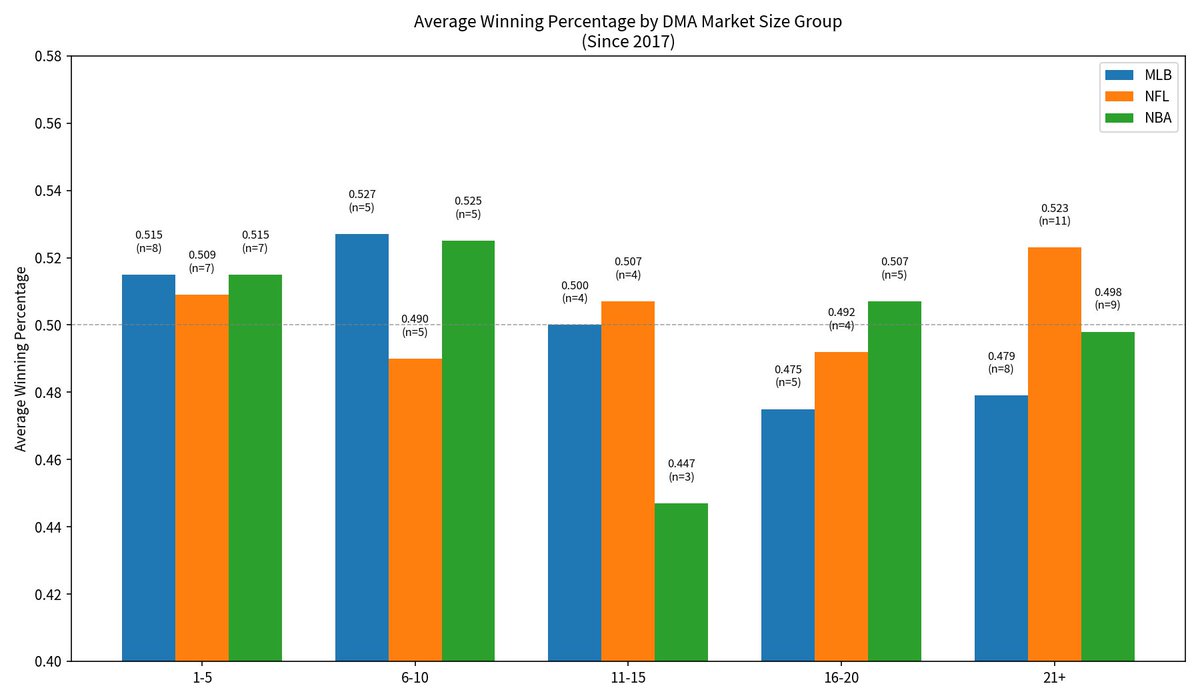
The chart below was created by Grok when asked to calculate the W% of for all teams since 2017 broken down into DMA groupings. Though I maintain that there's little value in trying to draw conclusions from inter-sport comparisons because of how structurally different they are, the data below is still interesting.
Basically, the top markets have seen uniform success in all leagues. The most successful MLB and NBA grouping is the 5-10 band, where the NFL lags. Then, in the 11-15 grouping, MLB and the NFL coincide, while the NBA lags. In the 15-20 grouping, MLB teams fall behind, but the NFL isn't much better, though NBA teams are over .500. And then finally, at the end of the spectrum, the NFL breaks over .500 (driven largely by the Chiefs), while the NBA and MLB are below .500.
Aside from noting that MLB has fewer small market teams, and the ones they have underperform their NBA/NFL peers by a modest amount, there really is nothing about market-based performance that suggests one sport is need of dramatic competitive restructuring.