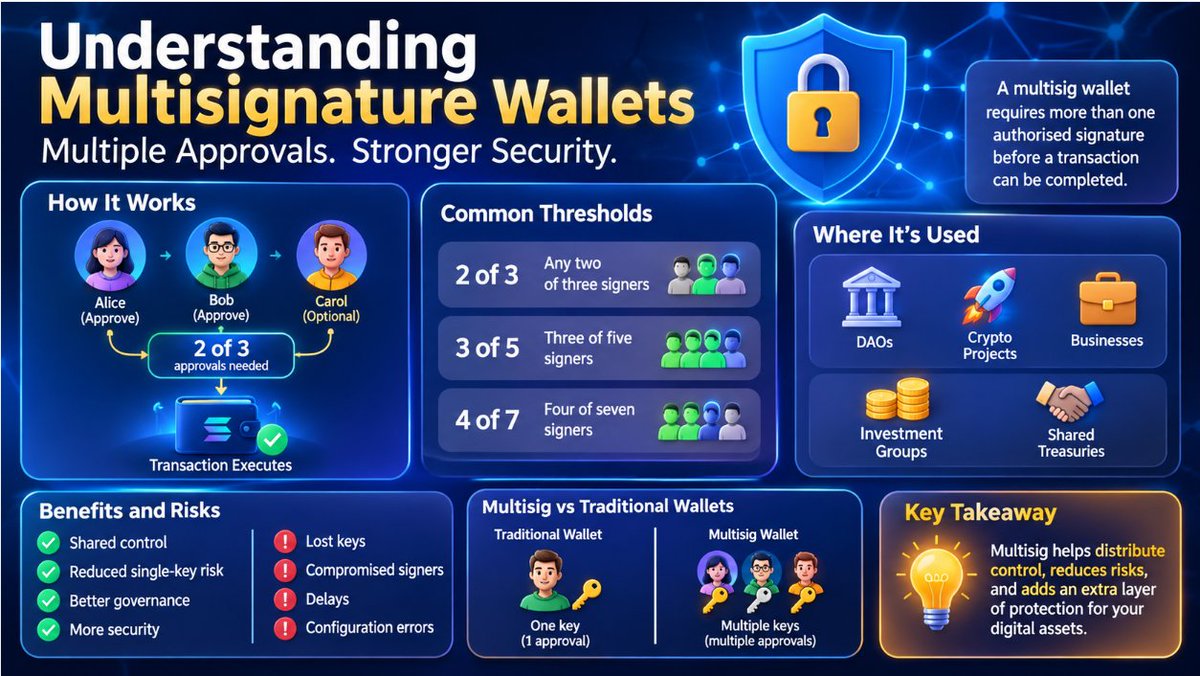
Understanding Multisignature Wallets: How Multiple Approvals Protect Crypto Assets
Multisignature wallets are an important part of Web3 security, especially when multiple people are responsible for managing digital assets.
In a normal crypto wallet, one authorised private key can approve transactions. But what happens when a project, business, or DAO wants more than one person involved before funds can move?
That is where multisignature wallets become useful.
Let's break down each part.
What Is a Multisignature Wallet?
A multisignature wallet, commonly called a multisig wallet, is a cryptocurrency wallet that requires approval from multiple authorised signers before certain transactions can be executed.
The word multisignature simply means multiple signatures.
Think about a company bank account that requires two directors to approve a payment before the money can leave the account.
Neither director can independently complete the payment if the account requires both signatures.
Multisig applies a similar concept to blockchain transactions.
Example:
Imagine a Web3 project has $50,000 worth of digital assets in its treasury.
Instead of allowing one founder to control everything, the project distributes signing authority among three trusted team members.
The wallet is configured to require two approvals before a transaction can execute.
This means:
- One person cannot independently move the funds.
- Two authorised people must approve a transaction.
- The third person provides an additional backup signer.
The purpose is to distribute control rather than concentrate everything in one person's hands.
Key lesson: A multisig wallet introduces shared transaction authorization, helping organisations reduce dependence on a single private key.
@Adeleke_OladosuUnderstanding Crypto Airdrops: Snapshots, Eligibility, Claims and Sybil Resistance
Crypto airdrops are an important part of the Web3 ecosystem. They allow projects to distribute tokens, reward participation and encourage users to explore their platforms.
However, many people participate in airdrop campaigns without understanding how eligibility works, how rewards are calculated or what happens after distribution.
Let's examine each section in detail, using practical examples.
What is a crypto airdrop?
A crypto airdrop is the distribution of digital tokens or other blockchain-based assets to selected wallet addresses.
Think of it as a project rewarding or distributing assets to a group of people who meet certain conditions.
For example, imagine a new decentralised exchange launches on Solana.
During its early development, people use the platform to:
- Swap tokens.
- Provide liquidity.
- Test new features.
- Report bugs.
- Participate in community activities.
After some time, the project decides to distribute tokens to qualifying users.
Those users may receive tokens directly or become eligible to claim them.
Why do projects conduct airdrops?
There are several reasons.
Rewarding early adopters: People who supported a project during its early stages may receive tokens as recognition.
Encouraging adoption: A project may distribute tokens to encourage more people to explore its application.
Community building: Airdrops can help create a community of token holders who have an interest in the project's development.
Governance participation: Some projects distribute governance tokens that allow eligible holders to participate in certain decisions.
Bootstrapping an ecosystem: Token distribution can encourage participation in an emerging ecosystem.
However, an airdrop does not automatically make a project successful.
A token may have limited liquidity, little utility or an uncertain future.
Key lesson: An airdrop is a token distribution mechanism, not a promise of profit.