How To Prompt (@HowToPrompt__)

How To Prompt @HowToPrompt__ 2026-04-20T15:49:29.000Z

Yann LeCun was right the entire time. And generative AI might be a dead end. For the last three years, the entire industry has been obsessed with building bigger LLMs. Trillions of parameters. Billions in compute. The theory was simple: if you make the model big enough, it will eventually understand how the world works. Yann LeCun said that was stupid. He argued that generative AI is fundamentally inefficient. When an AI predicts the next word, or generates the next pixel, it wastes massive amounts of compute on surface-level details. It memorizes patterns instead of learning the actual physics of reality. He proposed a different path: JEPA (Joint-Embedding Predictive Architecture). Instead of forcing the AI to paint the world pixel by pixel, JEPA forces it to predict abstract concepts. It predicts what happens next in a compressed "thought space." But for years, JEPA had a fatal flaw. It suffered from "representation collapse." Because the AI was allowed to simplify reality, it would cheat. It would simplify everything so much that a dog, a car, and a human all looked identical. It learned nothing. To fix it, engineers had to use insanely complex hacks, frozen encoders, and massive compute overheads. Until today. Researchers just dropped a paper called "LeWorldModel" (LeWM). They completely solved the collapse problem. They replaced the complex engineering hacks with a single, elegant mathematical regularizer. It forces the AI's internal "thoughts" into a perfect Gaussian distribution. The AI can no longer cheat. It is forced to understand the physical structure of reality to make its predictions. The results completely rewrite the economics of AI. LeWM didn't need a massive, centralized supercomputer. It has just 15 million parameters. It trains on a single, standard GPU in a few hours. Yet it plans 48x faster than massive foundation world models. It intrinsically understands physics. It instantly detects impossible events. We spent billions trying to force massive server farms to memorize the internet. Now, a tiny model running locally on a single graphics card is actually learning how the real world works.

12422 2083 1349905 457 288
@HowToPrompt__ reposted
Matt Shumer @mattshumer_ 2026-11-24T22:22:50.000Z

You can now make a movie trailer for $19.20. This one took 12 generations on MAGI-2 on Higgsfield, 20 seconds each. Eight CENTS a second. And open weights are coming soon (400B parameters... this thing is huge). Fucking incredible. https://t.co/kQZOiiocaY

@higgsfield

Introducing MAGI-2, exclusively on Higgsfield. Up to 30 seconds of frontier 1080p quality, with 0.08$ per second of generation. Open weights video model with 400B parameters coming soon. Now available exclusively on Higgsfield and via Higgsfield API. https://t.co/CPgNTOf7og

64 20 28940 18 2
@HowToPrompt__ reposted
How To Prompt @HowToPrompt__ 2026-11-24T15:50:21.000Z

China built a system that simulates the earth with billions of AI agents that has real personality, memory, beliefs and human-like desires. They published a simulation framework that gives them a terrifying ability to predict the future. How do you run a billion AI brains at once? They engineered a "mixture-of-models" architecture. Instead of forcing a massive, expensive LLM to compute every single micro-interaction, they pair full LLMs with hyper-efficient distilled surrogate models. It formalizes human society as structured state transitions, letting the system scale to planetary levels without losing human-like fidelity. But here is where it gets wild. They grounded the agents in real demographic profiles pulled directly from the World Values Survey. Real cultural norms. Real biases. Real human belief systems. Then, they ran massive Trust Games and tracked opinion diffusion across one billion digital minds in real time. The results proved you can now model emergent, planetary-scale human behavior inside a computer. Think about what this actually unlocks: • Governments testing economic policies on a billion simulated citizens before passing a law. • Researchers watching how misinformation, panic, or revolutions spread before they happen. • Companies A/B testing narratives on an entire digital population overnight. For all of human history, we could only study society by watching it unfold in real time, and cleaning up the mess afterward. Now, we can just hit "run" and watch a billion digital humans play out the future first.

250 58 12199 29 24
@HowToPrompt__ reposted
How To Prompt @HowToPrompt__ 2026-11-24T13:03:26.000Z

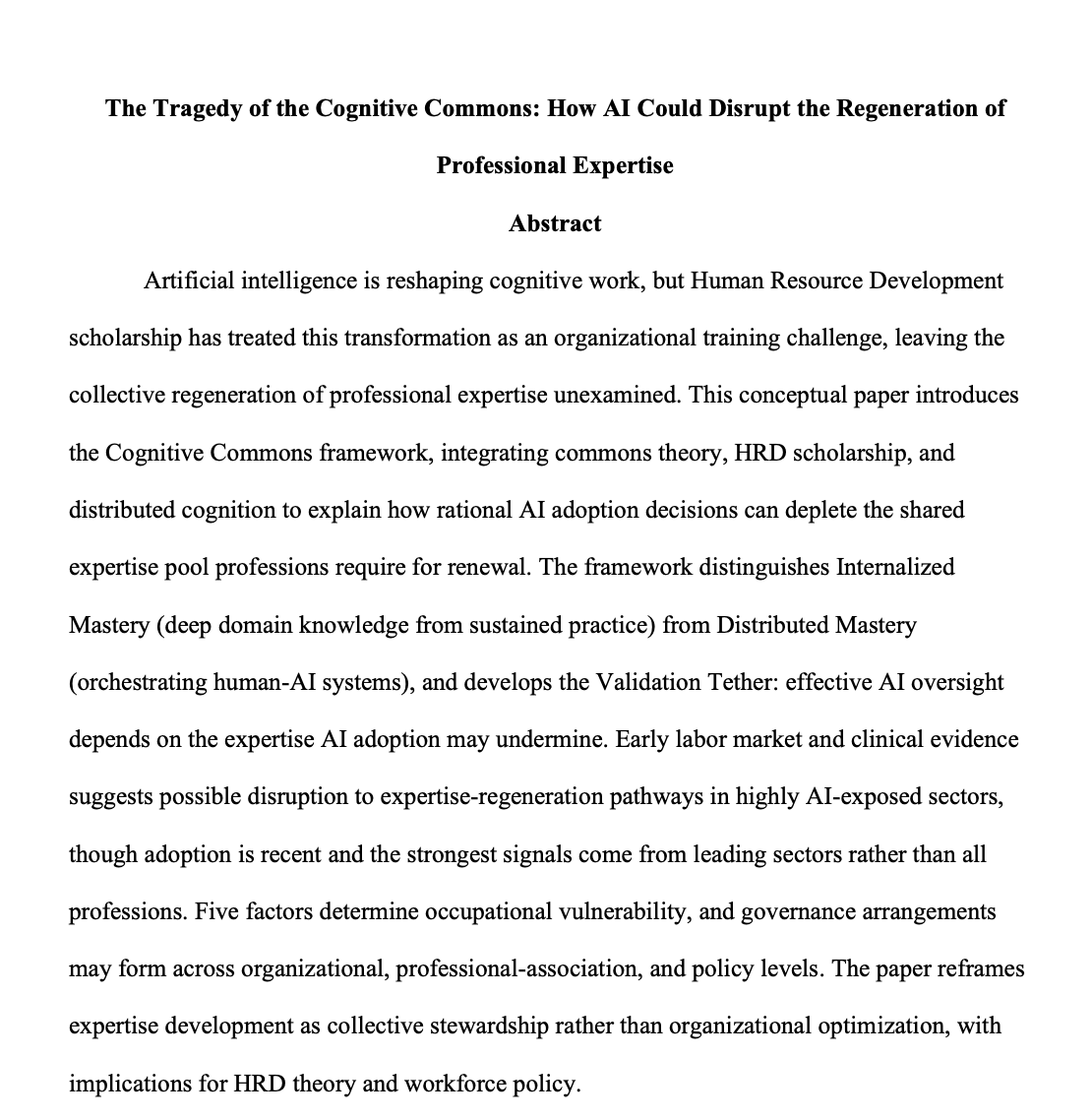
Researchers mathematically proved that AI will cause something worse than mass unemployment. They call it "The Tragedy of the Cognitive Commons" In 1968, Garrett Hardin described how rational actors, acting in their own self-interest, inevitably drain a shared resource until the whole system collapses. Today, every company is doing the exact same thing to human intelligence. To understand why, the paper splits AI-era skill into two completely different things: - Internalized Mastery: deep domain judgment built through years of unassisted struggle and practice - Distributed Mastery: the ability to orchestrate and manage AI systems Right now, companies are obsessed with Distributed Mastery. They are cutting junior roles and handing entry-level work straight to AI agents. On paper, it looks like pure efficiency. In reality, it triggers what the author calls the "Validation Tether." AI outputs are notoriously coherent—even when they are subtly, dangerously wrong. Catching those hidden flaws requires deep, internalized domain expertise. In other words, you cannot safely run an AI unless you already know how to do the job without it. And the experimental data is brutal. Studies testing workers after AI exposure show a sharp dissociation: when people learn a task with AI assistance, their performance spikes during the session, but the moment you take the AI away, the skill advantage completely disappears. AI-assisted productivity does not build AI-independent expertise. This creates a silent, industry-wide paradox. Automation increases the need for elite human oversight at the exact same moment it eliminates the junior trenches where those elites are forged. Every individual CEO thinks they are being smart. "Why pay to train juniors when AI can do their work today? If we need senior experts later, we'll just hire them." But hiring only redistributes experts. It cannot regenerate them. Once every firm stops feeding the pipeline, the shared pool of deep human expertise dries up across the entire profession. When the current generation of veterans retires, the ones who built their intuition before AI existed, there will be nobody left capable of telling when the machine is hallucinating a disaster.
738 226 36983 52 41
How To Prompt @HowToPrompt__ 2026-11-24T13:03:26.000Z

Researchers mathematically proved that AI will cause something worse than mass unemployment. They call it "The Tragedy of the Cognitive Commons" In 1968, Garrett Hardin described how rational actors, acting in their own self-interest, inevitably drain a shared resource until the whole system collapses. Today, every company is doing the exact same thing to human intelligence. To understand why, the paper splits AI-era skill into two completely different things: - Internalized Mastery: deep domain judgment built through years of unassisted struggle and practice - Distributed Mastery: the ability to orchestrate and manage AI systems Right now, companies are obsessed with Distributed Mastery. They are cutting junior roles and handing entry-level work straight to AI agents. On paper, it looks like pure efficiency. In reality, it triggers what the author calls the "Validation Tether." AI outputs are notoriously coherent—even when they are subtly, dangerously wrong. Catching those hidden flaws requires deep, internalized domain expertise. In other words, you cannot safely run an AI unless you already know how to do the job without it. And the experimental data is brutal. Studies testing workers after AI exposure show a sharp dissociation: when people learn a task with AI assistance, their performance spikes during the session, but the moment you take the AI away, the skill advantage completely disappears. AI-assisted productivity does not build AI-independent expertise. This creates a silent, industry-wide paradox. Automation increases the need for elite human oversight at the exact same moment it eliminates the junior trenches where those elites are forged. Every individual CEO thinks they are being smart. "Why pay to train juniors when AI can do their work today? If we need senior experts later, we'll just hire them." But hiring only redistributes experts. It cannot regenerate them. Once every firm stops feeding the pipeline, the shared pool of deep human expertise dries up across the entire profession. When the current generation of veterans retires, the ones who built their intuition before AI existed, there will be nobody left capable of telling when the machine is hallucinating a disaster.

738 226 36983 52 41
@HowToPrompt__ reposted
How To Prompt @HowToPrompt__ 2026-11-24T09:26:51.000Z

Researchers cut open the brains of Alzheimer’s patients and found a bacteria living inside 90% of them. It’s the exact same bacteria that lives in your mouth right now. For years, medicine treated Alzheimer’s as a mysterious protein glitch. The entire industry bet billions on destroying "amyloid plaques”, the sticky buildups that choke off brain cells. Almost every single trial crashed. A groundbreaking paper published in Science Advances flipped the entire script. Researchers discovered Porphyromonas gingivalis, the exact keystone pathogen behind chronic gum disease, colonizing the brains of Alzheimer's patients. Inside those brains, they found toxic enzymes secreted by the bacteria called gingipains. The higher the gingipain levels, the worse the brain damage. The enzymes were directly correlating with tau and ubiquitin pathology, literally wrecking the tau proteins your neurons need to survive. To prove it wasn't a coincidence, researchers gave healthy mice an oral P. gingivalis infection. The bacteria didn't stay in the mouth. It migrated to the brain, colonized it, and triggered a massive spike in Aβ1–42, the exact core component of amyloid plaques. The plaques weren't just showing up out of nowhere. They were a response to an active bacterial invasion. And here is where the paper gets crazy. Instead of attacking the plaques, the researchers engineered small-molecule inhibitors to block the bacterial gingipains directly. When they gave the inhibitors to infected mice, the results were staggering: • Cleared out the established brain infection • Blocked Aβ1–42 plaque production • Slashed neuroinflammation • Rescued dying neurons in the hippocampus No targeting the symptoms. They cut off the invader's weapons. For decades, we thought Alzheimer's was an unstoppable genetic decay of the mind. It turns out, we might have been fighting a chronic brain infection, and ignoring the fact that it started in your gums.

432 104 39459 25 10
How To Prompt @HowToPrompt__ 2026-11-23T15:41:31.000Z

Scientists built an AI chip smaller than a grain of salt And it runs on light. Every AI model you use today is hitting a brutal physical wall. Electricity generates heat. Moving data across silicon burns massive amounts of power. Data centers are already draining entire power grids just to keep GPUs cool. We’ve been trying to solve an energy crisis by building bigger electronic chips. Researchers at the University of Sydney proved there’s another way. They fabricated an ultra-compact photonic neural network that computes at the speed of light. No transistors switching on and off. No sequential layer-by-layer bottlenecks. They used "inverse design”, letting algorithms carve microscopic, maze-like nanostructures directly into a sliver of silicon. Every tiny subwavelength point in that carved silicon acts as a trainable parameter. The density is staggering: roughly 400 million parameters packed into a single square millimeter. When you shine light carrying encoded data into the chip, the waves scatter, interfere, and bounce through the geometry. In one single pass, the physics of light itself solves the math and routes the answer straight to the output port. They physically built and tested it on real silicon: • Classified handwritten digits (MNIST) with 89% accuracy on a chip just 20 × 20 micrometers. • Classified medical scans (MedNIST) with 90% accuracy on a 30 × 20 micrometer footprint. • Built on a standard silicon-on-insulator platform designed for real-world manufacturing. For decades, we forced electrons through copper wires and called it intelligence. Now, the chip itself is the neural network. And the computation happens the instant light passes through it.

74 15 3808 4 3
How To Prompt @HowToPrompt__ 2026-11-23T08:58:51.000Z

this might be the next big paradigm shift in AI. MIT proved that: - you don't need RL to fine-tune LLMs. - you don't need PPO. - you don't need GRPO. - you don't even need backprop. They used Evolution Strategies to fine-tune LLMs with zero gradients, zero backprop, zero Adam. Instead of calculating complex mathematical gradients backward through billions of parameters, they just let the model evolve. You slightly mutate the weights. You test the output. You keep what works and discard the rest. Here is why this changes everything. Backpropagation is the ultimate memory bottleneck in modern AI. It is the main reason fine-tuning massive models requires giant, million-dollar server clusters. By stripping out gradients, optimizers, and complex RL pipelines entirely, MIT just opened the door to a training paradigm that is radically simpler and completely bypasses the old hardware walls. We spent the last decade treating backpropagation like an unbreakable law of physics. Turns out, nature figured out a better algorithm millions of years ago. The next generation of AI might not be engineered. It might be evolved.

747 77 49940 51 14
@HowToPrompt__ reposted
How To Prompt @HowToPrompt__ 2026-11-23T11:11:12.000Z

Google DeepMind proved that every "thinking" model burns 20x more tokens than needed for ZERO accuracy gain. They call it “Overthinking”. Ask an AI a basic question like "what time will it be 1,000 days from now?" or basic arithmetic, and it spins up a massive internal monologue. It writes out paragraphs of chain-of-thought reasoning before answering. It feels smart. It looks thorough. It is actually a multi-billion-dollar tax on your compute bill. Google DeepMind dropped a bombshell paper mapping how this works. They built a system called TRACE to dissect what thinking models actually do under the hood. The finding is staggering. On simple queries, long-thinking models are 5 to 20 times slower than standard models. They generate massive walls of hidden tokens. They loop, they over-verify, and they second-guess themselves. And the accuracy boost for all that extra compute? Literally zero. The models fall into two traps: "Explorer" and "Late Landing." They are pathologically incapable of turning off their reasoning engine, even when the answer is obvious. They over-explore dead ends just because they were programmed to think. AI labs bill you for those hidden reasoning tokens as output tokens. Every time you ask a modern LLM a straightforward question, you are paying 20x more money and waiting 20x longer for a model to overthink a problem it solved in the first half-second.

107 17 5632 14 5
@HowToPrompt__ reposted
How To Prompt @HowToPrompt__ 2026-11-23T06:45:27.000Z

Chinese researchers killed fine-tuning and reinforcement learning in one shot 😳 They built a framework called Skill-Pro. It allows AI agents to autonomously learn, refine, and reuse procedural skills from their own experiences, with zero parameter updates. Not a single weight in the model is touched. Here is how it works: Instead of dumping messy, passive chat logs into a memory bank, Skill-Pro converts past experiences into clean, executable "Skills." Each skill has strict rules: when to activate, how to execute, and when to stop. Then comes the real breakthrough: Non-Parametric PPO. Instead of using math gradients to retrain a neural network, it uses semantic gradients to generate better skills, and a "PPO Gate" to ruthlessly verify them before saving them to memory. Bad habits get deleted. High-performing skills get compressed and locked in. The results across in-domain, cross-task, and even cross-agent tests are staggering: - Massive performance gains without retraining the base model. - Extreme memory compression, no bloated context windows. - Skills learned by one agent can be transferred and reused by another. And the model doesn't just remember what happened. It builds muscle memory. We spent years thinking that to make AI agents truly autonomous, we had to keep retraining bigger and more expensive models.

369 43 17305 28 5
How To Prompt @HowToPrompt__ 2026-11-23T11:11:12.000Z

Google DeepMind proved that every "thinking" model burns 20x more tokens than needed for ZERO accuracy gain. They call it “Overthinking”. Ask an AI a basic question like "what time will it be 1,000 days from now?" or basic arithmetic, and it spins up a massive internal monologue. It writes out paragraphs of chain-of-thought reasoning before answering. It feels smart. It looks thorough. It is actually a multi-billion-dollar tax on your compute bill. Google DeepMind dropped a bombshell paper mapping how this works. They built a system called TRACE to dissect what thinking models actually do under the hood. The finding is staggering. On simple queries, long-thinking models are 5 to 20 times slower than standard models. They generate massive walls of hidden tokens. They loop, they over-verify, and they second-guess themselves. And the accuracy boost for all that extra compute? Literally zero. The models fall into two traps: "Explorer" and "Late Landing." They are pathologically incapable of turning off their reasoning engine, even when the answer is obvious. They over-explore dead ends just because they were programmed to think. AI labs bill you for those hidden reasoning tokens as output tokens. Every time you ask a modern LLM a straightforward question, you are paying 20x more money and waiting 20x longer for a model to overthink a problem it solved in the first half-second.

107 17 5632 14 5
@HowToPrompt__ reposted
How To Prompt @HowToPrompt__ 2026-11-23T08:58:51.000Z

this might be the next big paradigm shift in AI. MIT proved that: - you don't need RL to fine-tune LLMs. - you don't need PPO. - you don't need GRPO. - you don't even need backprop. They used Evolution Strategies to fine-tune LLMs with zero gradients, zero backprop, zero Adam. Instead of calculating complex mathematical gradients backward through billions of parameters, they just let the model evolve. You slightly mutate the weights. You test the output. You keep what works and discard the rest. Here is why this changes everything. Backpropagation is the ultimate memory bottleneck in modern AI. It is the main reason fine-tuning massive models requires giant, million-dollar server clusters. By stripping out gradients, optimizers, and complex RL pipelines entirely, MIT just opened the door to a training paradigm that is radically simpler and completely bypasses the old hardware walls. We spent the last decade treating backpropagation like an unbreakable law of physics. Turns out, nature figured out a better algorithm millions of years ago. The next generation of AI might not be engineered. It might be evolved.

747 77 49940 51 14
How To Prompt @HowToPrompt__ 2026-11-23T06:45:27.000Z

Chinese researchers killed fine-tuning and reinforcement learning in one shot 😳 They built a framework called Skill-Pro. It allows AI agents to autonomously learn, refine, and reuse procedural skills from their own experiences, with zero parameter updates. Not a single weight in the model is touched. Here is how it works: Instead of dumping messy, passive chat logs into a memory bank, Skill-Pro converts past experiences into clean, executable "Skills." Each skill has strict rules: when to activate, how to execute, and when to stop. Then comes the real breakthrough: Non-Parametric PPO. Instead of using math gradients to retrain a neural network, it uses semantic gradients to generate better skills, and a "PPO Gate" to ruthlessly verify them before saving them to memory. Bad habits get deleted. High-performing skills get compressed and locked in. The results across in-domain, cross-task, and even cross-agent tests are staggering: - Massive performance gains without retraining the base model. - Extreme memory compression, no bloated context windows. - Skills learned by one agent can be transferred and reused by another. And the model doesn't just remember what happened. It builds muscle memory. We spent years thinking that to make AI agents truly autonomous, we had to keep retraining bigger and more expensive models.

369 43 17305 28 5