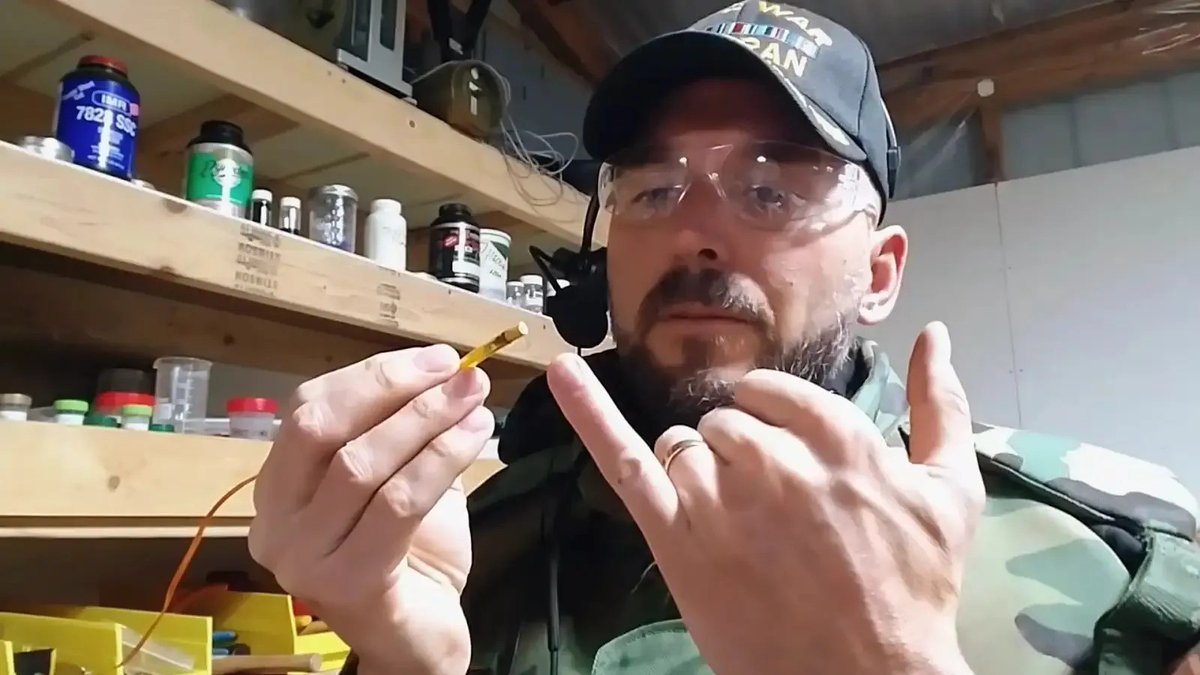
FBI arrests YouTube personality because a dead terrorist found him interesting
After 42-year-old Shamsuddin Jabbar conducted a vehicle ramming and shooting attack by himself in New Orleans on New Year’s Day 2025, which killed 14 innocent people and injured dozens more and he was shot and killed by police, the FBI found two IEDs that Jabbar had planted on Bourbon Street, which thankfully did not explode.
When agents searched Jabbar’s rented home, they found two laptops. On one of the laptops agents reported finding 12 videos, six of which were allegedly created by Jordan Andrew Derrick.
“In the videos, Derrick provided step-by-step instructions on how to make the explosives,” wrote FBI Special Agent Kacie L. Laidacker, in her affidavit in support of an application for a federal complaint.
Agent Laidacker wrote that her complaint request was based on her 17 years as an FBI Special Agent, her participation in the investigation, and her “personal observations, my training and experience, and information obtained from other agents and witnesses.”
She wanted Derrick charged with three federal felonies:
1. Engaging in the business of importing, manufacturing, or dealing in explosive materials without a license.
2. Teaching or demonstrating to any person the making or use of an explosive, a destructive device, or a weapon of mass destruction, or to distribute to any person, by any means, information pertaining to, in whole or in part, the manufacture or use of an explosive, destructive device or weapon of mass destruction, knowing that such person intends to use the teaching, demonstration or information for, or in furtherance of, any activity that constitutes a federal crime of violence.
3. Receive or possess a firearm which is not registered to him in the National Firearms Registration and Transfer record.
According to a Justice Department press release issued in May, the charges were changed.
The NFA violation was dropped. Derrick now faces “one count of engaging in the business of manufacturing explosive materials without a license, one count of unlawful possession of an unregistered destructive device, and one count of distributing information relating to manufacturing explosives, in violation of U.S. law.”
If he is convicted, Derrick faces up to 40 years in a federal prison without any possibility of parole.
Agent Laidacker’s complaint request was 36-pages long, and included multiple photos of videos Derrick had made over the years. Some of the titles seemed very damning: “How to make RDX,” and “NAP (primary explosive),” and “Detonators.”
FBI agents obtained Derrick’s purchase records from a chemical supply firm, which showed he had bought scores of what they said were suspicious chemicals and laboratory gear.
“Based upon my experience and training, the below list of chemicals are precursor chemicals used to make HME [Homemade explosives],” Laidacker wrote in her complaint application.
She asked the court to seal her complaint, because “based upon my training and experience, I have learned that online criminals actively search for criminal affidavits via the Internet and disseminate them to other online criminals as they deem appropriate, i.e. post them publicly online.”
Agent Laidacker did not return calls seeking her comments for this story.
Dixon Land, an FBI public affairs specialist in Kansas City, said his office would not allow her to comment.
The Arrest
“It was before 7 a.m. about six months ago when I was standing in the kitchen and saw a bunch of vehicles coming down the road. There were at least 20, and there was like a tank with a ‘door buster’ on it. Then came a force of at least 50 or 60 agents. That’s how we found out,” said Phoebe Derrick, Jordan’s wife and mother of their three sons: Henry, age 7, Thomas, age 5 and Wilhelm, who is 2.
The Derricks live on a 16.5-acre farm about an hour east of Kansas City.
“Please come out with your hands up,” one of the FBI agents said over a loudspeaker.
Jordan Derrick, 41, immediately went out to talk to the agents, some of whom were members of FBI’s Hostage Rescue Unit.
When Phoebe Derrick walked out with her children, she saw her husband’s hands were already tied behind his back with a Flex Cuff. She and her children were placed in an FBI vehicle and taken about a half-mile from their farmhouse.
“Our boys were all pretty brave, even though they were only in their underwear,” Phoebe Derrick said. “Our five-year-old told the agents not to touch the stuff in his room.”
She and her sons were allowed to return about an hour later, but were told they needed to grab some clothing and leave.
“I talked to the lead case agent. She said my ‘hubby’ was going to have an arraignment and be released on bond,” Phoebe Derrick recalled. “I asked where we were supposed to go.”
She told the agents that they had farm animals that needed care: chickens, ducks, goats and a pig. She was allowed to feed and water the animals before she was forced to leave.
She and the children went to Columbia, Missouri to stay with her husband’s parents.
“The agents weren’t really all that concerned, which is further proof of the joke of this whole thing,” she said. “There was no crime they were discovering.”
Jordan Derrick underwent a preliminary and a detention hearing, but contrary to what the FBI told his wife, he was not released and has been held in the county jail ever since.
“Dugan Ashley”
“I would describe myself as a First Amendment and Second Amendment activist,” Derrick said from a jail phone last week in the Pettis County, Missouri jail.
He pointed out that he served in the Army as a combat engineer, and that he is an Iraq War veteran.
“The military teaches you in-depth explosive training,” he said. “We blew up a lot of IEDs and enemy weapons.”
After his service, Derrick was scouted by several arms manufacturers, but his health intervened.
“I got Multiple Sclerosis and started going blind in 2009. In 2014 I got paralysis. I got diagnosed by the VA and tried to stay as healthy as possible,” he said. “This is the only time I have been untreated—in this jail. I am currently receiving no care for my MS. I fill out grievance forms telling them I have MS. My window of treatment was supposed to have started in November. I was supposed to go to a chemotherapy clinic, but so far, I haven’t heard back from them.”
He has problems viewing the thousands of pages of discovery documents prosecutors provided. The jail’s computer system is “practically unmanageable,” he said.
“Everyone else is in here for fentanyl and/or guns,” he said. “Ninety-five percent of the people are in for protecting drugs with guns, and they have no need for discovery. They’re all taking pleas. The jail is auto-piloted to process that. There’s no reasonable ability to organize your defense.”
Years ago, Derrick said he posted videos on YouTube under the names “Dugan Ashley” and later “Dug.” After several years, he decided to spike the channels, but some sites appear to have saved his content.
In 2023, he began publishing new videos on smaller channels about his current inventions, explosives and “energetic materials.”
“My general philosophy in terms of energetic materials is that the general public is not informed of it,” he said. “They’re not aware of the history. Congress doesn’t recognize any type of explosives as being covered by the Second Amendment, but as far as ammunition, it is.
“My personal opinion is that the United States of America should always be on top of the [explosives] field,” he said. “We’ve been that way through World War I and World War II. Energetic materials were all invented by people who are passionate in the field, and they have always been unrestricted. Restrictions have always been based on transfer and movement. Patents have never been restricted. Weapons are entirely separate—like a grenade—totally separate statutes like NFA items. In terms of energetic materials, the only restriction is in the framework of commerce and interstate transfer.”
Derrick was adamant he had not violated any law.
“No. absolutely not. Each charge is stretched by the government against me to cause criminal liability, and the way they stretch them is to ignore particular statutes. Each statutory violation has a defined set of requirements, especially in the context of what it is. I am doing technical research based on First Amendment-protected activity. I feel like it’s a personal vendetta by the government against me.”
Derrick was denied his release from jail at his detention hearing because the government claimed he was a danger to the community.
“I’ve got a big NFA collection. They opened my safe and laid it all out on a bed for photos. They claimed my SBSs and SBRs were illegal. They said I had thousands of rounds of ammunition, which I did. I told them to go to my room and find my books, and my lawyer gave all the info to the prosecutors and the whole gun thing disappeared,” he said. “I live in a very rural area. All the neighbors know what I do—what I test. They’re used to the bangs. It’s never been a problem.”
After the FBI left his home, all of his NFA items were still on the bed.
“They violated the NFA by leaving everything unsecure, not in the safe. We were worried they were trying to set up my wife,” he said. “They took all of my lab—everything—chemicals and electronics. They took every battery out of our house. Everything they took—nothing was illegal.”
Derrick was very clear about the dead terrorist, Shamsuddin Jabbar.
“I don’t know him. We never communicated in any way, shape or form,” he said. “I never met him. I never heard from him once.”
Legal reaction
Few attorneys understand the Second Amendment better than Matthew Larosiere, who is based in Orlando, Florida.
He has experience defending those accused of violating nonsensical gun laws, and he is known as a fighter within the country’s tight Second Amendment legal community.
He picks and chooses his cases carefully, once saying, “The best way for me to do the best work I can is by bringing the cases I want to bring.”
He joined Derrick’s defense team as a “consulting expert.”
“I am still not 100-percent clear what the charges even are,” he said. “It’s like there could be five or six superseding indictments. It’s unclear what the misconduct even is.”
The current charges relate to Derrick’s defunct YouTube channel, Larosiere believes.
“Engaging in a business to train people to engage in explosives? Without a license? And yes, that is exactly as crazy as it sounds,” he said. “I have never seen a case this bad … well, maybe Tate’s. I have not seen a case this bad outside of my own practice of taking cases this bad.”
As to whether prosecutors will take the case to an actual trial, Larosiere said, “I don’t know, to be honest. I don’t think they should, obviously.”
As to what Derrick allegedly did wrong, Larosiere said, “It was unusual but not illegal. There is no law against being unusual. It’s all so stupid.”
Said Larosiere: “The real reason the FBI chose him was because a terrorist liked his videos.”
The Second Amendment Foundation’s Investigative Journalism Project wouldn’t be possible without you. Click here to make a tax-deductible donation to support pro-gun stories like this.
@2AFDN