Nick Anthony (@EconWithNick)

Nick Anthony @EconWithNick 2026-11-25T14:32:40.000Z

File under reason 9000 that the government should not be collecting our private financial information.

@theragetech

🚨 U.S. FINANCIAL INTELLIGENCE UNIT HACKED Hackers appear to have gained access to FinCEN's secure data transfer system, used by financial institutions to send Bank Secrecy Act reports on customer activity to the agency. The reports include full names, addresses, amounts, and ID documents on file. The hack appears to also affect corporate transparency reporting, disclosing beneficial ownership of companies. Critics have long warned that the U.S. was building a honeypot of sensitive financial information that would be valuable to criminals.

3 1 100 0 0
@EconWithNick reposted
The Rage @theragetech 2026-11-25T12:35:39.000Z

🚨 U.S. FINANCIAL INTELLIGENCE UNIT HACKED Hackers appear to have gained access to FinCEN's secure data transfer system, used by financial institutions to send Bank Secrecy Act reports on customer activity to the agency. The reports include full names, addresses, amounts, and ID documents on file. The hack appears to also affect corporate transparency reporting, disclosing beneficial ownership of companies. Critics have long warned that the U.S. was building a honeypot of sensitive financial information that would be valuable to criminals.

45 11 3068 4 7
Nick Anthony @EconWithNick 2026-11-25T13:42:00.000Z

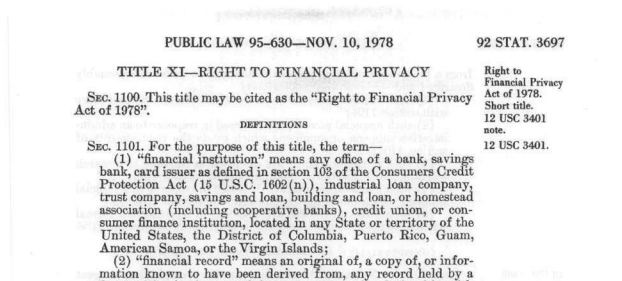
It can be difficult to be thankful for most legislation these days. But if we look to the past, some laws stand out. The Right to Financial Privacy Act of 1978 is one such law that I’m _almost_ thankful for. The Right to Financial Privacy Act was originally enacted in response to early surveillance under the Bank Secrecy Act. At the time, the Bank Secrecy Act had just gotten off the ground, and banks were required to begin reporting their customers’ activities to the government. While this seemed like an obvious violation of the Fourth Amendment, the Supreme Court gave it the okay under what is now known as the “third party doctrine.” In short, the Supreme Court said that if you reveal something to a third party, you no longer have a right to privacy. Recognizing the problem, Congress quickly enacted the Right to Financial Privacy Act. At its core, the Right to Financial Privacy Act established a process for notifying the public when the government requests their financial information. It also provided the public the opportunity to challenge said requests. The law then specifies that the government may access financial records held by a financial institution only with authorization from a customer, an administrative subpoena or summons, a search warrant, a judicial subpoena, or a formal written request. It’s this framework that I’m almost thankful for. I say “almost,” however, because that’s not where the law stopped. While the first half of the Right to Financial Privacy Act established new protections for financial information, the second half of the law tore those protections down. Congress created a list of twenty exceptions to the law that cover almost every instance in which the government might want to seize your information. For example, the law does not protect people from the Bank Secrecy Act or any other federal statute. In effect, the law may be called “The Right to Financial Privacy Act,” but Americans have no such thing. Part of the challenge is that the “right to financial privacy goes to the heart of the tension between an individual’s right to conduct [his or her] business without governmental intrusion and the government’s legitimate need for information in law enforcement.” But striking this balance is not an insurmountable task. While critics point to curbing criminal activity to justify invading the public’s financial privacy, there should be stronger protections so long as the US justice system maintains that the public is innocent until proven guilty. Neither fishing expeditions nor thread pulling that may lead to investigations should be considered a sound justification when financial information can reveal a person’s relationships, profession, religion, political leanings, locations, and more. A revised legal and regulatory regime for the financial sector must protect citizens against warrantless searches and seizures—a protection guaranteed by the Fourth Amendment. That would be something to be truly thankful for.
5 3 201 0 0
Nick Anthony @EconWithNick 2026-11-24T20:31:42.000Z

One of the biggest scandals of Operation Choke Point was that nothing happened in the end. Sure. The FDIC and others got dragged through the coals, but it largely just ended with Trump 1.0 promising it was over. Sure enough, Operation Choke Point 2.0 arrived. That "ended" with a voluntary rollback of reputational risk regulation and another promise from Trump. However, that's hardly binding either. Without serious legislative change, we will just be sitting here waiting for Operation Choke Point 3.0. And for that reason, @resistancemoney is spot on: Bitcoin remains important as an escape hatch.

@resistancemoney

A mass debanking crisis — think Canada truckers, but 10x — remains totally possible. It could be at the behest of the EU, or Trump, or his successor, or an emboldened Congress, or a swarm of AI agents enacting safety rails on their users. Bitcoin remains necessary.

23 7 1197 3 0
@EconWithNick reposted
George Selgin @GeorgeSelgin 2026-11-23T06:37:15.000Z

Whatever one thinks of libertarianism, the outmoded chart shown here is no reason to reject it: the pre-1914 statistics it uses are outmoded. Newer ones show very little improvement in the frequency and duration of recessions since the Fed's establishment. 1/3

@Tpohnka

This is the chart that made me change my ideology from basically an AnCap libertarian to a more mainstream conservative liberal. You can see in the chart exactly when the Federal Reserve was established, even without it being shown. https://t.co/GQlMcw2gY0

237 31 7974 2 2
@EconWithNick reposted
Cato CMFA @CatoCMFA 2026-11-21T17:13:01.000Z

When Outlook went down, Proton and Signal were still on. When the major banks went down, Bitcoin and community banks were still open. Yet, when the FAA went down, flights came to a halt. The gov't’s monopoly on air traffic control meant there was no alternative. @EconWithNick https://buff.ly/v4Q3JXi

1 1 185 0 0