Oliver (@EClock24)

@EClock24 reposted
Oliver @EClock24 2026-11-28T13:17:47.000Z

Everyone is posting about zero fees. I get it, it's sexy. But my favourite part of the launch is yield as margin. Normally your money sits idle on an exchange, doing nothing while you wait. On @grvt_io , your capital can earn while it waits. And you can still use that same capital to trade. You don't have to choose between earning and trading anymore. You can do both from the same balance. Imagine holding Gold for days, and your collateral is also working in background. That changes the whole game of holding. In traditional finance, only big clients get this from prime brokers. GRVT is making it normal for everyone. Create account: https://grvt.io/a/g/yz9g9ef5 .

@grvt_io

Just checked. Our High Yield Earn is currently delivering 11.49% APY. Your money doesn’t have to sit idle. https://t.co/mE5z4xBKZl

68 2 378 23 0
@EClock24 reposted
Oliver @EClock24 2026-11-28T13:15:15.000Z

2 months ago, a tool I used daily for copywriting changed its pricing 3x and removed my favorite model. No warning. If one company serves a model, they can change it, reprice it, or retire it overnight. We've all been there. That's why I kept digging into Lightchain. On @LightchainAI , independent operators serve open models. And every single change to the model list is a public onchain transaction. You can check it. No stealth removal. I asked Qwen3 on http://chat.lightchain.ai today a question I used to ask that old tool. Same quality, but this time I know it won't disappear tomorrow because a board meeting said so. For builders, this permanence matters more than hype. https://x.com/LightchainAI/status/2126315112260645087/video/1

54 1 434 19 0
Ellie @Ellie_963 2026-11-28T13:37:32.000Z

A customer issue is rarely just a customer issue Imagine a service outage affecting 3 customers The support team sees 3 separate tickets The service team sees an outage The HR team knows who has the skills to fix it But who connects all three? That's the interesting part of what @Cere_Bree is building with Cognie inside HRX Instead of looking at isolated records, Cognie connects customer, service and workforce context to recommend what should happen next And one detail I really like: it recommends the next step, but the human still makes the decision AI should help people see the bigger picture, not take the steering wheel

22 0 198 28 0
AHMED CRYPTOʷᵉᵇ³ @ahmed_Kols125 2026-11-28T11:49:39.000Z

🔐 على Binance حماية حسابك مش بتعتمد بس على قوة كلمة المرور، لكن كمان على الأجهزة اللي بتستخدمها لتسجيل الدخول قبل ما تدخل إلى حسابك من جهاز جديد، اتأكد إنه جهازك الشخصي ومحدّث بنظام حماية موثوق ولو اضطررت تستخدم جهازًا مشتركًا، ما تحفظش بيانات الدخول عليه واحرص على تسجيل الخروج بعد الانتهاء كمان مهم تراجع قائمة الأجهزة المسجّلة على حسابك بشكل دوري، ولو لاحظت جهازًا مش بتعرفه، اتخذ إجراءً فوريًا لتأمين حسابك 💡 نصيحة اليوم: ما تكتفيش بحماية الحساب وقت تسجيل الدخول، راجع باستمرار الأجهزة اللي عندها إمكانية الوصول إليه 🚨 تذكّر: Binance لن تطلب منك أبدًا نقل أموالك إلى محفظة آمنة أو إرسال عملات رقمية لتأكيد هويتك أو توثيق حسابك ⚠️ تنويه: هذا المحتوى لأغراض التوعية فقط، واحرص دائمًا على اتباع إرشادات الأمان الرسمية من Binance #Binance #BinanceSecurity #StaySAFU #CryptoSecurity

27 0 333 22 0
OLUWATOSIN @icetosin 2026-11-28T11:44:00.000Z

The problem with disconnected intelligence We have more software than ever, but having more tools doesn’t necessarily mean having better information. A company can have its customer records in one system, employee information in another, and service operations somewhere else. Each platform might work perfectly on its own, yet nobody has the complete picture when something goes wrong. This is the gap @cere_bree is trying to address with Relationship Intelligence. Instead of treating information as isolated records, CereBree wants to connect the relationships between people, services, and systems. That’s an important distinction. Sometimes the answer isn’t another application. It’s making the information we already have work together.

176 98 919 35 0
Nycole @ny14co 2026-11-28T13:35:42.000Z

simply incredible Cooking again...

@Nazii_Art

GM Dear Guys ☀️ 𝗧𝗵𝗲 𝗟𝗮𝘀𝘁 𝗕𝗼𝘂𝗻𝗱𝗮𝗿𝘆 From my ECHOES OF ANOTHER REALM collection 🔗 https://objkt.com/tokens/KT1LhBYYSd8Tc2rX11XMeb2bSkNj9erBhVpe/18?ref=tz1MxN26TcUQoVU1LQ4bXq8KBWCLndmLJ3zL A surreal vision of liberation, transformation, and the courage to transcend limitations. As reality fractures, a new world emerges beyond the familiar reminding us that every ending can become a beginning 💖🕊 #NFTArt #SurrealArt

46 1 306 25 0
BEN Gurain🥇 @sanmiastar 2026-11-27T17:27:14.000Z

𝗪𝗵𝗮𝘁 𝗜 𝗟𝗲𝗮𝗿𝗻𝗲𝗱 𝗔𝗯𝗼𝘂𝘁 𝗦𝗲𝗻𝗱𝗶𝗻𝗴 𝗨𝗦𝗗𝗧 𝗼𝗻 𝗧𝗥𝗢𝗡 𝗪𝗶𝘁𝗵𝗼𝘂𝘁 𝗡𝗲𝗲𝗱𝗶𝗻𝗴 𝗧𝗥𝗫 Imagine receiving your freelance payment in USDT, opening your wallet to send some of it to another address, only to discover that you cannot complete the transfer because you don’t have enough TRX for network fees. That was my experience. I had the USDT. I had the recipient’s wallet address. I was ready to transfer, but I needed another token just to move the stablecoins I already owned. It made me realise how an additional network-fee requirement can interrupt an otherwise simple payment process. That’s when I discovered GasFree on TRON. 𝗪𝗵𝗮𝘁 𝗶𝘀 𝗚𝗮𝘀𝗙𝗿𝗲𝗲? GasFree is a feature that makes supported stablecoin transfers on TRON possible without requiring users to hold TRX specifically to pay the transaction fee. Instead of paying the network fee in TRX, users can pay directly in the stablecoin they are transferring. Here’s how I approached it: 𝗦𝘁𝗲𝗽 𝟭: Open a supported wallet I started with my TronLink wallet, which supports GasFree transactions. 𝗦𝘁𝗲𝗽 𝟮: Activate GasFree I visited http://gasfree.io/transfer and completed the required one-time account activation. 𝗦𝘁𝗲𝗽 𝟯: Enter the transfer details I selected USDT, entered the recipient’s TRON wallet address and specified the amount I wanted to send. 𝗦𝘁𝗲𝗽 𝟰: Review the fees Before proceeding, I checked the activation and transfer fees displayed on the interface. 𝗦𝘁𝗲𝗽 𝟱: Confirm the transaction After reviewing the details, I proceeded with the transfer. 𝗪𝗵𝗮𝘁 𝗺𝗮𝗸𝗲𝘀 𝗚𝗮𝘀𝗙𝗿𝗲𝗲 𝗱𝗶𝗳𝗳𝗲𝗿𝗲𝗻𝘁? The biggest advantage is that I don’t have to keep a separate TRX balance just to make supported stablecoin transfers. Here are some important things to understand: ▫️ Supported tokens: GasFree supports USDT and USDD on TRON. ▫️ Alternative fee payment: Transfer fees can be paid directly in the stablecoin being transferred rather than in TRX. ▫️ One-time activation: Users must complete account activation before accessing the service. ▫️ Transparent fee information: Applicable activation and transfer fees are displayed before confirmation. ▫️ Simplified transfers: Users can move supported stablecoins without first acquiring TRX specifically to cover the transaction fee. 𝗧𝗵𝗲 𝗯𝗶𝗴𝗴𝗲𝗿 𝗽𝗶𝗰𝘁𝘂𝗿𝗲. For freelancers, remote workers, businesses and anyone who regularly receives or sends stablecoin payments, reducing unnecessary friction matters. Receiving USDT should not make sending USDT feel unnecessarily complicated. GasFree addresses this particular challenge by making supported stablecoin transfers more convenient and reducing the need to manage a separate token for transaction fees. It’s a practical improvement to the everyday user experience on TRON. Sometimes, the best innovation is simply making something that should be easy even easier. Explore GasFree: https://gasfree.io/transfer @justinsuntron #TRONEcoStar @DeFi_JUST #GasFree

30 1 10198 20 0
Tyzo @Hey_tyzo 2026-11-28T10:51:01.000Z

What if the stuff you did on Base months ago was already your ticket into a launch? That's the idea behind zBASE, the second Activity Market from @zerufinance and the numbers made me stop for a second Over the last 30 days Base saw more than 258M transactions 7.37M unique active addresses 32.8B dollars in DEX volume Most launches I've watched go to whoever is fastest on the day. All that activity on the chain itself barely counts Here your past and ongoing Base activity earns you Zaps, and Zaps give you a chance to take part in the auction. Your activity also decides your share of the supply burn Supply starts at 1,000,000,000 and keeps dropping while the race runs, so the final zBASE supply gets shaped by what people actually do onchain That's the bit that got me. You can't fake a long history in one afternoon. A wallet that's been active on Base for a while already has something a wallet made yesterday doesn't If you want to start earning Zaps yourself, here's my invite https://zaps.markets/?invite=zbkQFf9K Do you think your Base history is worth more than you realize?

90 0 616 97 0
Zenia @Zenia_sol 2026-11-28T13:34:39.000Z

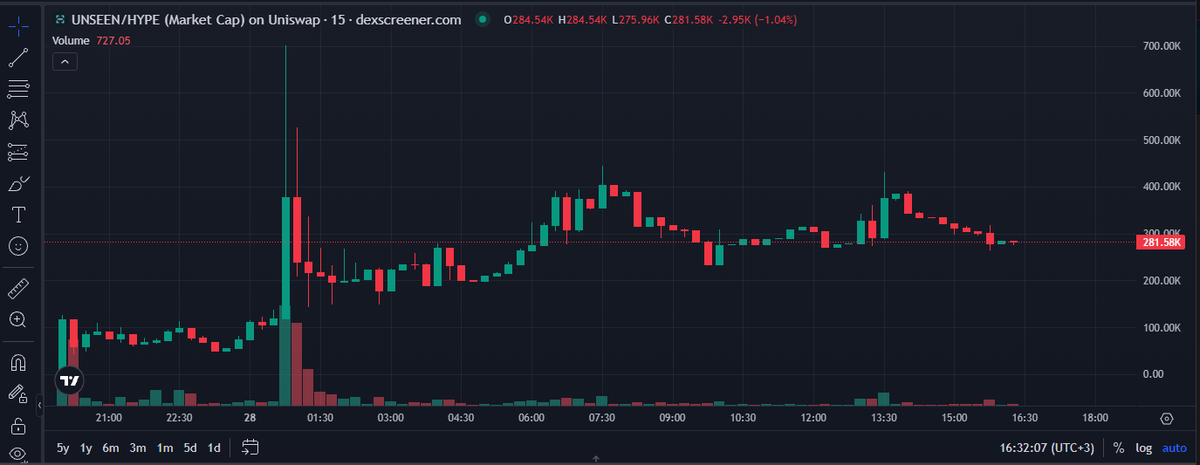
On Hyperliquid, a big position is never just a position. Anyone can click through to the wallet behind it: the balance, the other trades, how much margin is left to defend it. $Unseen is built to cut that link. How it works, per their docs: • You shield HYPE or USDC into a vault on Elysium • Your browser derives a fresh Hyperliquid account, an "alias", with no history • The alias trades Hyperliquid's own book, up to 40x on BTC What stays public: the position, its liq price, its P&L. What disappears: the fact that it's yours. The token side is simple. Half of every HYPE exit fee buys back UNSEEN and burns it. You don't need the token to use the product. Two things they say themselves, which I respect: there's no external audit yet, and anyone can launch a token with the same name. So check the contract: 0x6d1523348ad84210ee51d08676618ff5dd2b2819 Around $280K market cap on a brand-new chain. Very early, very small, and it trades like it. But the problem is real. On Hyperliquid, size is public by default. NFA, DYOR.
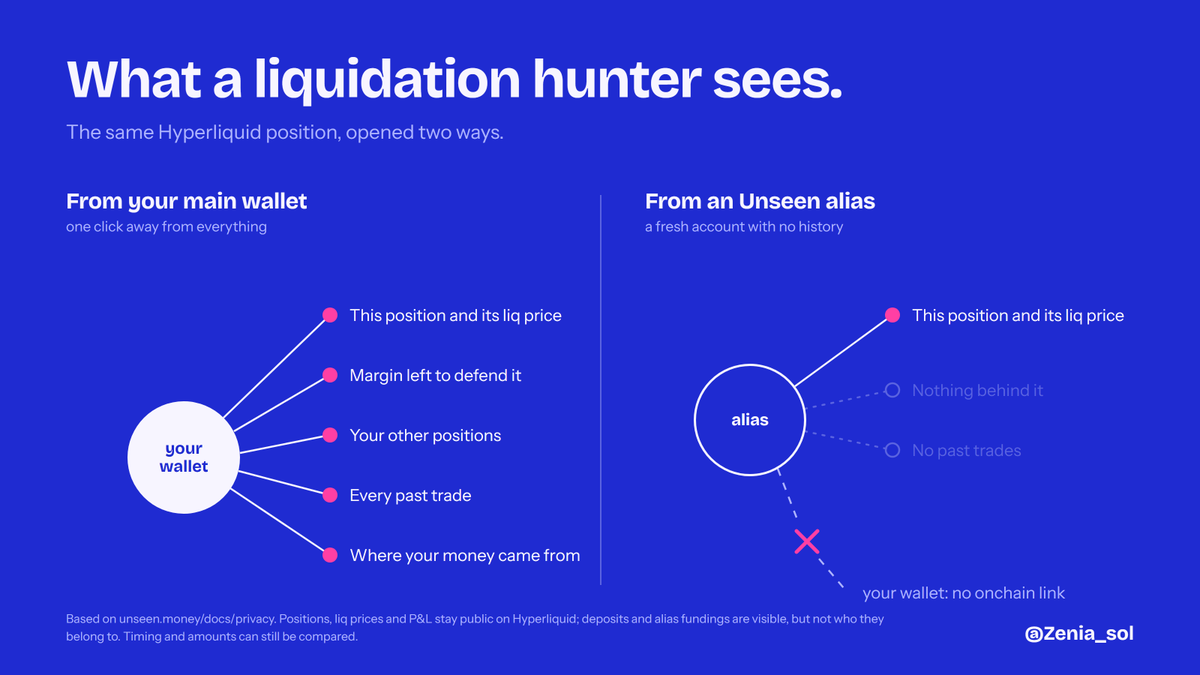
Diagram titled 'What a liquidation hunter sees.' The same Hyperliquid position opened two ways. Left, from your main wallet: the wallet links to five visible items: this position and its liq price, margin left to defend it, your other positions, every past trade, and where your money came from. Right, from an Unseen alias: a fresh account that links only to this position and its liq price; nothing behind it, no past trades, and the link back to your wallet is cut. Footnote: based on unseen.money docs; positions, liq prices and P&L stay public, deposits and fundings are visible but not who they belong to.DexScreener 15-minute chart of UNSEEN/HYPE market cap on Elysium since launch on Nov 27, 2026 (UTC+3): around $100K in the first hours, a spike with a wick near $700K just after midnight, then trading mostly between $200K and $400K, at $281.6K at 16:32 on Nov 28.
44 0 1784 31 0
Sam @oxsam100x 2026-11-28T13:48:41.000Z

officially a smartx ambassador 🦉🤝 a social trading app where you see real onchain positions from top traders and trade them from the same screen no fake pnl screenshots, no "trust me bro" backed by YZi Labs, going live soon @SmartXTerminal https://t.co/OoggtMIadr

69 6 1650 34 1
onvex.eth @onvex_eth 2026-11-28T13:21:09.000Z

Another buyback and burn completed by @grvt_io 900,000 $GRVT bought back from the market and permanently burned. That brings the total burned so far to 2 million tokens What I like here is that the update comes with an on chain transaction to verify, not just an announcement. For me, transparency and consistency matter when it comes to a token's supply management Worth keeping an eye on how GRVT continues this program

56 0 736 28 1
Hasinur @hasinur1995 2026-11-28T13:25:55.000Z

Honestly @primus_labs has been building confidential infrastructure for institutional onchain finance One of the harder open problems is not just computing on encrypted data but proving the computation was done correctly without anyone having to trust the operator Their co founder @xxiang_xie and the research team put out HasteBoots a succinct argument made specifically for TFHE with programmable bootstrapping. It got accepted at USENIX Security 2026 A single TFHE evaluation with bootstrapping now proves in a few seconds A batch of 16 finishes in under a minute. Verification takes about 126 ms and the proof is 0.28 MB Under the same parameters this is well ahead of the previous best result from Zama at CCS25 which needed roughly half an hour for one operation and could not practically support batching This is still research not something live in the product yet But it is the missing piece that lets confidential computation move from “trust the operator” to something that can be checked publicly. For the kind of institutional finance @primus_labs is targeting that change matters more than raw speed alone Explore Now: https://s.kaito.ai/REwQXCl Dont late join now: https://points.primuslabs.xyz/?ref=3OAUMIB

@hasinur1995

Proof of Reserves VS Full Solvency After FTX everyone rushed to post Proof of Reserves and acted like the problem was not solved Merkle proofs can show claimed assets but they do not prove liabilities are covered Solvency is Assets − Liabilities ≥ 0 An exchange can hold 100000 BTC and still be insolvent if its obligations total 150000 Assets alone only show half the picture On-chain wallets are public zkTLS can authenticate off-chain bank or custodian balances without exposing accounts Liabilities are harder Merkle trees and zkVMs can verify that the submitted records were added up correctly but they can not prove every liability was actually included @primus_labs currently focuses on the reserves side It uses zkTLS to authenticate off chain data and a zkVM to compute over the inputs it receives with selective disclosure Doing the same for liabilities would be the next logical step Making sure the underlying data is complete is still a separate problem though With complete and reliable inputs, proof of both sides could show that an institution is assets cover its reported obligations without exposing customer identities. That is what the industry actually needed after FTX >Proof of Reserves was the bare minimum in 2022 >Real transparency needs both sides Dont late join now: https://points.primuslabs.xyz?ref=3OAUMIB explore: https://s.kaito.ai/REwQXCl

90 3 502 95 0
Zero to Millions @Weirdo_idn 2026-11-28T12:44:18.000Z

One thing I believe Web3 needs to get right is making things easier for everyday users. Think about it, when you open a regular app, you don’t worry about which server or database is handling your request. You just expect everything to work. That’s the kind of experience @WireNetwork is trying to bring to Web3. And here’s what caught my attention: 🔹 UPAP: You can use your existing Ethereum or Solana wallet to interact across chains without creating a new wallet. 🔹 UTL: No more worrying about manual bridging. Assets stay on their native chains while ownership is coordinated through Wire’s Layer-1. 🔹 ROA: Applications and Node Owners can provision compute ahead of time and whitelist contracts, helping users enjoy smoother, gasless interactions. I like the direction Wire is taking because users shouldn’t have to understand all the technical complexity just to use a Web3 application. The technology should work behind the scenes while the experience stays simple.

@WireNetwork

Most people don't think about the infrastructure behind the applications they use every day. They open an app, complete an action, and move on. That's the standard blockchain applications should be working toward. Users shouldn't need to understand how multiple networks coordinate, which infrastructure handles execution, or why a particular action requires additional steps. That's the complexity we're building Wire to handle. So developers can focus on the experience, and users can focus on what they came to do.

155 5 3874 45 0
AB @AB_geniuss 2026-11-28T12:31:26.000Z

Trust in any platform is built on what happens after the deadline That is why @rarelistio stands out for me as a creator these days Creators pick a vetted project then publish original content on X Posts turn into RARS points that rank them on public leaderboards High ranks have received real USDT sent straight to their wallets Your RARS points are planned to convert into the $RARE token later The best systems stay quiet and just do exactly what they promise Maybe that is really all a creator needs from a platform to begin https://rarelist.io/r/AB_geniuss

65 5 419 33 0
𝙉𝙤𝙭𝙭 @RayhanTreader 2026-11-28T12:50:10.000Z

Season 2 Points on @perptools are worth paying attention to, but the key is understanding what actually drives your progress. Instead of chasing random activity, focus on the weekly objectives. Here’s how I would approach it: → Check the Points dashboard regularly to find active missions. → Complete the specific trading requirements listed for that week. → Stay consistent with qualifying actions rather than doing unnecessary trades. → Keep an eye on your weekly rank and accumulated Points. There’s another layer worth considering: referrals. When someone joins through your link and completes qualifying trading activity, you receive 10% credit from their activity. That means your progress doesn't have to depend entirely on your own trading volume. Points are distributed every Friday at 13:00 UTC, and they may play a role in future rewards. My takeaway: understand the weekly objectives, track your progress, and stay active with a clear strategy. Don't just trade blindly for Points.

139 1 523 175 0
JOSHUA @notboneles 2026-11-28T13:03:35.000Z

The news doesn’t move the market... the signal behind it does. Imagine ditching loyalty to one bank and one card — and accessing every bank and every card at the same time. Vugar (MEXC CEO) on the idea of true multi-bank access. The news doesn’t move the market... the signal behind it does. Best Trading Tool: http://alphawire.xyz @AlphaWireHQ

21 0 308 25 0
Deekay @deekay_btc 2026-11-28T03:00:01.000Z

The zBASE race had 161 traders two days ago. It has 2,377 now. 85.1M of the 1 billion supply is already gone, burning near 2.9M an hour, and none of it sits in a team wallet - 0% dev bag, 100% spawned by Base activity. But the number I keep looking at is the top of the board. First place sits at 3,667 zaps. Eighth sits at 1,840. That isn't a lead, it's a photo finish - and most of those wallets got there by having a real Base history that counted the moment they joined, not by grinding since day one. Which tells you what this board actually measures. Not who showed up earliest. Who was already doing things on Base before they'd ever heard of zBASE. Swaps, lending, borrowing, staking - the unglamorous activity sitting in wallets people forgot they had. The order from here is Race → Auction → Trading → Miner season, and the supply locks when the race ends. So the window where your past activity still counts is this one, right now. If you've been on Base for more than one cycle, you're probably ranked higher than you assume. Worth confirming before it closes. @zerufinance - check yours: https://zaps.markets/?invite=KRiFNWZF

614 7 3158 419 0
Merida ✨ @nafas22000 2026-11-28T12:37:00.000Z

One exchange account. One valid financial proof. A hundred wallets trying to borrow against it. See the problem? A lending protocol might verify that the account has sufficient assets. The data could be completely authentic. The zkTLS attestation could be valid. And the protocol could still make a terrible decision if it treats every wallet presenting that same financial evidence as an independent borrower. This is why identity binding matters when bringing offchain credit information into DeFi. It’s not enough to prove that an account exists or that its balance meets a threshold. A lending system also needs rules governing how that evidence can be used. Can the same proof be submitted repeatedly? Can it be reused by different wallets? How does the application establish that the borrower controls the account? What happens if account ownership changes? And can the system prevent someone from obtaining multiple loans against the same underlying financial signal? These aren’t problems that zkTLS automatically solves. zkTLS helps authenticate information from the original source. The application still needs replay protection, identity-binding policies, credential lifecycle management and responsible credit limits. That’s an important distinction for ZKredit, the credit-verification direction @primus_labs is developing. Making financial information verifiable is one part of the infrastructure. Making that information safe to use in lending decisions is another. A one-account-one-wallet restriction could help address one form of duplicate use, but it wouldn’t establish one human per wallet. Someone might control several legitimate accounts. Credentials could be compromised. And a genuine borrower could still default. So I’d be careful about calling any single binding mechanism a complete solution to Sybil resistance. The real opportunity is combining authenticated financial evidence with application-level protections against reuse and manipulation. That’s what I’d want to see demonstrated as ZKredit develops. Because a valid proof is useful. But a lending protocol also needs to know whether that proof is being used in a valid way. https://s.kaito.ai/yFTobLU

@nafas22000

A signed message saying “VERIFIED” isn’t the same thing as verifying the proof yourself. That distinction matters when you’re building financial infrastructure. Imagine a Canton application needs to confirm that a company meets a collateral requirement. The underlying information comes from a private bank account. The application shouldn’t need to receive the full bank statement. But should it simply trust an external service that says the requirement was satisfied? That’s the architectural question behind the Primus × HashCloak Canton proposal. The team has proposed building reusable Groth16 and UltraHonk proof verification components in Daml. The goal is to let a Canton application evaluate a cryptographic proof as part of its own workflow, rather than relying solely on an external attestor’s signed verdict. The distinction is important. An attestor can authenticate a statement. A proof verifier can independently check whether a submitted proof satisfies a particular cryptographic relation and its public inputs. Neither removes every trust assumption, especially those involving the original data source. But native verification can reduce dependence on a service that merely reports the final answer. There’s a serious engineering challenge here too. Daml doesn’t currently expose all the arithmetic these proof systems require. So the proposed work includes finite-field arithmetic, elliptic-curve operations, pairing checks, proof parsing and execution benchmarks. HashCloak would develop the reusable verification components. @primus_labs would connect its zkTLS proof pipeline to the proposed UltraHonk verification workflow. And the reference application would demonstrate a Canton contract accepting valid proofs and rejecting invalid ones without receiving the underlying private TLS data. That’s the proposed deliverable. Not a feature I’m claiming is already live. The proposal remains a draft, and practical execution costs still need to be evaluated. But I like the problem they’re addressing. Financial applications shouldn’t have to choose between exposing sensitive source data and blindly trusting a third party’s verdict. They should have a path toward checking the cryptographic evidence themselves. That’s the kind of infrastructure work that could make privacy-preserving verification more useful for institutional applications. https://s.kaito.ai/yFTobLU

167 2 1212 90 2