"Which definition of revenue are we talking about?"
As AI moves into everyday work, that question keeps coming up. An ontology is how the answer gets written down in a form agents can read: which business concepts matter, how they relate, which rules apply, and which data implements them.
One more signal added to the long list showing how ontology adoption is growing:
One year ago, Steve Wooledge, Collate CMO, couldn't tell what an ontology is. Today, Collate is announcing Ontology Studio as part of the Collate 2.1 release.
📈 Gartner (press release, May 11, 2026) predicts that by 2027, organizations that prioritize semantics in AI-ready data will raise agentic AI accuracy by up to 80% and cut costs by up to 60%.
🏠 Scout24, the company behind ImmoScout24, runs internal AI agents on a shared data foundation that links business knowledge to data. Angelita Frozza Sanches, Head of Data, describes agents as only as useful as the context behind their answers, with confidence scores and expert feedback driving continuous improvement.
The announcement, Ontology Studio in Collate 2.1, also puts weight on portability.
Jessica Talisman, Semantic Engineer and author of Ontology Pipeline, frames the test simply: "An ontology you can't take with you belongs to your vendor." Can it be inspected, validated and exported in open standards?
🏢 Several Fortune 500 companies contacted the Collate team directly after a webinar with Jessica Talisman on ontologies, context and why they matter.
Collate is the platform built on OpenMetadata: an open-source metadata and context platform for data discovery, lineage, governance and AI agents, built schema-first on JSON Schema and RDF/OWL. OpenMetadata is Apache 2.0 licensed, and it is primarily driven and maintained by Collate.
Metadata, meaning, and memory belong in one context platform. Metadata tells an agent what data exists. Meaning tells it what the data represents. Memory tells it what your organization has learned. If they are spread across separate tools, agents get partial views that disagree.
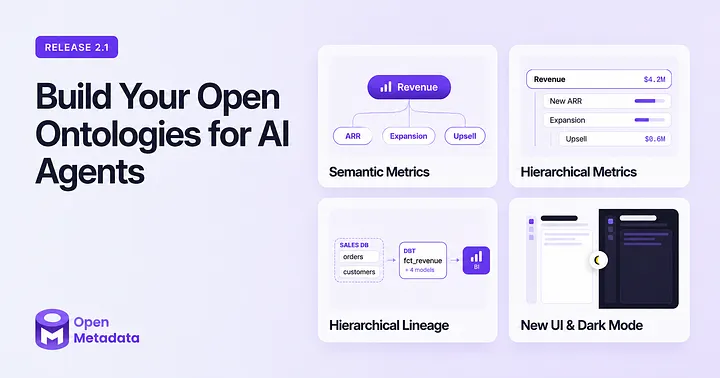
OpenMetadata keeps all three on one graph, and 2.1 gives AI agents a deeper understanding of business meaning. Collate 2.1 release is synced with OpenMetadata 2.1 release.
Ontology Studio is built on OWL and SKOS, imports and exports OWL, Turtle, RDF/XML and JSON-LD, and ships starter packs from standards such as FIBO, HL7 FHIR, GS1, EPCIS, ISA-95 and HR Open.
Whether or not you work with Collate or OpenMetadata, the point stands: business meaning written down in open standards improves what agents can do, and stays portable.
Collate Launches Ontology Studio for AI Agents https://www.getcollate.io/blog/announcing-collate-ontology-studio
Announcing OpenMetadata 2.1: Your Business Definitions in the Context Graph https://blog.open-metadata.org/announcing-openmetadata-2-1-your-business-definitions-in-the-context-graph-54c65a6c6749
#OpenMetadata #OWL #SKOS #AIAgents #DataGovernance
--
Missed a talk at #CDL26? Or missed the whole thing?
All talk recordings will be available in the next few days.
With this many ideas and speakers, nobody could catch them all live
✅ Were you there? Replays included in your ticket
🎟 Couldn’t make it? Get a remote ticket for permanent on-demand access
http://2026.connected-data.london?utm_source=twitter&utm_medium=social&utm_campaign=CDL26&utm_term=promo