ChartStrength (@ChartStrength)

Serenity @aleabitoreddit 2026-11-26T00:40:11.000Z

Leopold’s Situational Awareness lost 65% in Q3, but was up 88.5% through September per WSJ I think there’s far more value in evaluating his original entry points in $SNDK to $BE than ridiculing drawdown from peak. He stated that investing opportunities today “are the highest potential return we have seen in the lifetime of the fund.” Hope he makes a triumphant return in 2027.

1273 58 251021 95 6
ChartStrength @ChartStrength 2026-11-25T03:43:36.000Z

My recent USD margin account performance metrics against swing trading benchmarks: • 2.93:1 Payoff Ratio • 2.28 Profit Factor • +$156.47 Expectancy per trade • ~44% Win Rate (~25% breakeven threshold) • 11–21 Day Average Holding Period @markminervini I uploaded 2 years of brokerage data and got this breakdown. Want to get your book, which one would you recommend to start with?

0 0 12 0 0
ChartStrength @ChartStrength 2026-11-25T03:33:11.000Z

I would say that @markminervini and @jfsrev have the most precision risk orientated nature on @X. There are just so many of these other fintwit twerps uploading p&l screenshots which ads absolutely nothing to the trading community.

0 0 10 0 0
Prof @TheProfInvestor 2026-11-20T21:56:56.000Z

Nobody wants to be honest about their portfolio performance on. Market is in a bear trend. And now would be the best time we be honest with our followers. Well, let me go first. And let's see who else is willing to share theirs. My Trading Portfolio: +82% Since June my folio is only up 6% I took trades but its been a range bound I still think- it held up very well through this correction. I was already sitting on substantial cash, and the remaining positions I had were stopped out earlier this week. I respected my stops and stepped aside when the market stopped rewarding risk. My Long-Term Portfolio: -10% Not nearly as pretty. But I approach this portfolio very differently. I don't actively trade these holdings. I accept corrections, hold companies I believe in, and look to accumulate more when prices reach extreme levels. I also avoid highly speculative stocks in my long-term portfolio. A significant part of the recent drawdown has come from my Bitcoin and Ethereum exposure. And I'm perfectly comfortable admitting that. Now, here's how I see the broader market. We essentially went nowhere from May through October. The market was overdue for a shakeout, although nobody could have predicted exactly how intense it would become. As uncomfortable as this correction has been, I actually believe it's a healthier development for the market. Weak positions get flushed out. Excessive speculation gets punished. And eventually, attractive opportunities begin showing up again. When this storm passes, I believe we're going to see some tremendous opportunities. The important thing is making sure you still have the capital, patience, and mental clarity to take advantage of them. You don't have to win every week. You don't have to be right about every stock. You just have to survive the difficult periods without doing permanent damage to your portfolio. Now I'm curious. How have your portfolios held up through this correction?

372 7 64465 59 1
Venu @Venu_7_ 2026-11-18T03:14:54.000Z

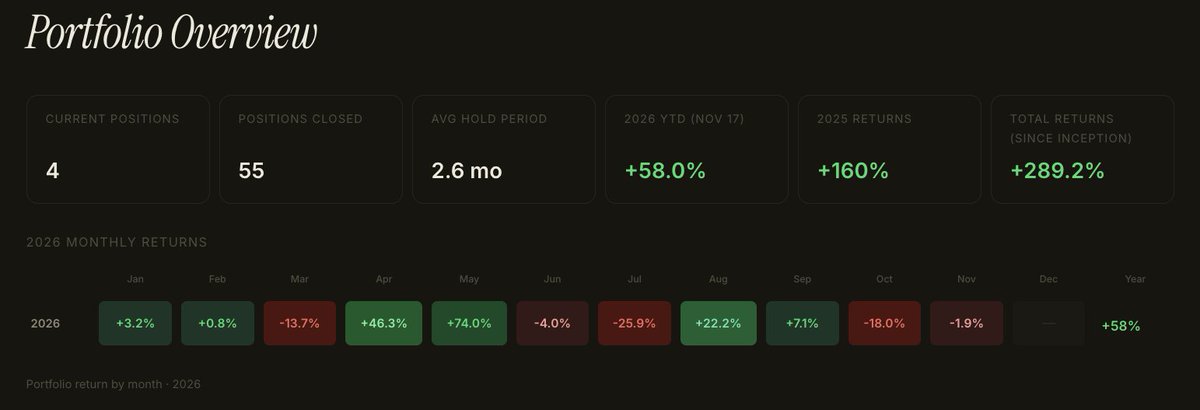
I believe it's important to share portfolio performance during both good and bad times. People deserve to see both sides of your journey, including the wins, losses, and mistakes along the way. 2026 Portfolio YTD: +58% Nasdaq $QQQ YTD: +6% One of the biggest reasons I've managed to preserve a significant portion of my gains this year comes down to profit-taking and risk management. Earlier this year, I took profits in names like $ARM, $MRVL, and $MU, with gains ranging from roughly 150% to 200%. At the time, some people thought I was selling too early, while others appreciated the discipline behind those decisions. And I'm no saint. I've made mistakes too! I didn't sell $NBIS near its highs and eventually exited in the $160s after buying in the $90s, locking in a gain of around 60%. Looking back, I could have managed that position better, and there are several other decisions I could have handled differently. But the biggest turning point came in early October. I started noticing some concerning developments beneath the surface of the market: Increasing numbers of failed breakouts. - Failed Stage 2 moves that couldn't sustain momentum. - Growing signs of institutional distribution. - Market leaders losing their 50-day SMA. - Deteriorating price and volume action across several sectors. I shared these observations publicly on X and gradually started becoming more defensive by reducing equity exposure and taking profits. At the time, some of those decisions didn't make sense to many people, including members of my own community. But as the correction unfolded, the reasoning became clearer. One of the biggest lessons I've learned is that you don't need to sell at the exact top or buy at the exact bottom to achieve strong returns. You need a framework that helps you recognize when market conditions are changing and the discipline to act on that evidence. I'm still learning, still making mistakes, and constantly working to improve my process. And I want to emphasize one thing: A good investment process isn't about being right all the time. It's about managing risk when you're wrong and making the most of opportunities when you're right. That's how I approach the markets, and that's what I'll continue sharing through both good and bad times.
254 3 25978 28 2
Venu @Venu_7_ 2026-11-18T14:15:12.000Z

@ChartStrength @pbd2k I actually did explained my entire semi book wins and losing ones here! https://x.com/Venu_7_/status/2120911491364991096?a=2kdTFzm0BBj5K9Dw6kA&s=20

@Venu_7_

One of my biggest lessons from 2026: It's not just about how much you make during a rally. It's about how much you protect when the trend changes. Semiconductors were responsible for a significant portion of my returns this year. But recognizing the warning signs and reducing exposure helped me protect roughly +60% YTD during this correction. Throughout 2026, I've taken approximately 50 trades, averaging around 5 positions per month. Nearly 40% of those trades were in semiconductors and AI-related names. That should tell you how heavily I participated in this sector and why recognizing the warning signs became so important. Here's how it all played out. 1) The first warning sign came from $NVDA. NVIDIA attempted a breakout but failed to sustain it. When one of the most important market leaders starts showing cracks, I pay attention. 2) The second warning was even more concerning. Many semiconductor stocks were building the right side of their bases, looking like they were preparing for another leg higher. Instead, we started seeing failed breakouts, sharp gap-downs, and deteriorating price action across the sector. That's when I started reducing my semiconductor exposure rather than buying dip. Here are my semiconductor and AI infrastructure trades from 2026, including winners and losers: $MRVL: +173% (final exit), +113% (first trim) $ARM: +155% (final exit), +98% (first trim) $MU: +146% $NBIS: +60% $TSEM: +33% $TXN: +29% $FPS: +25% $ASX: +18% $NVDA: +7% $VICR: +4% and -9% (separate trades) $KLAC: -9% $STM: -9% $CBRS: -9% $P: -10% $FORM: -34% $VSH: -48% Not every trade worked. I took losses, made mistakes, and certainly could have managed some positions better. One exit I'm particularly happy with is $NBIS. I sold around $158 after it lost its 200-day SMA, locking in approximately 60% gains. Could I have sold into strength earlier? Absolutely, and that's one thing I could have done better. So what's my plan now? Over the past month, I haven't initiated any new semiconductor positions. Instead, I've been focusing on hyperscalers like $MSFT and $META, along with $SPOT in digital streaming and $ISRG in healthcare and surgical robotics. I'm looking for companies with strong fundamentals, constructive technical structures, and relative strength rather than forcing trades in a damaged sector. And here's something I want to emphasize: Many semiconductor leaders are technically broken charts. This is coming from someone who generated a significant portion of this year's returns from the sector. I still believe many semiconductor companies have excellent long-term fundamentals. But strong fundamentals alone won't prevent a stock from entering a Stage 4 downtrend. Many of these names need time to complete their Stage 4 declines, establish Stage 1 bases, and eventually transition back into Stage 2 uptrends. That process could take weeks or months. Nobody knows exactly how long.There's no reason to stand in front of a moving train just because stocks are trading significantly below their highs. Let the selling pressure ease, let the bases form, and let the technicals improve. We'll have opportunities again when the sector starts showing signs of accumulation. My biggest takeaway: You don't need to catch the exact bottom or sell at the exact top to make meaningful returns. Follow the trend, respect the warning signs, manage your risk, and protect your capital when conditions deteriorate. That's what Stage Analysis and disciplined position trading are all about.

1 0 461 1 0
Venu @Venu_7_ 2026-11-18T13:37:03.000Z

And I know FinX isn’t always the most trustworthy place, but at the same time, you can’t go around trolling and doubting everyone. I’ve built an audience of 56K followers and a community of 1,000+ paid subscribers over time. That doesn’t mean I’m above criticism, but making assumptions about someone’s portfolio without knowing the facts is ridiculous. A little respect goes a long way!

8 0 2065 2 0