Caveman Tech (@Cavemtech)

Caveman Tech @Cavemtech 2026-11-22T06:32:23.000Z

~$700 turns one PCIe slot into five full-bandwidth GPU connections. That's roughly what the switch card, cables, and risers in this diagram cost (GPUs and drives not included). Here's what you get for it and why each part matters. 1⃣ PCIe switch card (the blue board) Spec: x16 host interface, PCIe Gen4/Gen5, with a high-lane-count switch chip under the heatsink and fan. Roughly 96 lanes total: 16 up to the CPU, 80 down to devices. Why it matters: It turns one motherboard slot into five full-width GPU connections without moving to a bigger, more expensive platform. 2⃣ High-density cable ports (SlimSAS / MCIO-style, x8 each) Spec: 10 ports, each carrying 8 PCIe lanes. Why it matters: GPUs can sit where cooling and space work best. Two x8 ports pair up to make one x16 link. 3⃣ Riser / adapter boards (under each GPU) Spec: 2× x8 cable inputs → 1× full PCIe x16 slot, with auxiliary power. Why it matters: Every GPU gets full x16 bandwidth, not a cut-down x4 or x8 link like many mining-style risers. 4⃣ Blower-style GPUs (dual-slot) Spec: Rear-exhaust coolers that push hot air out of the chassis. Why it matters: You can pack them side by side without them cooking each other. 5⃣ Enterprise U.2 SSDs (the Intel drives) Spec: 2.5" data center solid-state drives, attachable through the same switch ports. Why it matters: Large models and datasets load fast from storage right next to the compute. Why the price matters Multi-GPU workstation and server platforms with that many full x16 slots typically cost thousands before you buy a single GPU. Getting there for about $700 lets you reuse hardware you already own and scale as budget allows. The trade-off There are 80 lanes downstream and 16 back to the CPU, roughly 5:1 oversubscription. GPU-to-GPU traffic stays on the switch at full speed; traffic between the CPU and the GPUs shares one uplink. That's fine for inference and many fine-tuning jobs, but it's a bottleneck for heavy data movement between the host and the GPUs. On-prem AI doesn't have to start with a six-figure server. Sometimes it starts with understanding the plumbing. Would you build like this, or go with purpose-built GPU servers? #AI #Infrastructure #LocalAI #PCIe #HomeLab #ITLeadership

686 57 50689 42 8
Caveman Tech @Cavemtech 2026-11-25T01:21:37.000Z

🔓 We UNLOCKED hidden speed in Tesla P40s, cards from 2016, and we discovered the traps that were holding them back. No hardware mods. No driver patches. Just hidden settings that unlock speed already sitting in your cards. 🔍 Our discovery #1: "OK" P2P was corrupting data nvidia-smi said P2P "OK". CUDA said YES. Every single GPU-to-GPU copy came back silently corrupted, with no error. One kernel flag (iommu=pt) unlocked it: 192/192 copies perfect. 🔍 Our discovery #2: Multi-user speed was silently switched off llama-server with -np can answer several requests at once, but it only batches them if they land on NEIGHBOURING slots. Let the server choose and you get ZERO gain. Pin the slots: 45 → 122 tokens/sec on one P40 (+170%). 🔍 Our discovery #3: Two P40s were taking the slow road On Pascal, llama.cpp's tensor split falls back to its slowest way of combining the two cards' work. Build it with NVIDIA's NCCL: +9% faster writing, +23% faster prompt reading. 🔍 Our discovery #4: Your benchmarks may be lying llama.cpp's copy-ahead mode (ngram-mod) remembers earlier answers, so repeated test prompts look 5x faster than real life. What we unlocked 🚀 ⚡ 32B coder: 12.9 → 33 tokens/sec on code (2.6x) ⚡ Two P40s: +68% from tensor split alone (Ollama's way: +0%) ⚡ 8B with a DSpark helper: +68% on code, word-for-word identical answers ⚡ 4 requests at once: 2.7x more output from one card ⚡ Idle power: 54 W → 9.5 W per card Every result was re-tested by a second, skeptical run, and the answers were checked. Full write-up, every number and how to unlock it on your own cards 👇 https://gist.github.com/Cavemanmining/896bd4fa826da665525c9d2f9742bcff

@Cavemtech

🚀 We just made a 32B coding model run 2.4x FASTER on two 2016-era Tesla P40s. And we found something nobody warns you about: GPU-to-GPU copies on these cards were silently CORRUPTED, while every tool said everything was fine. The boost (all measured, answers checked) ⚡ 32B model: 12.9 → 21.6 tok/s on two P40s (+68%) ⚡ 32B on code with a small draft model: 30.2 tok/s (2.4x) ⚡ 8B model: 47 → 68 tok/s (+44%) ⚡ Idle power: 54 W → 9.5 W per card ⚡ Power cap at 150–175 W: little or no speed lost The discovery nvidia-smi said P2P "OK". CUDA said YES. But with the IOMMU in translation mode, every single GPU-to-GPU copy came back wrong, with no error at all. One kernel flag (iommu=pt) fixed it: 192/192 byte-exact, and GPU-to-GPU latency dropped from 14 µs to 1 µs. If you run multiple GPUs on Linux, check your bytes. "OK" isn't proof. The big lesson for P40 owners Extra P40s can make a model FASTER, not just fit a bigger one. Ollama's layer split gives +0%. llama.cpp's -sm tensor on a same-socket pair gives +44% to +68%. Gotcha: a draft model needs --spec-type draft-simple, or it never runs. The goal Squeeze every last drop of AI performance out of cheap 24 GB Pascal cards. It started with a great GitHub guide on enabling P2P (Cinderella-Man/how-to-enable-p2p-on-nvidia-gpus). And we're not done 👀 On Pascal, llama.cpp combines the two cards' results the slowest possible way. The math says the 8B could go from 68 up to ~94 tok/s if we kill that cost. Testing right now: • An NCCL build + an all-reduce patch for Pascal • Many requests at once, for AI agent crews • EAGLE-3 draft heads • NUMA / CPU pinning • Faster quant formats Results in a few hours. Full write-up, every number and how to reproduce 👇 https://gist.github.com/Cavemanmining/896bd4fa826da665525c9d2f9742bcff P40 owners: what's your best 32B tok/s on two cards?

41 3 2725 6 0
Gaelium @Gaeliumcore 2026-11-25T02:33:10.000Z

@Cavemtech Thanks, really useful. Ours is an Intel S2600ST, dual Xeon, so very close to your setup. We're on the stock layer split for now, so not exposed yet, but one card is still away for an RMA. Once it's back I'll run simpleP2P and watch dmesg, and report what the board shows.

1 0 15 1 0
Gaelium @Gaeliumcore 2026-11-25T02:26:49.000Z

@Cavemtech The iommu=pt one is scary. Silent P2P corruption with every tool saying OK is the worst kind of bug. Did you see it on every board, or only on certain chipsets? Running two P40s with llama.cpp here, definitely checking this.

1 0 82 1 0
Caveman Tech @Cavemtech 2026-11-25T02:29:14.000Z

Only tested on one board so far: dual-socket Intel X99, 2x P40 on the same socket, driver 580, VT-d in its default translation mode. It looks tied to the IOMMU mode, not the chipset: the kernel log showed the IOMMU blocking the peer writes ("DMAR ... PTE Write access is not set") while CUDA reported success. Quick check: 1. cat /sys/kernel/iommu_groups/*/type | sort | uniq -c → "DMA"/"DMA-FQ" = at risk, "identity" = passthrough 2. Run simpleP2P from cuda-samples (it verifies the data, the bandwidth test doesn't) 3. Watch dmesg for DMAR / AMD-Vi IO_PAGE_FAULT lines while it runs Stock llama.cpp layer split doesn't use peer copies, so you're only exposed with GGML_CUDA_P2P=1 or an NCCL build. Would love to hear what your board shows!

2 0 74 1 0
Caveman Tech @Cavemtech 2026-11-24T17:20:54.000Z

🚀 We just made a 32B coding model run 2.4x FASTER on two 2016-era Tesla P40s. And we found something nobody warns you about: GPU-to-GPU copies on these cards were silently CORRUPTED, while every tool said everything was fine. The boost (all measured, answers checked) ⚡ 32B model: 12.9 → 21.6 tok/s on two P40s (+68%) ⚡ 32B on code with a small draft model: 30.2 tok/s (2.4x) ⚡ 8B model: 47 → 68 tok/s (+44%) ⚡ Idle power: 54 W → 9.5 W per card ⚡ Power cap at 150–175 W: little or no speed lost The discovery nvidia-smi said P2P "OK". CUDA said YES. But with the IOMMU in translation mode, every single GPU-to-GPU copy came back wrong, with no error at all. One kernel flag (iommu=pt) fixed it: 192/192 byte-exact, and GPU-to-GPU latency dropped from 14 µs to 1 µs. If you run multiple GPUs on Linux, check your bytes. "OK" isn't proof. The big lesson for P40 owners Extra P40s can make a model FASTER, not just fit a bigger one. Ollama's layer split gives +0%. llama.cpp's -sm tensor on a same-socket pair gives +44% to +68%. Gotcha: a draft model needs --spec-type draft-simple, or it never runs. The goal Squeeze every last drop of AI performance out of cheap 24 GB Pascal cards. It started with a great GitHub guide on enabling P2P (Cinderella-Man/how-to-enable-p2p-on-nvidia-gpus). And we're not done 👀 On Pascal, llama.cpp combines the two cards' results the slowest possible way. The math says the 8B could go from 68 up to ~94 tok/s if we kill that cost. Testing right now: • An NCCL build + an all-reduce patch for Pascal • Many requests at once, for AI agent crews • EAGLE-3 draft heads • NUMA / CPU pinning • Faster quant formats Results in a few hours. Full write-up, every number and how to reproduce 👇 https://gist.github.com/Cavemanmining/896bd4fa826da665525c9d2f9742bcff P40 owners: what's your best 32B tok/s on two cards?

18 2 3433 5 1
Archy Gupta @archygupta22 2026-11-23T15:09:40.000Z

Jensen Huang is back! It’s a slap on the face of every Women who faced workplace harassment. I value him and his capabilities and his achievements. There’s no doubt about it but workplace romantic relationships are not straight forward. Do we know if he pressurised his subordinate into a relationship or was it mutual. Do we know if he tried to get close to other females in the company as well or not? Are we telling that if your manager asks for a romantic relationship with you, you have to agree to it and you can never go to the HR because nothing can hurt them. I personally have faced a similar borderline situation in one of the companies I worked at where someone was trying to get close to me. What happened is bad. This just makes workplaces very unwelcoming for women.

235 26 71327 794 42
Caveman Tech @Cavemtech 2026-11-24T00:30:46.000Z

Every connector in a multi-GPU AI rig, explained. Save this. 📌 🟧 DATA: GPU connections • PCIe x16 slot: the baseline. Gen4 ≈ 32 GB/s, Gen5 ≈ 64 GB/s per direction • x16 riser ribbon: extends a slot to a GPU on a frame. Shielded, short, rated for your gen • SlimSAS 8i (SFF-8654): x8 per port. Two = one x16 GPU. Common on Gen4 switch cards • MCIO (SFF-TA-1016): the Gen5 successor. Servers and newer switch cards • OCuLink (SFF-8611): x4. External GPUs on mini PCs and laptops • USB-style mining riser: x1. Fine for crypto, avoid for AI 🟦 DATA: storage • M.2 (M-key): x4, consumer NVMe • U.2 (SFF-8639): x4, enterprise NVMe. Hot-swap, power-loss protection 🟥 POWER: GPU and system • PCIe slot / riser: up to 75W • 6-pin: 75W | 8-pin: 150W • 12V-2x6 (12VHPWR successor): up to 600W. Seat it fully • EPS 8-pin: CPU power. Not the same as GPU 8-pin. Don't mix them up • Multi-PSU sync board: turns secondary PSUs on with the main one ⚡ POWER: the wall • C13/C14: standard PSU cord • C19/C20: heavy-duty cord for big PSUs • L6-30P → L6-30R: 30A 240V twist-lock, PDU to wall 🧠 The rule: bandwidth to every GPU, clean power to every GPU, and a circuit that can carry it all at 80%. Which connector has burned you? 👇

10 1 1305 1 0
Caveman Tech @Cavemtech 2026-11-23T06:49:48.000Z

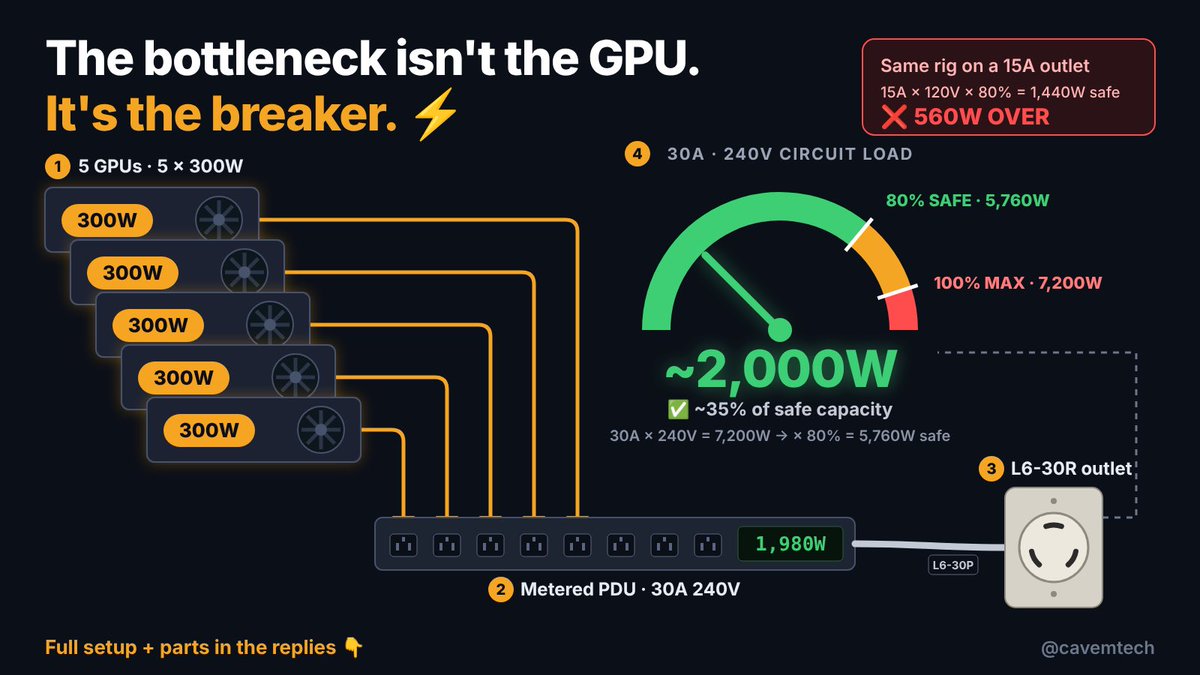
Last post: 1 PCIe slot → 5 GPUs through a PEX88096 switch. 22K of you dug into lanes, bandwidth, and P2P. But the real limit on local AI isn't PCIe. It's power. ⚡ 🔢 The math 5 GPUs × 300W = 1,500W CPU, board, drives, fans ≈ 300W PSU losses (~90% efficient) ≈ 200W ≈ 2,000W at the wall, sustained, the entire time your model is serving. 📏 The 80% rule Continuous loads should stay at 80% of the breaker rating. AI inference is a continuous load. 15A × 120V = 1,800W → 1,440W safe ❌ (560W over) 30A × 240V = 7,200W → 5,760W safe ✅ (~35% load) 🔌 The setup GPUs → metered 30A 240V PDU (C13/C19 outlets) → L6-30P plug → L6-30R receptacle on a dedicated circuit. The PDU meter shows real draw per outlet, so you see the load before the breaker does. ⚡ Why 240V Half the amps for the same watts, and most PSUs run slightly more efficiently there. Nearly all ATX and server PSUs are 100–240V auto-ranging. Check the label. ⚠️ Switch-rig gotcha Each x16 riser supplies up to 75W of slot power to its GPU. Power each riser from the same PSU as the GPU it feeds. Mixing PSUs on one card is asking for trouble. 🧠 Free headroom LLM inference is memory-bandwidth bound, not compute bound. Cap each card with nvidia-smi -pl 250 and tokens/sec barely moves while power drops a lot. Lanes get you the GPUs. Power keeps them running. Have a licensed electrician install the circuit. What's your AI rig running on: 15A, 20A, or 240V? 👇
23 0 1975 3 1
Kamil Skowron @kamilskowron 2026-11-23T19:33:03.000Z

TIL: NVIDIA's 580 driver, the last one for Pascal cards, still lets GTX 10-era cards do GPU-to-GPU P2P. No patches, no hacks, just switch it on🧓 Would've saved me an hour of kneeling in front of overheating cards with a hair dryer just to find that out😅 Apologies to everyone I was "ignoring" for the last hour! Tested on two P106-090 mining cards(GP106, same chip as a GTX 1060), and it works: ⚡ 7× less delay between the GPUs (22 → 3.1 µs) 🔁 +36% faster when both send at once (1.09 → 1.48 GB/s) 🧪 1.5 TB of test copies, every byte checked, 0 errors What it needs: ✅ two cards with the same chip ✅ IOMMU in passthrough mode (iommu=pt) ✅ a motherboard that routes the traffic (my B550 desktop does, a 9-GPU mining board doesn't) One-way speed stays at ~0.84 GB/s: these mining cards are hard-limited to PCIe 1.0 x4 Setup + numbers: https://github.com/Cinderella-Man/how-to-enable-p2p-on-nvidia-gpus/blob/main/docs/pascal-and-volta.md

@kamilskowron

The final boss of the day - Pascal architecture🤞🏻 https://t.co/1ljC5DwdLr

48 6 2605 3 0
Hillary Clinton @HillaryClinton 2026-11-23T19:48:10.000Z

Is it a national security scandal? Yes. Is it a corruption scandal? Yes. Is it an insider trading scandal? Yes. Is it a market manipulation scandal? Yes. If it’s “super intelligence,” call it Supergate.

61317 12361 8195236 19388 2229