@breakfast_dogs @tommy_cleary @SitSilver @AnneliseBocquet
Here’s an alternative mechanism on how SARS-CoV-2 infection triggers reactivation of Epstein-Barr virus. Besides infection-induced inflammation and cellular stress, SARS-CoV-2 nsp3 (Papain-like protease) directly promotes pro-lytic signaling for EBV by cleavage and destruction of EBV Nuclear Antigen (EBNA1), which is a key EBV component in suppressing lytic infection and maintaining latent state.
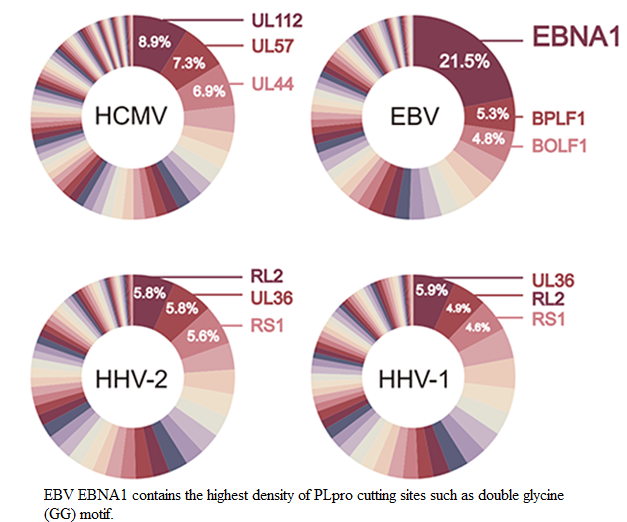
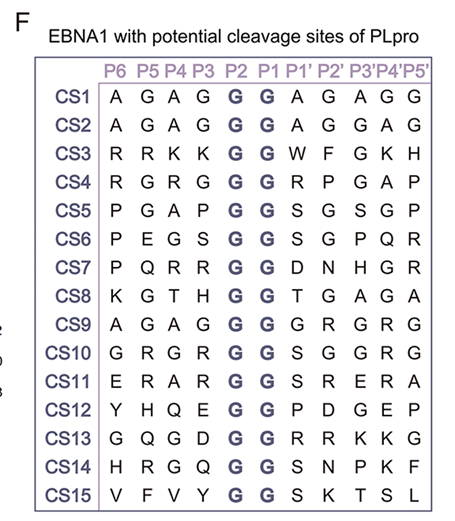
SARS-CoV-2 nsp3 PLpro typically recognizes and cuts the canonical motif LXGG↓XX after the double glycine. Sequence analysis has identified numerous putative PLpro cleavage sites in several large DNA herpes-related viruses (HCMV, EBV, HHV-1, and HHV-2). EBV EBNA1 protein contains the highest density of PLpro cutting sites.
As shown by in vitro experiments, expression of PLpro results in cleavage and destruction EBNA1, thus favoring lytic state of EBV. Both expression of PLpro or SARS-CoV-2 pseudovirus infection induces EBV reactivation.
Interestingly, experiments show SARS-CoV-2 nsp3 localizes to the cell nucleus and physically interacts with EBNA1, even though my analysis with PSORT II cannot detect any Nuclear Localization Signal on nsp3.
Assuming if SARS-CoV-2 is a bioweapon created by the Chinese military, have you wondered why they leaked or released a coronavirus instead of a more straightforward respiratory pathogen such as influenza virus? SARS-CoV-2 probably functions as a “slow-kill” bioweapon that inflicts long illness. SARS-CoV-2 possesses intrinsic proteases (nsp3 and nsp5) that cleave human proteins or reactivate EBV, increasing risks of protein amyloid formation, neurodegenerative diseases, EBV-related cancer, and even diabetes. By comparison, influenza virus doesn’t encode any intrinsic protease. Perhaps this is a reason why SARS-CoV-2 induces EBV reactivation whereas common cold influenza virus doesn’t.
Why if the CCP leaked or released SARS-CoV-2 for a sinister purpose?
Reference:
Du L, Wang M, Liu X, Peng Z, Zhang Z, Zhang Z, Liang Z, Sun Q, Zhuang J, Ma K, Chen YQ, Hou P, Zhang H, Guo D, Pan JA, Peng X. SARS-CoV-2 inhibits EBV-dependent tumor proliferation through PLpro-mediated degradation of EBNA1. Acta Pharm Sin B. 2026 Nov;16(11):7418-7433. doi: 10.1016/j.apsb.2026.07.042. Epub 2026 Jul 30. PMID: 42979380; PMCID: PMC13729527.
https://pubmed.ncbi.nlm.nih.gov/42979380/