Caffe' Satoshi (@CaffeSatoshi)

Caffe' Satoshi @CaffeSatoshi 2026-11-21T04:50:05.000Z

It is now the best time to start Buying in aggressively into Bitcoin. It's the 21st November 2026, and BTC just touched $55.5k. I will be leaving this pinned for the next years so you can see where I told everyone to BUY, whilst influencers were panicking and telling you we are going to zero and to short everything. Here is the mathematical explanation: Bitcoin is now trading around 0.547x of its Dacoinminster Power Law fair value, a 45.3% discount. Historically these periods have offered attractive accumulation opportunities. I also tested different buying strategies using the same $10,000 budget. Across 26 completed historical signals, starting with a 14-day DCA accumulated more BTC than spreading purchases over 12 months in every case. At today's valuation, I believe this is an excellent time to START DCAing. Don't try to catch the exact bottom. Start accumulating while Bitcoin is trading at a substantial discount. The opportunity is in the accumulation, not in predicting tomorrow's exact price. The full phyton code that can be used to reproduce my exact results and the chart are included below in the first comment for full transparency.

105 11 7774 6 2
Caffe' Satoshi @CaffeSatoshi 2026-11-26T09:45:59.000Z

South Korean TV financial Presenter starts crying on live TV amid the South Korean crash! Earlier, South Korea’s president encouraged citizens to shift their wealth from real estate into the domestic stock market. Some Koreans even sold their homes to invest. Now the stock market collapsed. Lesson: Never trust politicians

5 0 1048 2 0
Effed Orff @effdorff 2026-11-26T12:29:22.000Z

@CaffeSatoshi Yes and they also allowed leveraged single company ETFs too. But I put both down to naivety. US fund managers selling out and hedge funds shorting is what did the damage. It’s the difference between telling someone it’s ok to leave the front door open, and burgling a house

1 0 10 1 0
Caffe' Satoshi @CaffeSatoshi 2026-11-26T12:22:05.000Z

@effdorff And who encouraged ordinary citizens to sell their homes and move their wealth into the stock market in the first place? Politicians don't get to take credit when markets rise and blame foreign fund managers when they collapse.

0 0 38 1 0
Caffe' Satoshi @CaffeSatoshi 2026-11-26T09:20:29.000Z

Bitcoin cycle recovery times are actually compressing. From the 2017 top it took 3 years to reclaim the ATH (Dec ’17 to Dec ’20). From the 2021 top it took 2 years, 4 months (Nov ’21 → Mar ’24). We’re now 1 year 1 month into the current drawdown from the 2025 peak and price is still well below that high ($60.8k). Each cycle, the market is taking less time to absorb the sell-off and retake the previous all-time high.

6 0 695 0 0
Caffe' Satoshi @CaffeSatoshi 2026-11-26T05:29:56.000Z

BlackRock’s IBIT recorded $329.7 Million dollars worth of Bitcoin outflows yeaterday. Roughly $3 billion in net outflows over the past 11 trading days (Nov 11–Nov 25). Only one relatively small inflow day occurred (+$76.5M on Nov 16). Several sessions saw outflows above $500M.

0 0 544 0 0
Caffe' Satoshi @CaffeSatoshi 2026-11-25T11:19:24.000Z

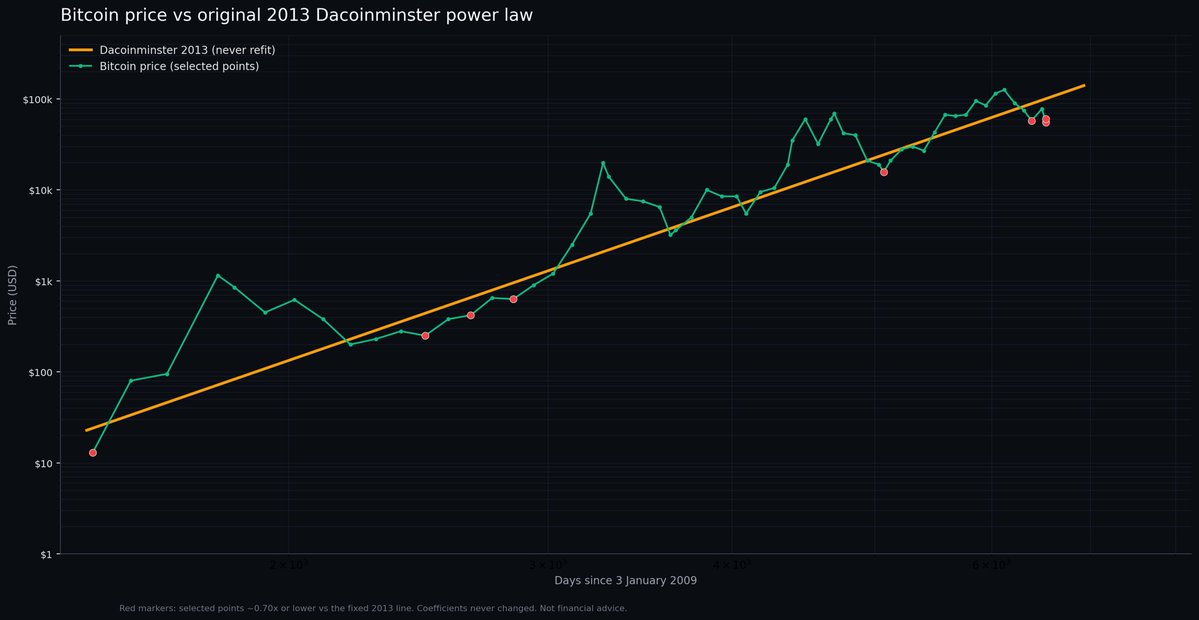
The 2013 Dacoinminster Power Law Never Got Rewritten. The Others Are Already Being Quietly Buried.While other models get refitted, abandoned, or explained away after this drop, the original Excel formula from February 2013 is still sitting there untouched, and price is still orbiting the exact same line it has used for over thirteen years. The 2013 Dacoinminster power law is the only one that never needed a rewrite and did not fail. Price = 4.41877086088824 × 10⁻¹⁷ × (days since 3 Jan 2009)^5.59806919936792 On 13 February 2013 a Bitcointalk user dropped the price history he had into Excel and let the spreadsheet choose the fit. It returned those two numbers. He posted them and left them. They have not been touched since. Bitcoin is now near $59,000. The same fixed line still reads about $100,800. That is roughly 0.59×. Deeper lows relative to this exact formula have landed in the same neighborhood before (roughly 0.54× to 0.65×). Recovery times from those levels have ranged from weeks to more than a year. The median of completed episodes of similar depth sits somewhere between two and four months. Other power-law models were fitted later. When the price path drifted from what they expected, their coefficients got adjusted or the models were quietly set aside. Their creators have started questioning the fit, the window, the data, or the whole idea. The original 2013 version has none of that. It has now been tested against more than thirteen years of data it never saw. The line only counts days. Everything else is the price moving around it. The coefficients are still the ones Excel returned in February 2013.
14 0 994 7 1
ˈsävrən(t)ē/₿ @FX191976 2026-11-25T14:31:49.000Z

@CaffeSatoshi But... I thought @Giovann35084111 invented the Power Law...🧐😇 I like "Gio" and he has done a lot of work with these calculations but I don't remember him ever saying anything about the original Excel formula from Dacoinminster posted on FEB 2013...

1 0 16 1 0
Caffe' Satoshi @CaffeSatoshi 2026-11-25T14:54:50.000Z

@FX191976 @Giovann35084111 I published the full story and first post 👇https://x.com/CaffeSatoshi/status/2125082431321514196

@CaffeSatoshi

No amount of tantrums will change the fact that Bitcoin's power law was already documented in 2013. A Bitcointalk user called Dacoinminster took Bitcoin's historical price data, put it into Excel, fitted a trendline and published the formula: price = 4.42 × 10⁻¹⁷ × (days since genesis)^5.6 That's it. No complicated models. No endless adjustments. No constant refitting. Just two numbers, published over 13 years ago and left untouched. He didn't build a personal brand around it. He didn't claim superiority. He didn't spend his time belittling people who disagreed with him. He simply shared what he had found. And that's what makes Dacoinminster such a remarkable OG. He gave the Bitcoin community one of its earliest publicly documented power law models, using nothing more than an Excel spreadsheet and a straightforward chart that anyone could understand. No ego. No theatrics. No need to call everyone else ignorant. Just an idea, a formula and the humility to let the work speak for itself. Meanwhile, someone else built an entire identity around supposedly discovering something that had already been published years earlier. No amount of tantrums, personal attacks or complicated excuses will change my mind. Perhaps it's time we started rewriting the history of Bitcoin's power law and giving credit where it was originally due. Dacoinminster deserves that credit.

1 0 30 0 0
Caffe' Satoshi @CaffeSatoshi 2026-11-25T13:54:09.000Z

Trump just proposed new tariffs of up to 20% on major trading partners following an investigation into alleged excess manufacturing capacity and industrial subsidies. The EU is included, although its rate is expected to remain capped at 15% under the existing trade agreement. China faces the proposed 20% rate. The administration argues that foreign subsidies and excess production are undermining American manufacturers. But tariffs are ultimately taxes on imports. Businesses and consumers often end up paying the price through higher costs. The measures still require further hearings and public consultation, with implementation potentially starting in January. Another escalation in the global trade war, and another source of uncertainty for businesses, markets and the global economy.

4 0 551 1 0
Caffe' Satoshi @CaffeSatoshi 2026-11-25T13:37:09.000Z

October headline PCE came in at 3.8%, while core PCE reached 3.3%, above the 3.2% forecast. US inflation isn't giving the Fed much breathing room. At the same time, Q3 GDP was revised up to 4.3%. The combination is uncomfortable: inflation remains elevated while the economy continues to grow strongly. That makes a December rate hike more likely and reduces the chances of monetary easing anytime soon. For Bitcoin, this is a headwind. Higher rates, rising Treasury yields and a stronger dollar can put further pressure on risk assets. I'm watching BTC price action alongside BVIV. If Bitcoin falls while implied volatility rises, that would suggest increasing downside stress.

4 0 617 2 0
Caffe' Satoshi @CaffeSatoshi 2026-11-25T12:27:51.000Z

@SergioMarakis found it and performed analysis : https://x.com/CaffeSatoshi/status/2125566376647491769

@CaffeSatoshi

Bitcoin's volatility is telling us something interesting. I've analysed 383 daily observations covering the past year, comparing Bitcoin's price with BVIV, the market's implied volatility index. The BVIV data was downloaded from Bloomberg and fed into python. The clearest example came on February 5. Bitcoin crashed 14.13% in a single day while BVIV exploded 56.08%, reaching 88.45. The following day BTC rebounded 12.52% and BVIV collapsed 27.86%. We've seen similar, although less extreme, volatility spikes during selloffs in January, June and November. The analysis measures BVIV against its rolling 90-day history, identifying readings above the 90th and 95th percentiles. It also tracks sudden increases in implied volatility, particularly when Bitcoin is falling. The logic is straightforward: when BTC falls and implied volatility rises sharply, the market is pricing in greater uncertainty and demand for downside protection. When BTC starts stabilising and implied volatility falls, that can signal easing stress. So where are we today? Bitcoin is around $58,500. BVIV is around 60 right now, significantly above its rolling 90-day 90th percentile of 46.14 and 95th percentile of 53.64. Volatility is still elevated. But today's reading is interesting. Bitcoin fell 2.09%, yet BVIV declined 1.86%. In other words, Bitcoin is still under pressure, but the market is no longer pricing in increasing volatility alongside the latest decline. My short-term view: Bitcoin remains in a fragile market, and another test of lower prices cannot be ruled out. However, the easing in implied volatility suggests the immediate panic is cooling. I expect choppy trading, with the potential for a relief bounce if BVIV continues to decline and BTC stabilises. The signal I'm watching now is simple: Bitcoin stabilising while BVIV falls. That would be a much more convincing sign that selling pressure is losing its grip.

1 0 26 1 0
Caffe' Satoshi @CaffeSatoshi 2026-11-25T12:27:06.000Z

@DCstar84 https://x.com/CaffeSatoshi/status/2125566376647491769

@CaffeSatoshi

Bitcoin's volatility is telling us something interesting. I've analysed 383 daily observations covering the past year, comparing Bitcoin's price with BVIV, the market's implied volatility index. The BVIV data was downloaded from Bloomberg and fed into python. The clearest example came on February 5. Bitcoin crashed 14.13% in a single day while BVIV exploded 56.08%, reaching 88.45. The following day BTC rebounded 12.52% and BVIV collapsed 27.86%. We've seen similar, although less extreme, volatility spikes during selloffs in January, June and November. The analysis measures BVIV against its rolling 90-day history, identifying readings above the 90th and 95th percentiles. It also tracks sudden increases in implied volatility, particularly when Bitcoin is falling. The logic is straightforward: when BTC falls and implied volatility rises sharply, the market is pricing in greater uncertainty and demand for downside protection. When BTC starts stabilising and implied volatility falls, that can signal easing stress. So where are we today? Bitcoin is around $58,500. BVIV is around 60 right now, significantly above its rolling 90-day 90th percentile of 46.14 and 95th percentile of 53.64. Volatility is still elevated. But today's reading is interesting. Bitcoin fell 2.09%, yet BVIV declined 1.86%. In other words, Bitcoin is still under pressure, but the market is no longer pricing in increasing volatility alongside the latest decline. My short-term view: Bitcoin remains in a fragile market, and another test of lower prices cannot be ruled out. However, the easing in implied volatility suggests the immediate panic is cooling. I expect choppy trading, with the potential for a relief bounce if BVIV continues to decline and BTC stabilises. The signal I'm watching now is simple: Bitcoin stabilising while BVIV falls. That would be a much more convincing sign that selling pressure is losing its grip.

1 0 20 1 0