This is an amazing excerpt from mathematician Levent Alpöge's report, who recently announced a potential proof of the Riemann Hypothesis after working with Claude. “Claude far outpaced me near the finish line. No, Claude flew, and danced, and sparkled near that finish line.”
In the past two weeks alone, I've put dozens of hours into building and training my own AI agents. I haven't been this excited about a technology shift in years.
For a long time, I wrote about AI as a tool. That has changed. What I'm working with now feels much closer to a team I'm training: I give feedback every day, the agents learn, and the more I put in, the better they get. Here's a status update of where I am right now.
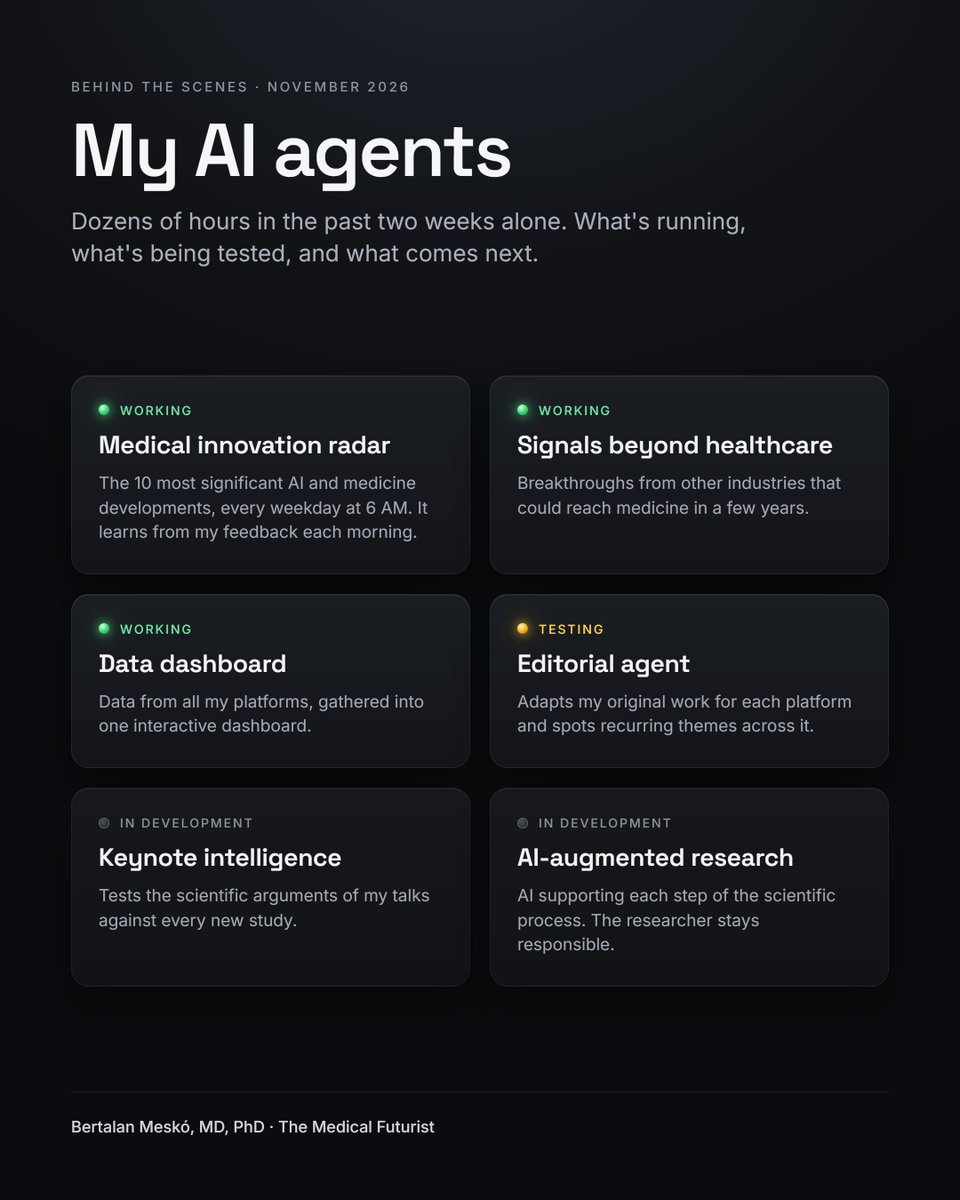
Already working
1) Medical innovation radar: Every weekday at 6 AM, an agent sends me the 10 most significant developments in AI and medicine. Each morning I tell it which ones mattered and what it missed, so it keeps getting better at telling a real breakthrough from ordinary news.
2) Signals from beyond healthcare: Once a week, a second agent tracks tech breakthroughs and studies from other industries that could reach medicine in a few years. That's where many of the future's surprises start.
3) Data dashboard: I used to pull together the numbers from all my platforms by hand. Now an agent builds an interactive dashboard for me. It feels like Jarvis in Iron Man.
Being tested
4) Editorial agent: It helps turn my original work into formats for different platforms, so I spend less time on repetitive tasks and more on analysis. Next, it will look for recurring themes and hidden connections across my articles, so I can spot trends earlier.
Under development
5) Keynote intelligence: Every new study can strengthen, challenge or disprove an argument I make on stage. I'm building a system that tests the scientific foundations of my talks on a regular basis.
6) AI-augmented research: Instead of one AI assistant, I'm exploring how different AI capabilities can support each part of the scientific process. The human researcher stays responsible for decisions, validation, and integrity.
Agents aren't magic. They need constant feedback, and they make mistakes. Still, as a futurist, I can't remember a recent shift that changed my daily work this quickly.
I'll keep sharing what works and what doesn't, and I would LOVE to hear your experience building agents and what you build them for!