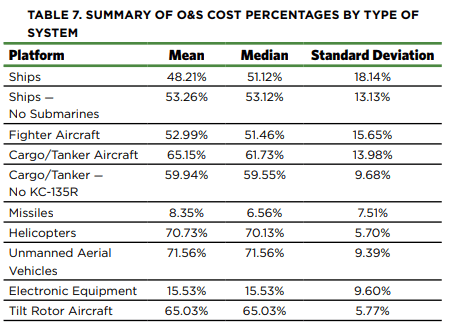
70% of tail on major systems is operations and support, so that includes MILPERS... A Predator or Global Hawk was also at 70% in O&S range despite being "unmanned".
I would def expect *sustainment* of newer drones which are more expendable to be on the lower end. For example missile O&S is like 8% of lifecycle cost.
But for sUAS, I could also see having dedicated units actually having pretty significant O&S costs relative to procurement costs. So unless a unit is churning through tons of sUAS in training, then the personnel costs could be pretty high compared to procurement. And where we are today, guys don't want to lose $15K drones on a regular basis.
https://acquisitiontalk.com/2020/09/ratio-of-sustainment-to-acquisition-costs-is-modernization-being-crowded-out/
@AustinEGrayYesterday - I noticed tension between how two sharp DoW leaders are viewing UxS business models for the Pentagon.
Here are the numbers. Their takes. My take. And what each take tells us about the future. This is a long thread, and does a full 3-way comparison of:
1) Big Traditional Platform vs. 2) Big Drone vs. 3) Small Drones
- Traditional programs spend 30% up front on RDTE and procurement + 70% on the tail of sustainment
- One of these senior leaders said it could be 10% and 90% for drones.
- 90% of a drone's cost is sustainment????
I'm going to prove his math went wrong right up front... and then end by proving him right.
- Start from 30% up front and 70% sustainment tail
- Assume 70% sustainment tail is spread over 20 years.
- 70 / 20 = 3.5 percentage points per year in sustainment.
- Note this is 3.5 PERCENTAGE POINTS not %
- So 30 percentage points up front and 3.5 percentage points per year running
- 3.5 / 30 = 12% of the up front cost every year in sustainment.
- Maybe this is 15-20% of the procurement pricetag depending on how much RDTE they needed.
Let's compare platforms: So at 15-20%, if DoW buys
Big Platform: $2B battleship it would spend $300-400M per year maintaining (this tracks, although DDGs have longer life and slightly lower cost per year than our assumptions here)
Big Drone: For a $40M drone, $6-8M per year
- Spend $50M up front (RDTE + procurement) then you'd need to spend $450M over the drone's life to reach the 10% / 90% ratio. This does not track. Even if the big drone lasts 10 years, you'd spend $45M per year on O&S on a $40M pricetag vessel (3-5x market COCO rates).
- What's happening with big drone numbers? Three factors. Up front costs are LOW. First year sustainment costs are VERY high. Lifespan of the drone is unknown.
Contractors (especially us VC-backed folks) subsidize the R&D and procurement up front. VCs pay for all R&D on IRAD. Then they undercut each other on procurement price. Suddenly you're charging $0 in RDTE and $30M per drone...
Then you end up with integration and technical debt as the customer asks you to do more. Also, because drones are new, soldiers and sailors need tons of training, maintenance, and other DOTMLPF support. For the $30M drone (that's really $40M) you charge the regular $15M per year sustainment + an extra $20M in integration & training + $5M more in software upgrades and $10M in an exercise sprint in Hawaii that PACOM needed...
Back in the Pentagon, they know some of these are 1-time fees, but they just saw you burn $50M in O&M in the first year on a vessel they paid $30M for. What if the vessel lasts 10 years and you're stuck with the whole bill the whole time?
10 years x $50M = $500M O&S bill on a $30M platform. Truly, the platform is $40M per and if you amortized the VC's IRAD onto it, would be $50M. That takes you to 90/10. Then, if O&S comes down to $20M-30M per year, you're down at $50M vs $300M. If the drone only lasts 5 years, you run it to $50M vs. $150M = 25% vs. 75%
At conservative assumptions, the big drone still comes in at a slightly higher sustainment tail than the traditional platform... but it's not too crazy.
Small drones are a whole different ballgame...
Small Drone: For 200 $5k drones ($1M), $150-200k
But how does a unit of infantry sustain 200 drones?
Maybe 10-20 guys could sustain 200 drones (most are in storage). But 10-20 guys is a $1M-2M tail per year just on personnel.
Another lens: what if your small drone lasts only 3 years? So you procure your 200 drones for $1M (assume away RDTE for now).
- Then you would get to spend $6M over the next 3 years ($2M per year) to sustain them.
- Spending $9M over 3 years ($3M per year) would get you to 90% vs 10% that our friends mentioned.
Could a unit of soldiers operating 200 drones spend $3M per year on O&S tail? 10-20 soldiers at $100k each = $1-2M per year. That leaves $1-2M per year on maintenance, fuel, parts, software updates, exercises, and non-personnel O&S. After your baseline maintenance of $200-500k per year (these are small crappy drone that break) you also need to upgrade them frequently.
In short... the 90/10 split makes A TON of sense for small drones. Small drones have VERY SHORT lifecycles and require a METRIC F-TON of soldiers, sailors, and marines to maintain. They're also cheap, and less intelligent, and simply require more people to do smart things.
@WarOnTheRocks research shows you need 4 infantry per pod of drones... I wrote about it in Palantir / @republicjournal with Bohdan Volyanyuk, after returning from Kyiv and Donbas (link in first comment). Drones take a lot of people.
Core drivers of this cost / price / $$ distortion:
- VCs subsidize up front costs (RDTE + sticker price)
- Technical & integration debt drives high early "sustainment" costs that are really integration + T&E
- Easier requirements process means you add requirements later, but this gets billed in O&S sprints
- DOTMLPF is a work in progress, so government is farming out lots of COCO work to industry, driving up O&S costs.
- Drone lifecycles are unknown and when you multiply early year high O&S costs x conservative long lifecycles = insane lifetime sustainment costs.
- Last - GAO has been preaching the good word about lots of these O&S cost drivers for years... check out the chart below. Extended life. Upgrades. Omitted costs...
I wrote this because the two leaders I discussed this with yesterday are two of the sharpest $$ thinkers in the Pentagon - one leading Navy's effort and another up at OSW.
Thanks to everyone helping figure out how to make UxS work.