4L.com (@4Ldotcom)

4L.com @4Ldotcom 2026-11-13T13:51:48.000Z

I suspect this will upset most readers. That gives me no pleasure, but the market is under no obligation to fund your fantasies about what your domains should be worth. You can wake up every night pitching a tent over imaginary deals. Reality can still leave you without your pants. For my September-October experiment, I priced the random four-letter .com domains included in the test at $10,000 each. The result was three deals, all in October, and a combined reported loss of $12,221.13, calculated using the standardized renewal costs explained in my earlier posts. Two of those deals were 24-month Lease to Own agreements. Their full contract value is already included in the reported result, although collecting the full amount still depends on the buyers completing their payments. Three domains found buyers. I still had to cover the holding costs of roughly 21,000 domains. The details have their own posts. My wallet funded the lesson: individual domains can sell for high prices. Generating enough of those sales to sustain the portfolio is another matter. Had I followed the recurring advice to ask $25,000 per domain to "create a price floor" I would have lost the portfolio long ago. I couldn't have covered renewal costs without outside financing. The advice was free. The consequences would not have been. Across the domain industry, some well-known community members promote a polished message: "Know your worth" "The seller decides the price" "Wait for the right buyer" Add the lifestyle instructions: wake up at 5 a.m., do squats, take an ice bath and whisper affirmations to your spreadsheet. Do all the squats you want. Your backside might become a premium asset. Your domains won't automatically follow. Six-pack abs do not automatically produce six-figure sales. Your portfolio also doesn't become liquid just because you remembered to hydrate. Supply and demand remain offensively unimpressed by leg day. The seller chooses the asking price. The buyer chooses whether to pay it. The registrar sends the renewal invoice regardless. One of these parties has an exceptionally reliable business model. Remember, many people selling success stories also sell their experience, services or expertise. The story itself is part of the business. When selling expertise pays your bills, "Here are all my mistakes and disappointing returns" becomes a challenging marketing campaign. Even honest disclosures can leave you with an incomplete picture. Before buying the success story, check whether selling you the story is part of the success. We see the impressive sale and the inspiring twenty-year wait. We rarely see the acquisition costs, renewals across the entire portfolio, fees, failures and capital tied up along the way. The sale gets a screenshot. The expenses apparently have a strict privacy policy. Without the full financial picture, those stories tell me very little about whether the business works. Researching demand is useful. Spending dozens of hours negotiating the "perfect" price with an imaginary customer is less productive. Rearranging your hopes into a price tag doesn't create a buyer. Exceptional sales happen. Lottery winners exist too. Their screenshots don't make lottery tickets a dependable business model. With five or ten cheap domains and negligible renewal costs, you can choose to play that lottery. Sales may be rare even at sensible prices. A large portfolio changes the arithmetic. That lottery subscription becomes expensive. For an ordinary investor listing domains on marketplaces and waiting for inbound buyers, pricing needs to bring in enough sales to cover the cost of holding the inventory. Does your portfolio generate a profit and enough cash to sustain itself? Or does it produce two beautiful screenshots a year, a few tears when nobody's watching, and another bank loan to renew domains nobody wants at those prices? The screenshots may be excellent content. The bank generally prefers cash flow. Following other market participants can be useful. Adopting every opinion and strategy they promote is optional. Listen. Compare. Look for missing costs. Think for yourself. Know your worth. Then check whether your business can pay its own renewal bill. Disclaimer: This is my personal opinion, based on my own experience, with no claim to universal truth. It concerns a business approach and makes no allegations about particular people or transactions. Agree, disagree, or just enjoy the squats. Your choice.

@SuperDomainscom

@4Ldotcom @spaceship Congrats...but I'd love to see a floor for 4-letter .com domain names of at least 25K.

40 6 2245 7 0
4L.com @4Ldotcom 2026-11-24T08:06:23.000Z

120 engineers? Impressive! πŸ˜… Perhaps before collecting new feature requests, Dynadot could implement some of the incredibly basic ones that customers have already requested. Over the past year alone, my domain purchases/sales through Dynadot have generated TENS OF THOUSANDS of dollars in commission revenue for the company. I chose to spend my money through Dynadot despite having plenty of alternative marketplaces available. Naturally, I would expect feature requests that could help customers like me purchase even more domains - and consequently generate even more revenue for Dynadot - to receive at least some attention. On October 5, I asked my personal account manager, Caleb Tweed, to add basic server-side filtering to the get_listings API. I'm not asking for anything particularly sophisticated. At the very least, three simple optional parameters would be enough: tld - filter by domain extension (e.g., .com). min_length - minimum number of characters in the domain name, excluding the TLD. max_length - maximum number of characters in the domain name, excluding the TLD. Ideally, there would also be options to exclude numbers, hyphens, and IDNs, but even those could easily be handled on the client side if the three basic filters were available. Caleb's response on October 5 was: "We'll need to add a filter, API currently doesn't support that. Will confer with the engineers and see the earliest they can add" Nearly two months later, in order to find 3L and 4L .com domains, I'm still expected to download all 5,707,239 domains from the Dynadot marketplace, spend hours making hundreds of unnecessary API requests, transfer gigabytes of data, and then filter everything locally. This is not only ridiculously inefficient for customers but also creates completely unnecessary server load and bandwidth consumption for Dynadot itself. What genuinely puzzles me is the logic behind soliciting new feature requests while previously submitted requests for fundamental, potentially revenue-generating functionality remain unaddressed. I'm not asking for preferential treatment or some highly specialized functionality tailored exclusively to my needs. I'm asking for fundamental API functionality that should arguably have been there from day one and would benefit other marketplace users as well. We're talking about filtering records by domain extension and string length, not building a nuclear reactor. Perhaps I'm missing something, but making it easier for customers to spend more money on your platform while simultaneously reducing your own infrastructure costs sounds like a reasonably sensible business priority. Hopefully, at least one of those 120 engineers can find some time to implement these three basic parameters before Dynadot starts collecting another round of feature requests. πŸ˜‰

2 0 163 1 0
4L.com @4Ldotcom 2026-11-20T10:30:00.000Z

🌐 Domain: XJCRβ€€COM πŸ’΅ Sold: $6,000 πŸ”€ Patterns: CCCC | ABCD βš™οΈ Landing: Spaceship πŸ“… Purchased: Aug 13, 2023 ⏳ Hold time: 1,193 days πŸ›’ Purchase: $150 (2.5%) 🧾 Fees: $1,500 (25%) πŸ“Š Net: $4,500 | Profit: $4,350 | ROI: 2900% 🏷 Sold via @Afternic https://t.co/sxbRXGvBpd

114 13 1445 14 1
4L.com @4Ldotcom 2026-11-19T11:12:12.000Z

🌐 Domain: YWBFβ€€COM πŸ’΅ Sold: $1,750 πŸ”€ Patterns: CCCC | ABCD βš™οΈ Landing: Spaceship πŸ“… Purchased: Oct 22, 2025 ⏳ Hold time: 392 days πŸ›’ Purchase: $150 (8.57%) 🧾 Fees: $0 (0%) πŸ“Š Net: $1,750 | Profit: $1,600 | ROI: 1066.67% 🏷 Sold via @Spaceship https://t.co/hfi39pR5hv

56 8 1024 9 0
4L.com @4Ldotcom 2026-11-19T07:00:02.000Z

🌐 Domain: MFGHβ€€COM πŸ’΅ Sold: $3,400 πŸ”€ Patterns: CCCC | ABCD βš™οΈ Landing: Spaceship πŸ“… Purchased: Nov 24, 2025 ⏳ Hold time: 359 days πŸ›’ Purchase: $650 (19.12%) 🧾 Fees: $0 (0%) πŸ“Š Net: $3,400 | Profit: $2,750 | ROI: 423.08% 🏷 Sold via @Spaceship https://t.co/buhkmuMwak

96 7 1248 16 1
4L.com @4Ldotcom 2026-11-18T09:50:20.000Z

🌐 Domain: TSMKβ€€COM πŸ’΅ Sold: $6,000 πŸ”€ Patterns: CCCC | ABCD βš™οΈ Landing: Spaceship πŸ“… Purchased: May 22, 2023 ⏳ Hold time: 1275 days πŸ›’ Purchase: $500 (8.33%) 🧾 Fees: $0 (0%) πŸ“Š Net: $6,000 | Profit: $5,500 | ROI: 1100% 🏷 Sold via @Spaceship https://t.co/LTjrI1Y7Er

108 11 1372 19 0
4L.com @4Ldotcom 2026-11-18T18:34:50.000Z

"I will also move the domains to Spaceship nameservers. On Spaceship, I want to test the offer option requiring a $50 mandatory payment to submit an offer, while using prices that I consider appropriate for each category of domains. The Spaceship part of the experiment has a specific purpose: I want to measure how many prospective buyers are willing to make an actual paid offer, what amounts they offer, and how many of those offers turn into sales" https://x.com/4Ldotcom/status/2116802425449283737

@4Ldotcom

My $10,000 4L .com pricing experiment: October update and the plan for November. After September produced zero sales, I continued the experiment through October to see whether a second month would bring a meaningful rebound. October has produced three deals at $10,000 each. Two of those are 24-month Lease to Own agreements. Using the figures in my latest report, October looks like this: β€’ Domains sold: 3 β€’ Total gross contract value: $30,000 β€’ Fees: $4,500 β€’ Acquisition cost of the domains sold: $2,250 β€’ Standardized renewal expense: $18,071.81 β€’ Reported profit: $5,178.19 There is an important qualification: the report counts both LTO agreements at their full contract value. Collecting their full $20,000 depends on the buyers completing the payments over 24 months. I remain concerned about buyer defaults. These agreements can still end before completion, so the reported $30,000 should not be treated as cash already collected. Even counting both LTO agreements at their full value, October's reported profit only partially offsets September's loss: β€’ September: -$17,399.32 β€’ October: +$5,178.19 β€’ Combined result in the current report: -$12,221.13 The experiment therefore currently shows a loss across the September - October reporting period. The reason for this deterioration is central to the experiment. Every domain included was given the same $10,000 asking price, with a 24-month LTO option. Sales volume fell sharply, while the cost of holding approximately 21,000 domains continued. Three deals demonstrate that individual domains can attract a $10,000 price. At the portfolio level, however, the resulting contract value has been insufficient to cover expenses across the experiment. For context, my benchmark starts in December 2024. From December 2024 through August 2026, the analyzed portfolio generated: β€’ 353 sales β€’ $771,092 in gross sales revenue β€’ Approximately $237,617 in profit, using the latest revised figures β€’ 21 consecutive profitable months That was approximately 16.8 sales and $11,315 in profit per month. October's reported profit is less than half that historical monthly average, and two of its three deals still depend on future installment payments. This portfolio had already demonstrated many profitable months without offering buyers an LTO option. As before, profit is calculated after fees, the acquisition cost of domains sold, and portfolio renewals. Renewals are standardized at $10.18 per domain per year and prorated for the reporting period. These figures do not represent the exact renewal invoices paid during each month. My conclusion remains that a blanket $10,000 asking price does not produce sufficient sales volume for the ordinary, random four-letter .com domains in my portfolio under this setup. Starting in November, I am changing the experiment. On Afternic and Dynadot, I will use a fixed $6,000 asking price with no LTO option. I will also move the domains to Spaceship nameservers. On Spaceship, I want to test the offer option requiring a $50 mandatory payment to submit an offer, while using prices that I consider appropriate for each category of domains. The Spaceship part of the experiment has a specific purpose: I want to measure how many prospective buyers are willing to make an actual paid offer, what amounts they offer, and how many of those offers turn into sales. I will continue tracking the portfolio from the same December 2024 starting point and using the same renewal-cost benchmark. November will test whether the new setup can restore sufficient sales volume and improve profitability.

3 0 89 0 0
4L.com @4Ldotcom 2026-11-16T07:39:32.000Z

🌐 Domain: PBNXβ€€COM πŸ’΅ Sold: $3,000 πŸ”€ Patterns: CCCC | ABCD βš™οΈ Landing: Spaceship πŸ“… Purchased: Feb 10, 2023 ⏳ Hold time: 1,374 days πŸ›’ Purchase: $250 (8.33%) 🧾 Fees: $0 (0%) πŸ“Š Net: $3,000 | Profit: $2,750 | ROI: 1100% 🏷 Sold via @Spaceship https://t.co/WmaotddcvY

108 10 1798 16 2
4L.com @4Ldotcom 2026-11-14T15:03:21.000Z

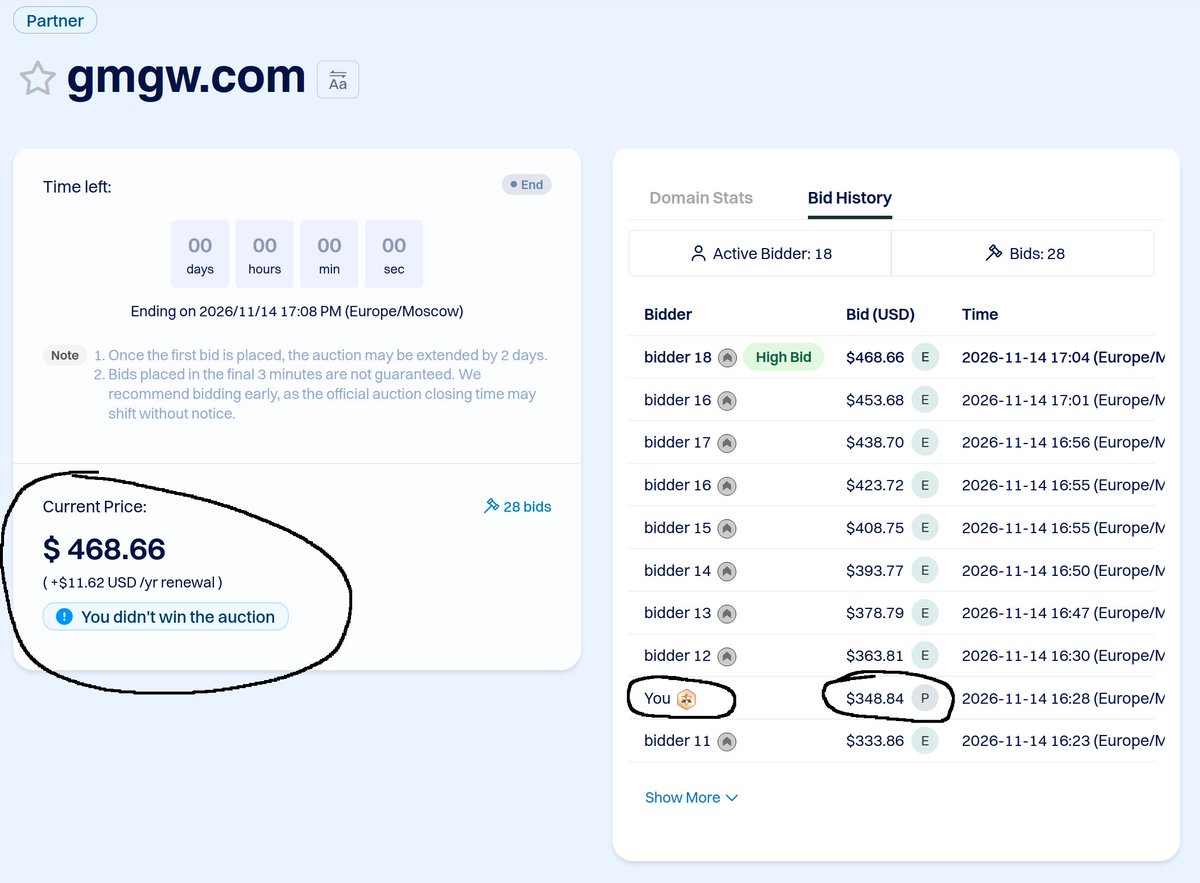
Following up on the auction/purchase comparison above: I tested a mechanism that can create a substantial gap between a reported winning bid and a buyer's effective acquisition cost. The background is a discussion in Gname's official NamePros thread. I had challenged discrepancies between the displayed auction prices for domains I sold and the amounts used to calculate my payouts. Gname explained that a qualifying reseller who wins an auction receives a rebate equal to 60% of the difference between the winning bid and the initial reserve price. https://www.namepros.com/threads/gname-official-thread.1306996/post-9731121 For example, a $1,100 winning bid with a $100 reserve produces a $600 rebate. The reseller's effective purchase price is therefore $500. My follow-up concerned the same auctions offered through Dynadot: whether its customers pay the full bid while competing against resellers with a much lower effective cost, and whether the partner receives the rebate when its customer wins. That follow-up remained unanswered. So this weekend I paid for Gname reseller status and tested the mechanics myself. I chose gmgw .com, registered with eName and simultaneously available for bidding through Dynadot and Gname. I participated through both platforms. My test covered only Dynadot and Gname. I have not investigated which other registrars or auction platforms, if any, participate in the same arrangement. On Dynadot, I set a $350 proxy bid. My recorded bid was $348.84. That appeared on Gname as a $356.79 partner bid. I then placed a $371.50 bid directly through my Gname reseller account, outbidding my own Dynadot bid. In this auction, Gname used an $83.41 base labelled "External Price" to calculate the rebate: $371.50 βˆ’ 60% Γ— ($371.50 βˆ’ $83.41) = $198.65. In other words, I outbid my own $348.84 Dynadot bid with a Gname bid that would have cost me $198.65 if it had won at that level. The auction has now closed. The final screenshots show: β€’ Dynadot's closing auction price: $468.66, plus $11.62 renewal. β€’ Gname's closing bid: $474.44. β€’ Gname's finalized "External Price": $83.41. β€’ Reseller rebate: ($474.44 βˆ’ $83.41) Γ— 60% = $234.62. β€’ Amount due shown in my Gname reseller panel: $474.44 - $234.62 = $239.82. I was ultimately outbid on both platforms. The $239.82 is the amount calculated in my reseller panel at the closing bid; I did not see the winner's payment. That displayed reseller amount was $228.84 below Dynadot's reported closing price, or 48.83% less. This comparison excludes separate renewal charges and the cost of reseller membership. For auctions using this arrangement, a Dynadot retail bidder receiving no rebate competes against resellers who can place higher nominal bids while committing substantially less money. This provides a concrete mechanism by which a domain can later be offered below its reported auction result while still leaving room for profit and an intermediary's cut. I also checked Dynadot's public auction information, help pages and Terms of Use. Its auction FAQ explicitly states: "Final Cost: Your winning bid plus renewal fee". In the materials I reviewed, I found no disclosure of this 60% reseller rebate, the base used to calculate it, or whether Dynadot receives and retains it when a customer wins a partner auction. I find that lack of transparency deeply disappointing. Dynadot makes the bidder's obligation to pay the full price clear, but the materials I reviewed do not explain the potentially substantial reseller benefit associated with the transaction. If Dynadot receives and retains that rebate, a substantial share of the customer's auction payment becomes Dynadot's margin while the customer bears the full price. An arrangement with that financial impact should be clearly disclosed before customers bid.

@4Ldotcom

I reviewed my September and October 4L .com purchases and compared them with auctions I had previously lost. I only participate in a small fraction of these auctions, bidding on specific domains that interest me. This is a small, selective sample. These are the exact same domains I bid on and lost, then subsequently bought through intermediaries. My purchase prices already included the intermediaries’ cut. Below are the ten largest dollar differences among the records I matched. Each line shows the reported auction winning price, what I paid, how much cheaper it was, and how many days after the auction I purchased it. $1,279.76 β†’ $1,000: $279.76 cheaper (21.86%), 25 days later. $823.80 β†’ $650: $173.80 cheaper (21.10%), 68 days later. $810.95 β†’ $650: $160.95 cheaper (19.85%), 31 days later. $619.40 β†’ $500: $119.40 cheaper (19.28%), 14 days later. $768.99 β†’ $650: $118.99 cheaper (15.47%), 23 days later. $364.50 β†’ $250: $114.50 cheaper (31.41%), 100 days later. $361.97 β†’ $250: $111.97 cheaper (30.93%), 87 days later. $353.09 β†’ $250: $103.09 cheaper (29.20%), 105 days later. $325.14 β†’ $250: $75.14 cheaper (23.11%), 61 days later. $283.49 β†’ $250: $33.49 cheaper (11.81%), 41 days later. All percentages are calculated relative to the reported auction winning price. Combined reported winning prices: $5,991.09. Total I paid through intermediaries: $4,700. Difference: $1,291.09, or 21.55% less. In every example above, my eventual purchase price was way below my own unsuccessful auction bid, even with the intermediary’s cut included. The records don’t show whether the winning bids were actually paid or what happened before the domains reached the intermediaries. But the repeated difference between the reported auction results and my subsequent purchase prices raises questions about the transparency of the process.
21 2 1140 2 0
Rebrand.now @Rebrand_Now 2026-11-15T01:49:35.000Z

I don't believe dyna keeps the rebate (although I could be wrong about that part). That is a rebate offered by @gnamedotcom to its bidders. The issue is that @Dynadot @dynatodd participates in this at all. It hurts bidders who bid directly through their platform. We'd be better off bidding through gname. Why would Dyna do that Todd?

0 0 158 1 0
4L.com @4Ldotcom 2026-11-15T08:45:05.000Z

I agree that this disadvantages Dynadot bidders. But I'm not convinced that Dynadot receives none of the financial benefit. First, my $348.84 Dynadot bid appeared on Gname as a $356.79 bid under "Partners Bidder:106664". My bid was therefore submitted through a partner account, making the financial terms attached to that account directly relevant. Second, using the 60% rebate formula and the $83.41 base shown in my Gname reseller panel, a nominal bid of approximately $746.99 would have a net cost of $348.84: $746.99 βˆ’ 60% Γ— ($746.99 βˆ’ $83.41) β‰ˆ $348.84. If Dynadot's partner account receives the same rebate and passes its full benefit through as buying power, rather than Dynadot and Gname retaining the difference in whatever proportions they may have agreed between themselves, then my $348.84 should support roughly $747 in nominal bidding capacity, before separate costs. In that scenario, I see no economic reason for Dynadot to let me lose the domain when my actual budget, after accounting for the rebate, would still allow it to outbid the competing offers on my behalf. Yet my Dynadot proxy was outbid by my direct $371.50 Gname reseller bid, which would have cost me only $198.65 if it had won at that level. I raised these exact issues, including Dynadot's role and the recipient of the rebate, in Gname's official NamePros thread. Those questions were left unanswered. Given that silence, I am assuming the worst: that Dynadot, Gname, or both retain the rebate or an equivalent financial benefit while the Dynadot customer pays the full auction price. I have not seen the settlement between the platforms, so that remains an assumption. But I see no reason to give Dynadot the benefit of assuming it receives nothing when the financial arrangement has still not been explained.

0 0 119 0 0
4L.com @4Ldotcom 2026-11-14T08:01:39.000Z

You can ask any price you want and dream about huge profits, but so far, I haven't seen a single successful example of someone investing in random 4L .com domains (which is what my post was about, not meaningful words or trademarks), setting extremely high prices, and actually making money from their portfolio instead of losing it. On the other hand, I've seen the opposite happen many times. Owners of large 4L .com portfolios ask $20,000-$100,000 per domain, but eventually end up selling me batches of 100–200 domains at prices 200–300 times lower than their original asking prices, simply because they need money to pay for domain renewals.

3 0 151 0 0
4L.com @4Ldotcom 2026-11-11T16:42:24.000Z

🌐 Domain: FHGPβ€€COM πŸ’΅ Sold: $3,000 πŸ”€ Patterns: CCCC | ABCD βš™οΈ Landing: Spaceship πŸ“… Purchased: Dec 1, 2023 ⏳ Hold time: 1,075 days πŸ›’ Purchase: $300 (10%) 🧾 Fees: $0 (0%) πŸ“Š Net: $3,000 | Profit: $2,700 | ROI: 900% 🏷 Sold via @Spaceship https://t.co/8biU8GK5Td

90 5 1602 21 0
4L.com @4Ldotcom 2026-11-08T08:21:34.000Z

🌐 Domain: LHFFβ€€COM πŸ’΅ Sold: $3,000 πŸ”€ Patterns: CCCC | ABCC βš™οΈ Landing: Spaceship πŸ“… Purchased: Feb 28, 2025 ⏳ Hold time: 617 days πŸ›’ Purchase: $550 (18.33%) 🧾 Fees: $0 (0%) πŸ“Š Net: $3,000 | Profit: $2,450 | ROI: 445.45% 🏷 Sold via @Spaceship https://t.co/YVY5rnHPnq

109 7 1947 16 2
4L.com @4Ldotcom 2026-11-04T17:35:09.000Z

I just completed 5 domain auctions on @gnamedotcom, and the results left me with some questions. Here's what happened: βœ… 5 out of 5 domains sold successfully! πŸ“Š Auction results: Reserve price: $1 per domain Current bid before closing: $135 each on 3 domains The other 2 domains showed "Pending System Processing" Final transaction amount: $91.88 per domain Gname service fee: 15% Net proceeds: $78.10 per domain πŸ’°Total received: $390.50 for all 5 domains. Here's what I don't understand: Three domains showed a current bid of $135 shortly before the auctions closed. However, after completion, Gname reported a final transaction amount of just $91.88. That's a difference of $43.12 per domain, before the standard 15% service fee! Questions for the Gname team: 1) Why did the displayed auction price of $135 turn into a final transaction amount of $91.88? 2) Is there an additional reseller commission or another fee that isn't clearly displayed? 3) Where can sellers see a complete breakdown of the winning bid, all deductions, and final payout?

25 1 1845 1 0
4L.com @4Ldotcom 2026-11-05T10:57:38.000Z

I'm currently at the office and can't check my UID right now. Also, it's not possible to send you private messages anyway on X. I would like to get a public response, so please check the auction history of the domains I mentioned (all of them are shown in the screenshots) and explain exactly what happened during those auctions and why the final amounts dropped so much. Thank you in advance.

0 0 63 0 0
4L.com @4Ldotcom 2026-11-03T16:33:19.000Z

🌐 Domain: FGCMβ€€COM πŸ’΅ Sold: $6,000 πŸ”€ Patterns: CCCC | ABCD βš™οΈ Landing: Spaceship πŸ“… Purchased: Feb 27, 2026 ⏳ Hold time: 249 days πŸ›’ Purchase: $715 (11.92%) 🧾 Fees: $1,500 (25%) πŸ“Š Net: $4,500 | Profit: $3,785 | ROI: 529.37% 🏷 Sold via @Afternic https://t.co/JTp3sBxyH2

102 10 2571 19 4