Acu.eth (@0xLongDC)

Binz @binz1104 2026-11-29T01:13:25.000Z

Understanding a listing is an important step before making any swap. On @quipnetwork, QuipSwap gives users a chance to explore what each side offers and understand how a swap works. When browsing QuipSwap listings, here are three things worth checking: 1. What is being offered? Identify the asset or item on the first side of the listing. 2. What is being requested? Check what the other side expects in return. 3. Compare both sides: Make sure you understand the terms before selecting a swap. If you're new to the platform, start with a paper swap. It allows you to practice the process without using real funds. After completing a qualifying paper swap, head back to the Points dashboard to check your quest progress. Remember, each qualifying paper swap earns 1 QP, with a daily limit of 5 QP. The goal isn't just to complete activities. It's to understand how QuipSwap works and become more familiar with the Quip ecosystem. Explore Quip: https://quip.network

45 1 366 50 0
Fujina.eth @0xNickHL 2026-11-29T01:03:04.000Z

Good morning guys, your past trades may already be worth checking @zerufinance built Zaps around wallet history, so you can connect the wallets you already trade with and see your starting balance Zaps are planned to count toward a future airdrop under the final rules and for traders, the $50K ZeruAI x Ditto competition is live join through Zaps, check the campaign requirements, trade normally and track your progress through verified activity do not force volume connect your wallet, check your Zaps and join the competition: https://app.zaps.wtf/campaigns/ditto

49 0 347 56 0
Hieu Minh @mhieu3609 2026-11-29T01:05:27.000Z

Most people are "struggling" with 10-15 applications per month just to manage their studies, health and career. Each app runs its own world. Study progress does not know your career goals. Health data is in one place, skills and achievements are in another place. As a result, everything is fragmented, decisions are reactive instead of strategic. CereBree's 4Core DNA solves this problem correctly. This is not another chatbot or independent app. It is a unified AI agentic system, connecting learning - health - career (and expanding the pillars Grow, Study, Work, Retire with the HEAL class about wellbeing) into a common context class. AI understands the connection between aspects of your life, remembers, learns from behavior and grows with you over time. Instead of jumping between dozens of tools, you have a life - a system. All are operated by $CRX - utility token on Base (audited by Hashlock). $CRX is used to: Pay and receive discounts up to 10% on ecosystem platforms Unlock access tiers and participation rights Earn rewards through referral, content, bug bounty Tied to the buyback & burn mechanism from platform revenue, helping token value associate with actual use @CereBree is building many specific products (HRX, CereAura, uWork, CereOnco...) in the same AI ecosystem for individuals and businesses, with the vision of connecting real life with artificial intelligence. One life One system Powered by $CRX Are you tired of managing too many apps? @Cere_Bree #4CoreDNA #CRX #AgenticAI

@Cere_Bree

Most people juggle 10–15 platforms a month to manage learning, health and career. 4Core DNA connects them into one agentic AI system that grows with you. One life. One system. Powered by $CRX https://t.co/H3SluyE8v9

31 0 329 31 0
Miss Mutant Ape @MissMutantApe 2026-11-29T01:03:54.000Z

When a token represents a real-world asset, one of the first things I want to know is who stands behind it. That is one reason @MMIX_io takes a permissioned approach. According to its official Trust Center, every company and project must go through a review before it can build on the network. The Foundation checks areas such as project fit, compliance and readiness. The validator model follows the same principle. Validators are appointed by the MMIX Foundation rather than operating as anonymous network participants. This makes it clearer who is responsible for running and securing the network. There is an important distinction, though. Reviewing a company or project does not guarantee that an underlying asset is safe, valuable or free from risk. The actual asset is issued by an independent issuer, and its own documentation and legal structure still matter. For me, this is what accountability in RWA infrastructure should start with: knowing who is building, who operates the network and where responsibility sits. Explore the Trust Center and community updates: https://hub.mmix.io More details on the approach from @MMIX_io.

78 3 403 68 0
T.Messio @TrieuMessi 2026-11-29T01:03:46.000Z

Tired of switching between DEXTools for charts, another exchange for orders, and yet another app for portfolio. Tried @perptools everything's in one place, no tab hopping. Self-custody, solid speed on Orderly, high leverage, and transparency. AI Arena runs agents with just a few settings .Spot is 0% fee. Tap Prediction is quick and low-entry with high multipliers. Combines discovery, spot, perps, prediction, and AI in one app. Also earning Season 2 points. Worth a look if you're doing juggling tabs.

@TrieuMessi

I used to spend entire mornings just checking my portfolio before daring to place a trade. I’d hop from one wallet to another, switch between different chains, and open various apps all just to see what my balances looked like. There was even a time when I miscalculated my PnL because I forgot to include a position on a different chain; I thought I was in the green, but I was actually down slightly. It was exhausting, and I felt frustrated with myself for being so overwhelmed by my own data. Ever since I started using the Portfolio Dashboard on @perptools things have become so much easier. Now, I just open one screen and see everything: which wallets hold funds, which chains are active, my total portfolio value, my actual PnL, and my remaining trading balance. No more manual calculations. Seeing it all laid out, I can finally tell whether I’m actually in profit or at a loss, and whether I’m over-leveraged or still have room to maneuver. What I appreciate most is the sense of being in control. In the past, I’d often enter a trade simply because a chart looked good, without really knowing where I stood overall. Now, by looking at the big picture first, my decisions are much more level-headed. Not every tool changes the way I trade, but this one truly helps me get a handle on my own numbers before I go into battle against the market.

55 11 383 53 0
TDH | The Drop Hunter @bella_summerss 2026-11-29T00:55:00.000Z

My imaginary first 24 hours in @PlayJadebound: Day 1: Get a Spirit Beast, mine JDB, enjoy the passive income dream. Night 1: Realize I forgot to build defenses. Day 2: My Spirit Beast is chilling while I'm doing all the work. Turns out I'm not the farm owner. I'm the employee. 😂 60 Spirit Beasts, 5 elemental affinities, farming, expeditions and raids. I'm already wondering how chaotic this game could get. A little fan-made animation inspired by Jadebound's whitepaper. #Jadebound #GameFi

27 0 176 29 0
bibi.eth @nguyenthambt 2026-11-29T01:01:57.000Z

When I look at tokenised assets, one limitation stands out. Many projects put an asset onchain, but the asset still operates separately from payments, commerce and other real-world services. That is the gap @MMIX_io is trying to address with its Layer 1 blockchain for businesses and real-world assets. The idea is to connect tokenised property, financial services, payments and online checkout through one shared network, rather than leaving each asset isolated inside its own application. MMIX Coin sits at the network level as the native asset used to pay transaction fees. There is also an interesting detail in the official documentation: applications can sponsor those fees for users, so customers do not necessarily need to hold the native coin themselves. This creates a useful distinction between the infrastructure businesses use and the payment experience customers actually see. The broader vision is not simply to put more assets onchain. It is to connect those assets with services people and businesses already use, while keeping issuance permissions, participant verification and transfer rules within the network. MMIX mainnet is planned for 2027, so this is the architecture and direction being developed rather than a claim that every application is already live. Explore the project and its community: https://hub.mmix.io That connection between real assets and everyday business activity is what I want to understand better as @MMIX_io develops.

95 6 526 85 0
Kim @destinydou_ 2026-11-29T00:54:27.000Z

a technically interesting product still needs a clear answer to one practical question: how much does it cost to use? @quipnetwork recently published a breakdown of how randomness services charge developers. there's an important distinction in the current QVRF status: its pricing model has not been finalized or publicly published yet. the service is designed to deliver quantum-generated values through a request-and-callback flow, with payment intended to use QuipSwap's payment rail. for developers, the next questions are straightforward: what is the cost per request? how does network gas affect the final bill? what verification guarantees are available at delivery? technical innovation attracts attention. predictable costs and clearly documented guarantees help developers decide whether they can build around it.

@quipnetwork

Draws your players can check for themselves 🎲 QVRF pulls every random number from quantum hardware and publishes the proof behind it, so players don't have to take the operator's word for it. How Quip Network works for gaming ↓ https://quip.network/use-cases/gaming https://t.co/fj3AV4HouT

72 1 434 70 0
GodAir @dang_duytan 2026-11-29T00:58:03.000Z

MMIX Districts is a planned free mint of 3,000 digital districts on Ethereum, with a two-stage reveal that makes the collection different from a standard NFT drop. At mint, holders discover the size of their land. The announced plan is that once MMIX mainnet goes live, Ethereum transfers will be frozen and each district will move to its holder's MMIX wallet. That is where the buildings inside each district can be revealed. The two stages serve different purposes. Ethereum reveals the land size first, while MMIX is where holders are expected to discover what has been built on their district. One important clarification: owning a District NFT does not mean owning the physical land, buildings or businesses represented in its artwork. It is a digital collectible connected to the planned MMIX ecosystem. The current whitelist application round is closed, so the next step is to follow official announcements for updates on the mint and mainnet migration. Explore the official Community Hub: https://hub.mmix.io Keep up with the announcements from @MMIX_io.

100 8 600 88 0
SaintLee (❖,❖) @SaintLee04 2026-11-29T00:28:00.000Z

4 swaps. One full trading loop. Almost no gas friction. USDC → USDT → ETH → USDT → USDC. I tested this loop on @strato_net and barely had to worry about gas thanks to its sponsored transactions. No constant checking of native gas balances just to try multiple swaps. Trading fees and slippage still apply, but removing gas friction makes the experience noticeably smoother. Curious about STRATO? Explore it and try trading yourself. 🔗 https://app.strato.nexus/?ref=JE3V5ZSB7C DYOR. NFA

@SaintLee04

28 active traders. Top 20 rewarded. That leaderboard caught my attention. @strato_net is running a trading competition with $12,000 worth of $STRATO allocated to the top 20 volume creators. The competition is still relatively small based on the current leaderboard snapshot, which makes this worth checking out before it gets more crowded. STRATO is a HardFi ecosystem combining tokenized assets, borrowing, trading, savings and more on one Layer 1. If you're curious about the platform, here's a chance to explore it while competing for the rewards. Open my referral link. Connect your wallet. Explore STRATO and start trading. 🔗 https://app.strato.nexus/?ref=JE3V5ZSB7C Top 20 in the volume pool get rewarded. Qualified volume only, so make sure to check the rules. #STRATO #TradingCompetition

36 0 947 33 0
Mel Mew @fhaoh2001 2026-11-29T00:04:00.000Z

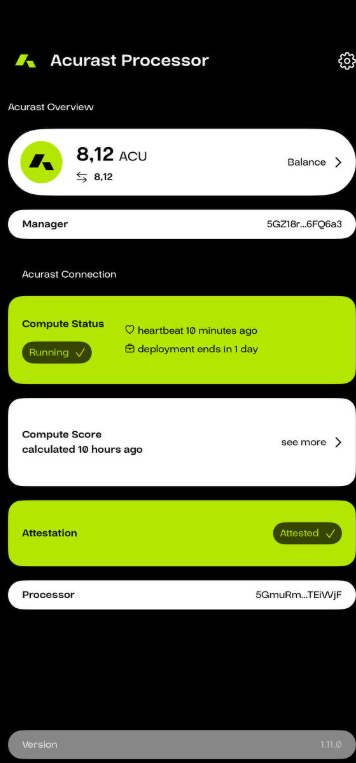
Can a real language model run on an ordinary smartphone, or is mobile AI still limited to small demonstrations? The November 6 @Acurast blog answers this with actual Mainnet measurements. The starting point is an experiment by Coinbase on October 12. Coinbase fine-tuned an open-weight model, Qwen3.5-9B, using its own fraud review data for under $100, then self-hosted it instead of relying on a third-party model API. To be clear, this does not mean Coinbase uses Acurast. The question explored by Acurast was whether a model of that size could run on its decentralized phone network. The result was yes. Acurast tested the 9B model on Android phones with 16 GB of RAM. Compressed to around 4 bits per weight, the model occupied approximately 5.7 GB. In the reported setup, a 16 GB flagship device could run it with around 0.8 GB of memory remaining. The Deployment exposed the model through an HTTPS endpoint with an OpenAI-compatible API and was restricted to attested phones. The first response became available about five minutes after the deployment command. No GPU, separate cloud account, or Docker setup was needed for this test. The performance numbers are particularly interesting. On the fastest tested phones, the 9B model processed prompts at up to 85.2 tokens per second and generated output at 9.3 tokens per second. In a larger test involving more than 100 phones, one of the fastest 16 GB devices took 3 minutes and 15 seconds to process a 7,000-token prompt using the 9B model. The corresponding times were 1 minute and 37 seconds for the 4B model and 15 seconds for the 0.8B model. This also explains why distributed execution matters. Each phone handles its own requests. Adding more phones increases the number of independent prompts the network can process simultaneously, rather than making one individual response faster. The smaller models can also run on 8 GB devices, potentially bringing more compatible Processors into the available compute pool. Cost is another useful data point. During the reported test, devices with at least 12 GB of RAM averaged 0.57 ACU per phone per day. Instant matching was approximately 1.03 ACU per day. At the time, that represented roughly $0.05 to $0.10 daily. These were test-day market figures, not permanent pricing. The practical use cases are what make this architecture worth examining. Background fraud reviews, suspicious transaction screening, message filtering, and overnight batch scoring do not always require an immediate response. Independent workloads can be distributed across multiple phones instead of depending on one centralized server. I also checked my own Processor status. It showed Running, with the last heartbeat 10 minutes earlier and the device marked Attested. That attestation matters because the reported model deployment accepted only attested phones. I cannot claim my device is running Qwen3.5-9B, but it is online and can be considered for workloads that match its capabilities. For anyone with compatible hardware, Processor Lite supports everyday Android phones and iPhones without a factory reset. Processor Core is designed for dedicated Android devices and requires a factory reset.
33 0 253 37 0
Ducky | 𝔽rAI @0xDucky1st 2026-11-29T00:48:20.000Z

Your smartphone could run backend jobs for an application you've never installed. Imagine a service that checks an API every five minutes. On @Acurast, developers can configure execution intervals, the number of runs and maximum runtime. Assigned Processors execute those scheduled tasks. This is how everyday hardware becomes infrastructure for recurring computational work. Experience it from the provider side with your own phone: https://hub.acurast.com/rebellion?ref=teb88x

65 0 380 74 0
Rosie @roseton_g 2026-11-28T15:23:23.000Z

What if your idle USDT had an entire city to explore? 👀 Meet BB.BOY and discover BiFu Wealth District @BifuGlobal ◆ Four destinations. ◆ Different possibilities. ◆ One unified account. A city of choices. All in one account. #BiFu #BiFuAICreativeVideoContest https://t.co/yG9mvj81Pq

75 0 2886 33 1
00K @tagsincos 2026-11-29T00:43:28.000Z

you don't necessarily need a quantum computer to participate in a quantum compute network. @quipnetwork recently reported that more than 1,500 nodes had run on its testnet at peak. what caught my attention was the onboarding message behind that update: an app, some disk space, and hardware people may already own. the network is designed to bring classical and quantum resources into the same compute marketplace. that means participation doesn't have to begin with owning specialized quantum equipment. the bigger question is how this participation develops over time. peak node count is a useful snapshot, but sustained activity, hardware diversity and successful work will tell a deeper story.

@quipnetwork

Draws your players can check for themselves 🎲 QVRF pulls every random number from quantum hardware and publishes the proof behind it, so players don't have to take the operator's word for it. How Quip Network works for gaming ↓ https://quip.network/use-cases/gaming https://t.co/fj3AV4HouT

64 5 409 77 1
Taiwan @mtave0128 2026-11-29T00:39:08.000Z

a decentralized network needs people willing to operate it, not just people willing to talk about it. one recent development worth watching: @getblockio has joined @quipnetwork as a testnet validator. this adds an infrastructure operator to the group testing Aglais ahead of mainnet. the detail matters because validator participation involves more than downloading an application. operators help test the network's ability to maintain and coordinate its infrastructure. one partner does not prove decentralization. but tracking who operates the network, how many independent participants join, and how responsibilities are distributed gives the community a much better picture of its progress.

@quipnetwork

Draws your players can check for themselves 🎲 QVRF pulls every random number from quantum hardware and publishes the proof behind it, so players don't have to take the operator's word for it. How Quip Network works for gaming ↓ https://quip.network/use-cases/gaming https://t.co/fj3AV4HouT

78 4 427 80 1
Catq.eth @catqpx 2026-11-29T00:39:01.000Z

the bottleneck in scaling compute may not be capital anymore. it may be access to electricity. building new data centers is becoming increasingly difficult in markets where grid connections can take years. even major cloud providers face a growing gap between their compute commitments and the infrastructure needed to deliver them. this puts a different model into perspective. @Acurast already has 360K+ phones running workloads, turning existing devices into a distributed compute network rather than waiting for new data centers to come online. it doesn't mean smartphones can replace large-scale data centers. but it does show how unused computing capacity could become part of a broader infrastructure layer. the future of compute may need more than bigger data centers. it may also need more ways to distribute the workload.

@Acurast

The constraint isn’t money. It’s power: in some constrained markets, new data centers can wait years for grid access. Meanwhile, 360K+ phones on Acurast are already running workloads. @Microsoft , @Oracle , @awscloud , and @Google have committed $2.47T worth of compute they haven’t delivered yet. https://acurast.com/blog/network-and-tech/hyperscaler-backlog-compute-phones/

43 1 303 46 0
Magic Hunter @MadMagicSOL 2026-11-29T00:05:00.000Z

The easy mistake with cloud compute is treating a signed contract as capacity that already exists. Today's @Acurast write-up cites Cloud Wars putting remaining performance obligations and backlogs at Microsoft, Oracle, AWS and Google Cloud at $2.47 trillion of compute already committed, but not yet delivered. Official posts say the bottleneck is not money. In some markets, new data centers can wait years for grid access. Acurast says 360,000+ phones in 175+ countries are already running workloads, with 800,000+ deployments. Phones will not train frontier models. The same post is clear on that. The claim is narrower: some always-on agents, confidential work, and edge tasks can run on hardware already in people's hands. Try it here: https://hub.acurast.com/rebellion?ref=z55q92

@Acurast

The constraint isn’t money. It’s power: in some constrained markets, new data centers can wait years for grid access. Meanwhile, 360K+ phones on Acurast are already running workloads. @Microsoft , @Oracle , @awscloud , and @Google have committed $2.47T worth of compute they haven’t delivered yet. https://acurast.com/blog/network-and-tech/hyperscaler-backlog-compute-phones/

46 0 369 50 0
Van Quan @Vanquan_titans 2026-11-28T16:00:01.000Z

It’s 11:47. Checkout is down. Who calls the merchant before their noon sale? Say you run support for a payments platform. Two shops report the same error within a minute. Their tickets look identical. What you can’t see in the queue is that one shop has a launch email scheduled to go out at noon. Its account manager knows. The engineer on call knows the checkout integration inside out. Right now, those three people are looking at three different things. That’s where HRX from @cere_bree makes sense to me. It’s designed to connect a service issue with the customers it affects, the commitments you’ve made to them, and the people with the skills to help. With those details together, support can get the error to the payments engineer while the account manager calls the merchant. There’s still time to pause the email. Thirteen minutes later, the same phone call is a much worse conversation. That’s the test I’d give any ops tool in a demo. Give it two identical tickets and ask, “Which customer should we call first, and why?”

@Cere_Bree

CereBree's smart contracts have been audited by @Hashlock_ with the scope covering the token, presale, and staking contracts. https://t.co/yeFSanU5l7

133 2 602 148 0
Martin Ho @MartinHo99999 2026-11-28T22:30:01.000Z

MƯỢN THÔNG TIN NGƯỜI THÂN ĐỂ TẠO TÀI KHOẢN BINANCE, GIỜ NGƯỜI THÂN MẤT THÌ KHI RÚT COIN SÀN YÊU CẦU PHẢI KYC KHUÔN MẶT. Case này thật bó tay thật, anh em rút kinh nghiệm là tạo tài khoản chính chủ để dễ xử lí về sau. https://t.co/5sVzTMaXRg

38 2 1309 38 0